


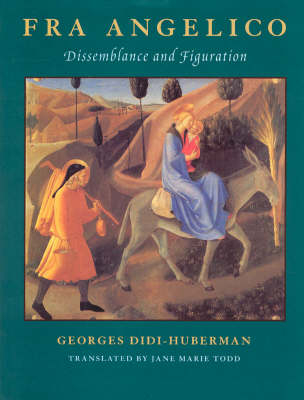
Fra Angelico
Dissemblance and Figuration
Seiten
1995
University of Chicago Press (Verlag)
978-0-226-14813-7 (ISBN)
University of Chicago Press (Verlag)
978-0-226-14813-7 (ISBN)
- Titel ist leider vergriffen;
keine Neuauflage - Artikel merken
An exploration of the work of Fra Angelico (1400-1455), a Florentine painter who took Dominican vows, approaching his work as a largely theological project. The book examines his solutions to the problems he faced of representing the unrepresentable and portraying the divine and spiritual.
The traditional story of Renaissance painting is one of inexorable progress toward the exact representation of the real and visible. Georges Didi-Huberman disrupts this story with a new look - and a new way of looking - at the 15th-century painter Fra Angelico. In doing so, he aims to alter our understanding of both early Renaissance art and the processes of art history. A Florentine painter who took Dominican vows, Fra Angelico (1400-1455) approached his work as a largely theological project. For him, the problems of representing the unrepresentable, of portraying the divine and the spiritual, mitigated the more secular breakthroughs in imitative technique. Didi-Huberman explores Fra Angelico's solutions to these problems - his use of colour to signal approaching visibility, of marble to recall Christ's tomb, of paint drippings to simulate (or stimulate) holy anointing. He shows how the painter employed emptiness, visual transformation and displacement to give form to the mystery of faith. In the work of Fra Angelico, an alternate strain of Renaissance painting emerges to challenge rather than reinforce verisimilitude.
Didi-Huberman traces this disruptive impulse through theological writings and iconographic evidence and identifies a widespread tradition in Renaissance art that ranges from Giotto's break with Byzantine image-making well into the 16th century. He reveals how the techniques that served this ultimately religious impulse may have anticipated the more abstract characteristics of modern art, such as colour fields, paint spatterings and the absence of colour.
The traditional story of Renaissance painting is one of inexorable progress toward the exact representation of the real and visible. Georges Didi-Huberman disrupts this story with a new look - and a new way of looking - at the 15th-century painter Fra Angelico. In doing so, he aims to alter our understanding of both early Renaissance art and the processes of art history. A Florentine painter who took Dominican vows, Fra Angelico (1400-1455) approached his work as a largely theological project. For him, the problems of representing the unrepresentable, of portraying the divine and the spiritual, mitigated the more secular breakthroughs in imitative technique. Didi-Huberman explores Fra Angelico's solutions to these problems - his use of colour to signal approaching visibility, of marble to recall Christ's tomb, of paint drippings to simulate (or stimulate) holy anointing. He shows how the painter employed emptiness, visual transformation and displacement to give form to the mystery of faith. In the work of Fra Angelico, an alternate strain of Renaissance painting emerges to challenge rather than reinforce verisimilitude.
Didi-Huberman traces this disruptive impulse through theological writings and iconographic evidence and identifies a widespread tradition in Renaissance art that ranges from Giotto's break with Byzantine image-making well into the 16th century. He reveals how the techniques that served this ultimately religious impulse may have anticipated the more abstract characteristics of modern art, such as colour fields, paint spatterings and the absence of colour.
Georges Didi-Huberman is professor at the Ecole des Hautes Etudes en Sciences Sociales in Paris. He is the author of more than thirty books on the history and theory of images, including Images in Spite of All, published by the University of Chicago Press. Jane Marie Todd has translated some seventy books, including Writing, Law, and Kingship in Old Babylonian Mesopotamia, also published by the University of Chicago Press.
| Erscheint lt. Verlag | 19.10.1995 |
|---|---|
| Übersetzer | Jane Marie Todd |
| Zusatzinfo | 20 colour plates, 69 halftones |
| Sprache | englisch |
| Maße | 225 x 290 mm |
| Gewicht | 1326 g |
| Themenwelt | Kunst / Musik / Theater ► Kunstgeschichte / Kunststile |
| Kunst / Musik / Theater ► Malerei / Plastik | |
| Geisteswissenschaften ► Religion / Theologie ► Christentum | |
| ISBN-10 | 0-226-14813-0 / 0226148130 |
| ISBN-13 | 978-0-226-14813-7 / 9780226148137 |
| Zustand | Neuware |
| Informationen gemäß Produktsicherheitsverordnung (GPSR) | |
| Haben Sie eine Frage zum Produkt? |
Mehr entdecken
aus dem Bereich


aus dem Bereich
wenn Kirche Spaß macht, entsteht ein Ort der Begeisterung
Buch | Softcover (2025)
Kösel (Verlag)
CHF 28,90
und was sie über die Kirche verraten
Buch | Hardcover (2024)
C.H.Beck (Verlag)
CHF 39,90


