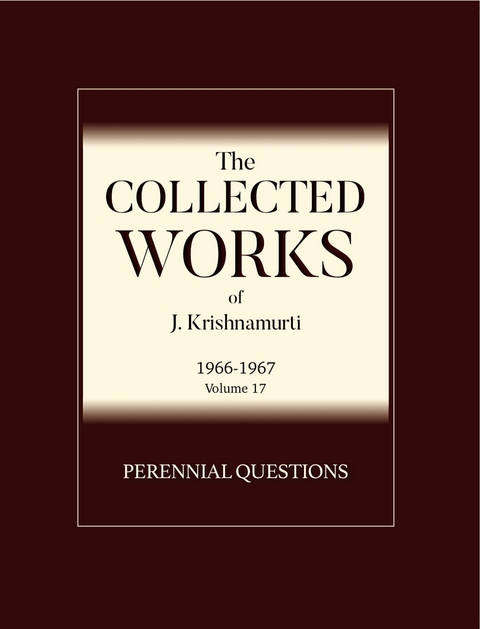
Perennial Questions (eBook)
145 Seiten
Krishnamurti Foundation America (Verlag)
978-1-912875-06-1 (ISBN)
JIDDU KRISHNAMURTI (18951986) is regarded internationally as one of the great educators and philosophers of our time. Born in South India, he was educated in England, and traveled the world, giving public talks, holding dia logues, writing, and founding schools until the end of his life at the age of ninety. He claimed allegiance to no caste, nationality, or religion and was bound by no tradition. Time magazine named Krishnamurti, along with Mother Teresa, 'one of the five saints of the 20th century,' and the Dalai Lama calls Krishnamurti 'one of the greatest thinkers of the age.' His teachings are published in 75 books, 700 audiocas settes, and 1200 videocassettes. Thus far, over 4,000,000 copies of his books have been sold in over thirty languages. The rejection of all spiritual and psychological authority, including his own, is a fundamental theme. He said human beings have to free themselves of fear, conditioning, authority, and dogma through selfknowledge. He suggested that this will bring about order and real psychological change. Our violent, conflictridden world cannot be transformed into a life of goodness, love, and compassion by any political, social, or economic strategies. It can be transformed only through mutation in individuals brought about through their own observation without any guru or organized religion. Krishnamurti's stature as an original philosopher attracted traditional and also creative people from all walks of life. Heads of state, eminent scientists, prominent leaders of the United Nations and various religious organizations, psychiatrists and psychologists, and university professors all engaged in dialogue with Krishnamurti. Students, teachers, and millions of people from all walks of life read his books and came to hear him speak. He bridged science and reli gion without the use of jargon, so scientists and lay people alike could understand his discussions of time, thought, insight, and death. During his lifetime, Krishnamurti established foundations in the United States, India, England, Canada, and Spain. Their defined role is the preservation and dissemination of the teachings, but without any authority to interpret or deify the teachings or the person. Krishnamurti also founded schools in India, England, and the United States. He envisioned that education should emphasize the understanding of the whole human being, mind and heart, not the mere acquisition of academic and intellectual skills. Education must be for learning skills in the art of living, not only the technology to make a living. Krishnamurti said, 'Surely a school is a place where one learns about the totality, the wholeness of life. Academic excellence is absolutely necessary, but a school includes much more than that. It is a place where both the teacher and the taught explore, not only the outer world, the world of knowledge, but also their own thinking, their behavior.' He said of his work, 'There is no belief demanded or asked, there are no followers, there are no cults, there is no persuasion of any kind, in any direction, and therefore only then we can meet on the same platform, on the same ground, at the same level. Then we can together observe the extraor dinary phenomena of human existence.'
I do not know how you regard these meetings. It is really quite a serious gathering, not an afternoon picnic, nor have we gathered to have an amusing time here. Presumably we have come together to talk over the many problems that every human being throughout the world is faced with. And as we are going to go into it, not only in detail if there is time, but also to go into it seriously, with a deliberate intention, one must come to these talks and discussions not in any sense of being entertained intellectually, or emotionally excited, but rather to go into the many human problems seriously, with a great deal of hesitation and understanding. Then perhaps these meetings will be worthwhile.
First of all, I think we should be clear that we are not discussing any particular philosophy. The speaker does not belong to the Orient or to the Occident. He has no particular philosophy, nor formulated ideas which one must accept or reject. But what is, it seems to me, necessary is that we should together examine the very complex problems of our lives, the very urgency of these problems. Most of us try to run away from them because we do not understand, or escape has become such a habit that we easily slip, without thought, without any intention, into this network of escapes that man has cultivated through centuries upon centuries.
What is necessary is to examine unemotionally, not merely intellectually. Because the intellect doesn’t solve any problem; it can only invent a lot of ideas, theories. Nor can emotion dissipate the urgency of the problems that one has to face and resolve. What is necessary, it seems to me, is a mind that is capable of examination. To examine there must be freedom from personal views, with a mind that is not guided by one’s own temperament, inclination, nor is compelled by circumstances. And that’s quite a difficult task because we are accustomed to examine everything from a personal point of view of like or dislike, to certain commitments, to certain philosophies, to certain formulas. And therefore we’re always translating these problems according to our particular limitation; but if we would translate or understand these problems deeply and fully, it seems to me that one must look at them, not as an individual, but as a human being. I think there is a vast difference between the two. The individual is the local entity, the American, the man who lives on the West Coast or the East Coast, or in the Midwest. The individual is the Indian, far away, with his outlook, with his limitations, with his superstitions, with his innumerable religions and doctrines and beliefs. The individual is caught in his nationalities, by the division of the sectarian spirit, whether it be Catholic or Protestant, or the various nationalistic divisions with their Democratic, Republican political parties, and so on and on and on. In that frame the individual exists. But I think the human being supersedes the individual. Whether they live in Russia, China, India, America or in any other part of the world, human beings have the same common factor of sorrow, of joy, of unresolved miseries, despairs, the immense loneliness of modern existence, the utter meaninglessness of life as it is lived now throughout the world—the wars, the continuation of hatred, the national divisions, the utter despair of life. At that level is the human being, though the individual does partake of all that; but if we merely consider the individual, we shall not inquire much, very deeply. It is like cultivating one’s own little backyard, and to cultivate that little backyard is necessary. But that little land is in relation to the whole of the earth upon which man lives as a human being in travail, in despair, in agony—this endless sorrow, this fleeting love, and the ending of life.
So if we could consider these problems as human beings, not as an American unrelated to the rest of the world, unrelated to the vast hungry East, but rather as a human being with all the innumerable problems, then perhaps we can intelligently, with care, resolve our problems. And into that we are going together, taking a journey together. When we take a journey, both of us give attention to every step that we take. It isn’t that you are listening this evening to a speaker, but rather sharing together the whole of life’s problems. And to share together, the responsibility is yours as well as the speaker’s. You can’t just sit there and be told what to do or not to do, what to believe and what not to believe, or what to follow, and so on—which becomes rather immature and rather childish—but to share together any problem, both of us must, both the speaker and you must be alert, attentive, see the urgency of the problems, and give one’s mind and heart, everything that one has, to find out, to inquire. Because what we are going to do in all these talks and discussions is to inquire, to examine, and thereby find out for oneself. Because there is no guide, no philosopher, no teacher; no one can lead you, because all that has been tried. There have been teachers; there have been gurus; there have been systems, saviors, priests, little sectarian leaders with their particular idiosyncrasies and philosophies; but all these priests, leaders, teachers, saviors have not solved the human problems of war, of our daily misery, of our despair, our innermost agonies and loneliness. They have helped to escape, to bring about some kind of narcotic which will give us some vague hope, or gives visions of a new life; but actually the change does not take place. It is like those people who take LSD, hoping thereby to escape into some reality of a life of a great vision, but actually these innumerable drugs, or many drugs, do not fundamentally, radically alter the human mind.
So, what we are going to attempt to do is to explore, and to explore there must be freedom. That’s the first thing: freedom to inquire, which obviously means freedom from any commitment, intellectual or otherwise, from any philosophy, from any dogma, so that the mind can look. And a mind can only look, explore, when it is not caught, for the time being at least, in its own problems, or in its own hopes. It is not committed to any philosophy, to any dogma, to any church. And this, it seems to me, is one of the most difficult things to do. To look attentively at our own problems as human beings demands not only freedom but attention. To attend implies, surely, doesn’t it, to give your mind and heart to it, totally—with your nerves, with your ears, with your eyes, with your heart, with your mind—to give totally to understand something. And to give so attentively, totally, there needs to be no motive, no persuasion. You do it naturally because the urgency of the problem is so great that it must be solved. But if we have a motive—and all our urgency generally is based on some limited motive—our problems continue.
The task for the listener, for you, is very great, because most of us don’t want to solve these problems—the problems of love, death, and how to live. And that’s what we’re going to discuss; that’s what we’re going to inquire into: whether it is at all possible for human beings to be totally rid of all despair, which means to be totally free of all fear, and therefore to lead a life, not in the future, but a life that is not limited by time as yesterday, today, and tomorrow; and whether it is at all possible to free the mind from all the centuries upon centuries of conditioning by the propaganda of churches, religions, by the propaganda of society, the whisper of the neighbor, of the magazines, of the newspapers, of the politicians, of the priests, so that the mind is free. Otherwise man will live everlastingly in pain, misery, and sorrow.
We are asking ourselves whether it is at all possible for human beings, living in this world—not running away into a monastery or to some peculiar philosophy, or taking drugs—to change radically. Because the more intelligent you are, the more aware you are of the world’s problems, the more there is despair, there is no meaning, and so drugs are a way of escape. By escape we think we are going to resolve the problems. On the contrary. So, can we bring about a radical change in our way of thinking, living, feeling?
Obviously, considering what the world is, the more aware one is of these extraordinarily complex problems, the more one wants a change; one wants a deep, revolutionary change—not at the economic or social level because they never do really solve any human problem, as the communist revolution has proved. After killing millions and millions of people, they’ve come back to the same pattern. But what we are talking about is a revolution at a totally different level, a revolution in the psyche, in the mind itself; and whether it is at all possible to bring about that change, that revolution, not guided by our inclination, by our temperament, or compelled by circumstances, society.
One can see that one does change a certain amount, to a certain degree, by circumstances, by influence, through some form of compulsion, an invention. That’s going on all the time in our life. Some environmental compulsion makes us, whether we are willing or not willing to change, modify; but such modification doesn’t alter the fundamental issues of life. First, one of the fundamental issues of life is freedom, and it requires tremendous inquiry, intelligence, sensitivity to find out what it is to be free. Revolt is not freedom. Revolt against the present structure of society, which is completely bourgeois, middle-class, the revolt against...
| Erscheint lt. Verlag | 9.9.2022 |
|---|---|
| Reihe/Serie | The Collected Works of J. Krishnamurti 1966-1967 | The Collected Works of J. Krishnamurti 1966-1967 |
| Sprache | englisch |
| Themenwelt | Geisteswissenschaften ► Philosophie |
| Sozialwissenschaften ► Pädagogik ► Schulpädagogik / Grundschule | |
| Schlagworte | Analysis • clarity • Emotional Clarity • freedom • India • KFA • learning • Logic • Meaning • Mind • Philosophy • Self Help • Teach • Teachings • Thought • Truth |
| ISBN-10 | 1-912875-06-3 / 1912875063 |
| ISBN-13 | 978-1-912875-06-1 / 9781912875061 |
| Informationen gemäß Produktsicherheitsverordnung (GPSR) | |
| Haben Sie eine Frage zum Produkt? |
 EPUB (Ohne DRM)
Digital Rights Management: ohne DRM
Dieses eBook enthält kein DRM oder Kopierschutz. Eine Weitergabe an Dritte ist jedoch rechtlich nicht zulässig, weil Sie beim Kauf nur die Rechte an der persönlichen Nutzung erwerben.
Dateiformat: EPUB (Electronic Publication)
EPUB ist ein offener Standard für eBooks und eignet sich besonders zur Darstellung von Belletristik und Sachbüchern. Der Fließtext wird dynamisch an die Display- und Schriftgröße angepasst. Auch für mobile Lesegeräte ist EPUB daher gut geeignet.
Systemvoraussetzungen:
PC/Mac: Mit einem PC oder Mac können Sie dieses eBook lesen. Sie benötigen dafür die kostenlose Software Adobe Digital Editions.
eReader: Dieses eBook kann mit (fast) allen eBook-Readern gelesen werden. Mit dem amazon-Kindle ist es aber nicht kompatibel.
Smartphone/Tablet: Egal ob Apple oder Android, dieses eBook können Sie lesen. Sie benötigen dafür eine kostenlose App.
Geräteliste und zusätzliche Hinweise
Buying eBooks from abroad
For tax law reasons we can sell eBooks just within Germany and Switzerland. Regrettably we cannot fulfill eBook-orders from other countries.
aus dem Bereich