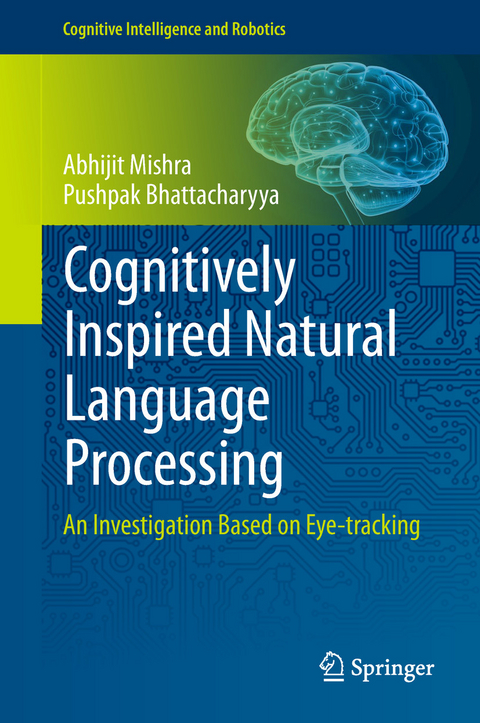
Cognitively Inspired Natural Language Processing (eBook)
XVII, 174 Seiten
Springer Singapore (Verlag)
978-981-13-1516-9 (ISBN)
This book shows ways of augmenting the capabilities of Natural Language Processing (NLP) systems by means of cognitive-mode language processing. The authors employ eye-tracking technology to record and analyze shallow cognitive information in the form of gaze patterns of readers/annotators who perform language processing tasks. The insights gained from such measures are subsequently translated into systems that help us (1) assess the actual cognitive load in text annotation, with resulting increase in human text-annotation efficiency, and (2) extract cognitive features that, when added to traditional features, can improve the accuracy of text classifiers. In sum, the authors' work successfully demonstrates that cognitive information gleaned from human eye-movement data can benefit modern NLP.
Currently available Natural Language Processing (NLP) systems are weak AI systems: they seek to capture the functionality of human language processing, without worrying about how this processing is realized in human beings' hardware. In other words, these systems are oblivious to the actual cognitive processes involved in human language processing. This ignorance, however, is NOT bliss! The accuracy figures of all non-toy NLP systems saturate beyond a certain point, making it abundantly clear that 'something different should be done.'
Abhijit Mishra is currently a part of IBM Research, Bangalore, India, where he serves as a Research Scientist in the Department of Cognitive Solutions and Services. Prior to joining IBM Research, he was a PhD student at the Department of Computer Science and Engineering, Indian Institute of Technology Bombay. He interned at the Center for Research and Innovation in Translation and Translation Technologies, CBS, Copenhagen under the guidance of Prof. Michael Carl. Abhijit was also a part of 'Developing Multilingual Resources for Indian Languages through Crowdsourcing,' a project launched by the IIT Bombay in collaboration with Xerox Research Center India, Bangalore. The aim of the project was to build a system that helps NLP developers customize and float linguistic annotation tasks using popular crowdsourcing service providers (like Amazon's Mechanical Turk). Abhijit is currently involved in multiple projects based on Natural Language Generation.
Prof. Pushpak Bhattacharyya is a recent past President of the ACL (2016-17). He is Director of the IIT Patna and Vijay and Sita Vashee Chair Professor at the Department of Computer Science and Engineering, IIT Bombay. He studied at the IIT Kharagpur (BTech), IIT Kanpur (MTech) and IIT Bombay (PhD) and has been a visiting scholar and faculty at MIT, Stanford, UT Houston and University Joseph Fourier (France). Prof. Bhattacharyya's main research areas are Natural Language Processing, Machine Learning and AI. He has published more than 250 research papers and led government and industry projects of international and national importance. Author of the textbook 'Machine Translation,' he is a Fellow of the National Academy of Engineering, Eminent Engineer awardee of the Institute of Engineers India, and a recipient of the Patwardhan Award (IIT Bombay) and VNMM Award (IIT Roorkee) - both for technology development - and faculty grants from IBM, Microsoft, Yahoo and the United Nations.
This book shows ways of augmenting the capabilities of Natural Language Processing (NLP) systems by means of cognitive-mode language processing. The authors employ eye-tracking technology to record and analyze shallow cognitive information in the form of gaze patterns of readers/annotators who perform language processing tasks. The insights gained from such measures are subsequently translated into systems that help us (1) assess the actual cognitive load in text annotation, with resulting increase in human text-annotation efficiency, and (2) extract cognitive features that, when added to traditional features, can improve the accuracy of text classifiers. In sum, the authors' work successfully demonstrates that cognitive information gleaned from human eye-movement data can benefit modern NLP. Currently available Natural Language Processing (NLP) systems are weak AI systems: they seek to capture the functionality of human language processing, without worrying about how thisprocessing is realized in human beings hardware. In other words, these systems are oblivious to the actual cognitive processes involved in human language processing. This ignorance, however, is NOT bliss! The accuracy figures of all non-toy NLP systems saturate beyond a certain point, making it abundantly clear that something different should be done.
Abhijit Mishra is currently a part of IBM Research, Bangalore, India, where he serves as a Research Scientist in the Department of Cognitive Solutions and Services. Prior to joining IBM Research, he was a PhD student at the Department of Computer Science and Engineering, Indian Institute of Technology Bombay. He interned at the Center for Research and Innovation in Translation and Translation Technologies, CBS, Copenhagen under the guidance of Prof. Michael Carl. Abhijit was also a part of “Developing Multilingual Resources for Indian Languages through Crowdsourcing,” a project launched by the IIT Bombay in collaboration with Xerox Research Center India, Bangalore. The aim of the project was to build a system that helps NLP developers customize and float linguistic annotation tasks using popular crowdsourcing service providers (like Amazon’s Mechanical Turk). Abhijit is currently involved in multiple projects based on Natural Language Generation. Prof. Pushpak Bhattacharyya is a recent past President of the ACL (2016–17). He is Director of the IIT Patna and Vijay and Sita Vashee Chair Professor at the Department of Computer Science and Engineering, IIT Bombay. He studied at the IIT Kharagpur (BTech), IIT Kanpur (MTech) and IIT Bombay (PhD) and has been a visiting scholar and faculty at MIT, Stanford, UT Houston and University Joseph Fourier (France). Prof. Bhattacharyya’s main research areas are Natural Language Processing, Machine Learning and AI. He has published more than 250 research papers and led government and industry projects of international and national importance. Author of the textbook ‘Machine Translation,’ he is a Fellow of the National Academy of Engineering, Eminent Engineer awardee of the Institute of Engineers India, and a recipient of the Patwardhan Award (IIT Bombay) and VNMM Award (IIT Roorkee) – both for technology development – and faculty grants from IBM, Microsoft, Yahoo and the United Nations.
Chapter 1. Introduction.- Chapter 2. Eye-tracking: Theory, Methods, and Applications in Language Processing and Other Areas.- Chapter 3. Estimating Annotation Complexities of Text Using Gaze and Textual Information - Case studies of Translation and Sentiment Annotation.- Chapter 4. Scanpath Complexity: Combining Gaze Attributes for Modeling Effort in Text Reading/Annotation.- Chapter 5. Predicting Readers’ Sarcasm Understandability by Modeling Gaze Behavior.- Chapter 6. Harnessing Cognitive Features for Sentiment Analysis and Sarcasm Detection.- Chapter 7. Learning Cognitive Features from Gaze Data for Sentiment and Sarcasm Classification using Convolutional Neural Network.- Chapter 8. Conclusion and Future Directions.
| Erscheint lt. Verlag | 1.8.2018 |
|---|---|
| Reihe/Serie | Cognitive Intelligence and Robotics | Cognitive Intelligence and Robotics |
| Zusatzinfo | XVII, 174 p. 34 illus., 30 illus. in color. |
| Verlagsort | Singapore |
| Sprache | englisch |
| Themenwelt | Geisteswissenschaften ► Sprach- / Literaturwissenschaft ► Sprachwissenschaft |
| Informatik ► Theorie / Studium ► Künstliche Intelligenz / Robotik | |
| Schlagworte | Cognitive Computational Linguistics • Cognitive Features for Classification • Cognitive NLP • Eye-movement Data for NLP • Eye-tracking and NLP |
| ISBN-10 | 981-13-1516-7 / 9811315167 |
| ISBN-13 | 978-981-13-1516-9 / 9789811315169 |
| Informationen gemäß Produktsicherheitsverordnung (GPSR) | |
| Haben Sie eine Frage zum Produkt? |
 PDF (Wasserzeichen)
DRM: Digitales Wasserzeichen
Dieses eBook enthält ein digitales Wasserzeichen und ist damit für Sie personalisiert. Bei einer missbräuchlichen Weitergabe des eBooks an Dritte ist eine Rückverfolgung an die Quelle möglich.
Dateiformat: PDF (Portable Document Format)
Mit einem festen Seitenlayout eignet sich die PDF besonders für Fachbücher mit Spalten, Tabellen und Abbildungen. Eine PDF kann auf fast allen Geräten angezeigt werden, ist aber für kleine Displays (Smartphone, eReader) nur eingeschränkt geeignet.
Systemvoraussetzungen:
PC/Mac: Mit einem PC oder Mac können Sie dieses eBook lesen. Sie benötigen dafür einen PDF-Viewer - z.B. den Adobe Reader oder Adobe Digital Editions.
eReader: Dieses eBook kann mit (fast) allen eBook-Readern gelesen werden. Mit dem amazon-Kindle ist es aber nicht kompatibel.
Smartphone/Tablet: Egal ob Apple oder Android, dieses eBook können Sie lesen. Sie benötigen dafür einen PDF-Viewer - z.B. die kostenlose Adobe Digital Editions-App.
Buying eBooks from abroad
For tax law reasons we can sell eBooks just within Germany and Switzerland. Regrettably we cannot fulfill eBook-orders from other countries.
aus dem Bereich