


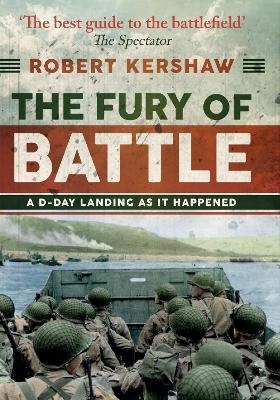
The Fury of Battle
A D-Day Landing As It Happened
Seiten
2018
Amberley Publishing (Verlag)
9781445688527 (ISBN)
Amberley Publishing (Verlag)
9781445688527 (ISBN)
- Keine Verlagsinformationen verfügbar
- Artikel merken
A unique description of what the D-Day landings were like, combining the detail of Antony Beevor with the human insights of Stephen Ambrose, including the experiences of French and Germans in the fighting.
Before the war, Normandy’s Plage d’Or coast was best known for its sleepy villages and holiday destinations. Early in 1944, Field Marshal Erwin Rommel took one look at the gentle, sloping sands and announced ‘They will come here!’ He was referring to Omaha Beach — the primary American D-Day landing site. The beach was subsequently transformed into three miles of lethal, bunker-protected arcs of fire, with chalets converted into concrete strongpoints, fringed by layers of barbed wire and mines. The Germans called it ‘the Devil's Garden’.
When Company A of the US 116th Regiment landed on Omaha Beach on 6 June 1944, it lost 96% of its effective strength. Sixteen teams of US engineers arriving in the second wave were unable to blow the beach obstacles, as first-wave survivors were still sheltering behind them. This was the beginning of the historic day that The Fury of Battle narrates hour by hour — from midnight to midnight — tracking German and American soldiers fighting across the beachhead.
Deafened by broadsides from supporting battleships and weak from seasickness, the men caught sight of land at 6.15. Eleven minutes later, the assault was floundering under intense German fire. Two-and-a-half hours in, General Bradley, commanding the landings aboard USS Augusta, had to decide whether to proceed or evacuate. On 6 June there were well over 2,400 casualties on Omaha Beach – easily D-Day’s highest death toll.
The Wehrmacht thought they had bludgeoned the Americans into bloody submission, yet by mid-afternoon the troops were ashore. Why were the casualties so grim, and how could the Germans have failed? Robert Kershaw draws on American troops’ eyewitness accounts together with letters and post-combat reports to expose the horrors of Omaha Beach. He also cites the experiences of the Germans and of French civilians.
These are stories of humanity, resilience, and dark humour; of comradeship holding beleaguered men together during an amphibious landing that looked as though it might never succeed.
Before the war, Normandy’s Plage d’Or coast was best known for its sleepy villages and holiday destinations. Early in 1944, Field Marshal Erwin Rommel took one look at the gentle, sloping sands and announced ‘They will come here!’ He was referring to Omaha Beach — the primary American D-Day landing site. The beach was subsequently transformed into three miles of lethal, bunker-protected arcs of fire, with chalets converted into concrete strongpoints, fringed by layers of barbed wire and mines. The Germans called it ‘the Devil's Garden’.
When Company A of the US 116th Regiment landed on Omaha Beach on 6 June 1944, it lost 96% of its effective strength. Sixteen teams of US engineers arriving in the second wave were unable to blow the beach obstacles, as first-wave survivors were still sheltering behind them. This was the beginning of the historic day that The Fury of Battle narrates hour by hour — from midnight to midnight — tracking German and American soldiers fighting across the beachhead.
Deafened by broadsides from supporting battleships and weak from seasickness, the men caught sight of land at 6.15. Eleven minutes later, the assault was floundering under intense German fire. Two-and-a-half hours in, General Bradley, commanding the landings aboard USS Augusta, had to decide whether to proceed or evacuate. On 6 June there were well over 2,400 casualties on Omaha Beach – easily D-Day’s highest death toll.
The Wehrmacht thought they had bludgeoned the Americans into bloody submission, yet by mid-afternoon the troops were ashore. Why were the casualties so grim, and how could the Germans have failed? Robert Kershaw draws on American troops’ eyewitness accounts together with letters and post-combat reports to expose the horrors of Omaha Beach. He also cites the experiences of the Germans and of French civilians.
These are stories of humanity, resilience, and dark humour; of comradeship holding beleaguered men together during an amphibious landing that looked as though it might never succeed.
A graduate of Reading University, Robert Kershaw joined the Parachute Regiment in 1973. He was selected to command the 10th Battalion (10 PARA). He saw active service in Northern Ireland, the First Gulf War and Bosnia. His final army appointment was with the Intelligence Division at HQ NATO in Brussels. On leaving the Army with the rank of Colonel in 2006 he became a full-time writer of military history and a consultant military analyst. He is the author of a dozen books including Tank Men (2008) and A Street in Arnhem (2014). He has participated in numerous National Geographic and History Channel documentaries.
| Erscheinungsdatum | 07.11.2018 |
|---|---|
| Zusatzinfo | 24 Plates, black and white |
| Verlagsort | Chalford |
| Sprache | englisch |
| Maße | 156 x 234 mm |
| Gewicht | 743 g |
| Themenwelt | Geisteswissenschaften ► Geschichte ► Allgemeines / Lexika |
| Geschichte ► Allgemeine Geschichte ► 1918 bis 1945 | |
| Geschichte ► Teilgebiete der Geschichte ► Militärgeschichte | |
| ISBN-13 | 9781445688527 / 9781445688527 |
| Zustand | Neuware |
| Informationen gemäß Produktsicherheitsverordnung (GPSR) | |
| Haben Sie eine Frage zum Produkt? |
Mehr entdecken
aus dem Bereich



aus dem Bereich
Deutschland 1933 bis 1945
Buch | Hardcover (2025)
S. Fischer (Verlag)
CHF 47,60
ein Psychologe erlebt das Konzentrationslager
Buch | Hardcover (2024)
Kösel (Verlag)
CHF 30,80


