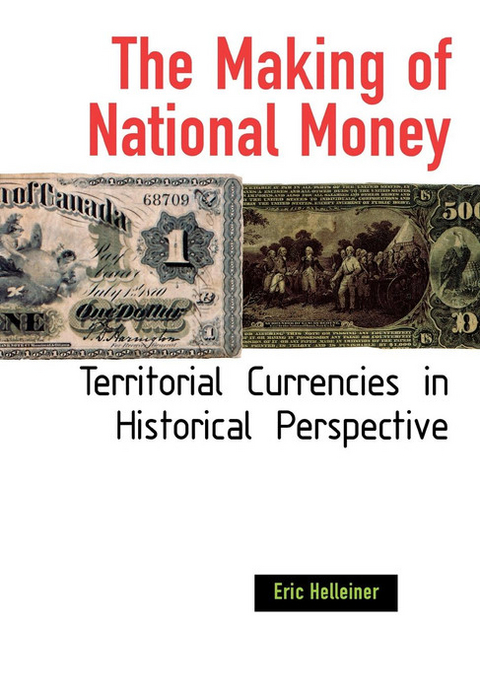
The Making of National Money (eBook)
296 Seiten
Cornell University Press (Verlag)
978-1-5017-2072-7 (ISBN)
Why should each country have its own exclusive currency? Eric Helleiner offers a fascinating and unique perspective on this question in his accessible history of the origins of national money. Our contemporary understandings of national currency...
Why should each country have its own exclusive currency? Eric Helleiner offers a fascinating and unique perspective on this question in his accessible history of the origins of national money.
Our contemporary understandings of national currency are, Helleiner shows, surprisingly recent. Based on standardized technologies of production and extraction, territorially exclusive national currencies emerged for the first time only during the nineteenth century. This major change involved a narrow definition of legal tender and the exclusion of tokens of value issued outside the national territory. "Territorial currencies" rapidly became bound up with the rise of national markets, and money reflected basic questions of national identity and self-presentation: In what way should money be managed to serve national goals? Whose pictures should go on the banknotes?
Helleiner draws out the potent implications of this largely unknown history for today's context. Territorial currencies face challenges from many monetary innovations—the creation of the euro, dollarization, the spread of local currencies, and the prospect of privately issued electronic currencies. While these challenges are dramatic, the author argues that their significance should not be overstated. Even in their short historical life, territorial currencies have never been as dominant as conventional wisdom suggests. The future of this kind of currency, Helleiner contends, depends on political struggles across the globe, struggles that echo those at the birth of national money.
Why should each country have its own exclusive currency? Eric Helleiner offers a fascinating and unique perspective on this question in his accessible history of the origins of national money. Our contemporary understandings of national currency are, Helleiner shows, surprisingly recent. Based on standardized technologies of production and extraction, territorially exclusive national currencies emerged for the first time only during the nineteenth century. This major change involved a narrow definition of legal tender and the exclusion of tokens of value issued outside the national territory. "Territorial currencies" rapidly became bound up with the rise of national markets, and money reflected basic questions of national identity and self-presentation: In what way should money be managed to serve national goals? Whose pictures should go on the banknotes? Helleiner draws out the potent implications of this largely unknown history for today's context. Territorial currencies face challenges from many monetary innovations—the creation of the euro, dollarization, the spread of local currencies, and the prospect of privately issued electronic currencies. While these challenges are dramatic, the author argues that their significance should not be overstated. Even in their short historical life, territorial currencies have never been as dominant as conventional wisdom suggests. The future of this kind of currency, Helleiner contends, depends on political struggles across the globe, struggles that echo those at the birth of national money.
Eric Helleiner is CIGI Chair in International Governance and Associate Professor of Political Science at the University of Waterloo. His previous books include States and the Reemergence of Global Finance: From Bretton Woods to the 1990s, also from Cornell.
| Erscheint lt. Verlag | 5.7.2018 |
|---|---|
| Verlagsort | Ithaca |
| Sprache | englisch |
| Maße | 150 x 150 mm |
| Themenwelt | Sachbuch/Ratgeber ► Beruf / Finanzen / Recht / Wirtschaft ► Wirtschaft |
| Geschichte ► Allgemeine Geschichte ► Neuzeit (bis 1918) | |
| Sozialwissenschaften ► Politik / Verwaltung ► Europäische / Internationale Politik | |
| Sozialwissenschaften ► Politik / Verwaltung ► Politische Theorie | |
| Wirtschaft ► Betriebswirtschaft / Management | |
| Wirtschaft ► Volkswirtschaftslehre ► Finanzwissenschaft | |
| Wirtschaft ► Volkswirtschaftslehre ► Wirtschaftspolitik | |
| ISBN-10 | 1-5017-2072-4 / 1501720724 |
| ISBN-13 | 978-1-5017-2072-7 / 9781501720727 |
| Informationen gemäß Produktsicherheitsverordnung (GPSR) | |
| Haben Sie eine Frage zum Produkt? |
 PDF (Adobe DRM)
Kopierschutz: Adobe-DRM
Adobe-DRM ist ein Kopierschutz, der das eBook vor Mißbrauch schützen soll. Dabei wird das eBook bereits beim Download auf Ihre persönliche Adobe-ID autorisiert. Lesen können Sie das eBook dann nur auf den Geräten, welche ebenfalls auf Ihre Adobe-ID registriert sind.
Details zum Adobe-DRM
Dateiformat: PDF (Portable Document Format)
Mit einem festen Seitenlayout eignet sich die PDF besonders für Fachbücher mit Spalten, Tabellen und Abbildungen. Eine PDF kann auf fast allen Geräten angezeigt werden, ist aber für kleine Displays (Smartphone, eReader) nur eingeschränkt geeignet.
Systemvoraussetzungen:
PC/Mac: Mit einem PC oder Mac können Sie dieses eBook lesen. Sie benötigen eine
eReader: Dieses eBook kann mit (fast) allen eBook-Readern gelesen werden. Mit dem amazon-Kindle ist es aber nicht kompatibel.
Smartphone/Tablet: Egal ob Apple oder Android, dieses eBook können Sie lesen. Sie benötigen eine
Geräteliste und zusätzliche Hinweise
Buying eBooks from abroad
For tax law reasons we can sell eBooks just within Germany and Switzerland. Regrettably we cannot fulfill eBook-orders from other countries.
aus dem Bereich