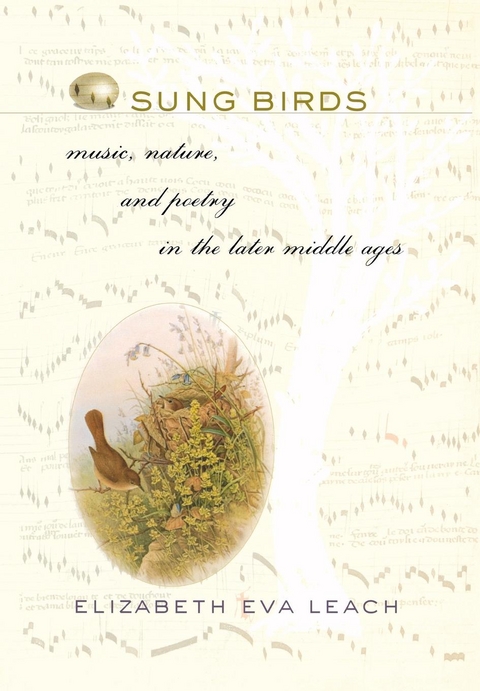
Sung Birds (eBook)
368 Seiten
Cornell University Press (Verlag)
978-1-5017-2757-3 (ISBN)
Is birdsong music? The most frequent answer to this question in the Middle Ages was resoundingly "no." In Sung Birds, Elizabeth Eva Leach traces postmedieval uses of birdsong within Western musical culture. She first explains why such melodious sound...
Is birdsong music? The most frequent answer to this question in the Middle Ages was resoundingly "no." In Sung Birds, Elizabeth Eva Leach traces postmedieval uses of birdsong within Western musical culture. She first explains why such melodious sound was not music for medieval thinkers and then goes on to consider the ontology of music, the significance of comparisons between singers and birds, and the relationship between art and nature as enacted by the musical performance of late-medieval poetry. If birdsong was not music, how should we interpret the musical depiction of birdsong in human music-making? What does it tell us about the singers, their listeners, and the moral status of secular polyphony? Why was it the fourteenth century that saw the beginnings of this practice, continued to this day in the music of Messiaen and others?
Leach explores medieval arguments about song, language, and rationality whose basic terms survive undiminished into the present. She considers not only lyrics that have their singers voice the songs or speech of birds but also those that represent other natural, nonmusical, sounds such as human cries or the barks of dogs. The dangerous sweetness of birdsong was invoked in discussions of musical ethics, which, because of the potential slippage between irrational beast and less rational woman in comparisons with rational human masculinity, depict women's singing as less than fully human. Leach's argument comes full circle with the advent of sound recording. This technological revolution-like its medieval equivalent, the invention of the music book-once again made the relationship between music and nature an acute preoccupation of Western culture.
Is birdsong music? The most frequent answer to this question in the Middle Ages was resoundingly "no." In Sung Birds, Elizabeth Eva Leach traces postmedieval uses of birdsong within Western musical culture. She first explains why such melodious sound was not music for medieval thinkers and then goes on to consider the ontology of music, the significance of comparisons between singers and birds, and the relationship between art and nature as enacted by the musical performance of late-medieval poetry. If birdsong was not music, how should we interpret the musical depiction of birdsong in human music-making? What does it tell us about the singers, their listeners, and the moral status of secular polyphony? Why was it the fourteenth century that saw the beginnings of this practice, continued to this day in the music of Messiaen and others?Leach explores medieval arguments about song, language, and rationality whose basic terms survive undiminished into the present. She considers not only lyrics that have their singers voice the songs or speech of birds but also those that represent other natural, nonmusical, sounds such as human cries or the barks of dogs. The dangerous sweetness of birdsong was invoked in discussions of musical ethics, which, because of the potential slippage between irrational beast and less rational woman in comparisons with rational human masculinity, depict women's singing as less than fully human. Leach's argument comes full circle with the advent of sound recording. This technological revolution-like its medieval equivalent, the invention of the music book-once again made the relationship between music and nature an acute preoccupation of Western culture.
Elizabeth Eva Leach is University Lecturer in Music at the Faculty of Music, University of Oxford and a Fellow of St Hugh's College.
| Erscheint lt. Verlag | 5.7.2018 |
|---|---|
| Verlagsort | Ithaca |
| Sprache | englisch |
| Maße | 160 x 160 mm |
| Themenwelt | Kunst / Musik / Theater ► Musik ► Klassik / Oper / Musical |
| Kunst / Musik / Theater ► Musik ► Musikgeschichte | |
| Kunst / Musik / Theater ► Musik ► Musiktheorie / Musiklehre | |
| Geschichte ► Allgemeine Geschichte ► Mittelalter | |
| Geisteswissenschaften ► Geschichte ► Regional- / Ländergeschichte | |
| ISBN-10 | 1-5017-2757-5 / 1501727575 |
| ISBN-13 | 978-1-5017-2757-3 / 9781501727573 |
| Informationen gemäß Produktsicherheitsverordnung (GPSR) | |
| Haben Sie eine Frage zum Produkt? |
 PDF (Adobe DRM)
Kopierschutz: Adobe-DRM
Adobe-DRM ist ein Kopierschutz, der das eBook vor Mißbrauch schützen soll. Dabei wird das eBook bereits beim Download auf Ihre persönliche Adobe-ID autorisiert. Lesen können Sie das eBook dann nur auf den Geräten, welche ebenfalls auf Ihre Adobe-ID registriert sind.
Details zum Adobe-DRM
Dateiformat: PDF (Portable Document Format)
Mit einem festen Seitenlayout eignet sich die PDF besonders für Fachbücher mit Spalten, Tabellen und Abbildungen. Eine PDF kann auf fast allen Geräten angezeigt werden, ist aber für kleine Displays (Smartphone, eReader) nur eingeschränkt geeignet.
Systemvoraussetzungen:
PC/Mac: Mit einem PC oder Mac können Sie dieses eBook lesen. Sie benötigen eine
eReader: Dieses eBook kann mit (fast) allen eBook-Readern gelesen werden. Mit dem amazon-Kindle ist es aber nicht kompatibel.
Smartphone/Tablet: Egal ob Apple oder Android, dieses eBook können Sie lesen. Sie benötigen eine
Geräteliste und zusätzliche Hinweise
Buying eBooks from abroad
For tax law reasons we can sell eBooks just within Germany and Switzerland. Regrettably we cannot fulfill eBook-orders from other countries.
aus dem Bereich