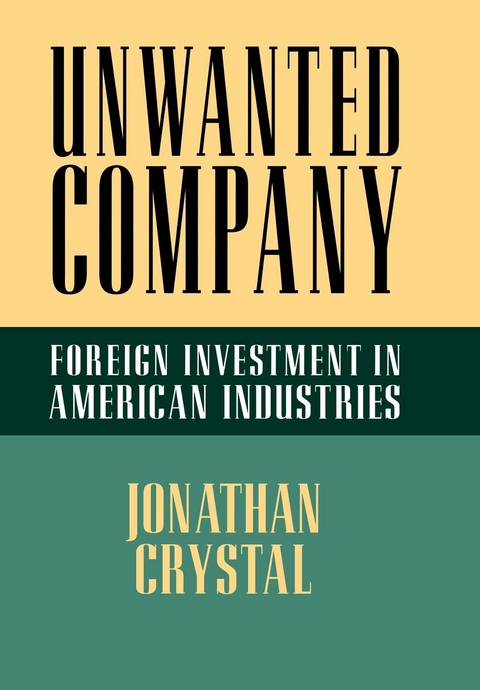
Unwanted Company (eBook)
256 Seiten
Cornell University Press (Verlag)
978-1-5017-2361-2 (ISBN)
In the last quarter century, the U.S. economy has been transformed by a large inflow of direct investment from abroad. Foreign companies, mainly from Europe and Japan, have built factories and acquired U.S. firms at an ever-increasing rate. Jonathan...
In the last quarter century, the U.S. economy has been transformed by a large inflow of direct investment from abroad. Foreign companies, mainly from Europe and Japan, have built factories and acquired U.S. firms at an ever-increasing rate. Jonathan Crystal finds inconsistencies in how American businesses have responded to this globalization of production.
U.S. firms, especially multinationals, have conflicting interests regarding investment protection, Crystal shows. Many American firms, under siege from overseas competitors, have already expended considerable energy in obtaining trade protection, but they are competing not only with foreign imports but also with locally established foreign-owned firms. American businesses may favor stricter regulation of foreign companies that threaten their bottom line, but they also consider their own interests as global investors subject to retaliatory protection in other countries. Restrictions on "foreign" investment, it seems, are not so attractive when they are imposed by other countries.
Unwanted Company examines the different ways in which important U.S. industries (including semiconductors, automobiles, steel, consumer electronics, telecommunications, and airlines) reacted to this new challenge. It focuses on the political responses of U.S.-owned firms to how Washington ought to regulate foreign direct investment and how it ought to treat foreign-owned firms in the United States. Some industries welcomed (or at least didn't oppose) foreign investment, whereas others sought restrictive and discriminatory policies. Crystal demonstrates how the nature of the domestic political environment shapes the translation of economic interests into policy preferences.
In the last quarter century, the U.S. economy has been transformed by a large inflow of direct investment from abroad. Foreign companies, mainly from Europe and Japan, have built factories and acquired U.S. firms at an ever-increasing rate. Jonathan Crystal finds inconsistencies in how American businesses have responded to this globalization of production.U.S. firms, especially multinationals, have conflicting interests regarding investment protection, Crystal shows. Many American firms, under siege from overseas competitors, have already expended considerable energy in obtaining trade protection, but they are competing not only with foreign imports but also with locally established foreign-owned firms. American businesses may favor stricter regulation of foreign companies that threaten their bottom line, but they also consider their own interests as global investors subject to retaliatory protection in other countries. Restrictions on "foreign" investment, it seems, are not so attractive when they are imposed by other countries.Unwanted Company examines the different ways in which important U.S. industries (including semiconductors, automobiles, steel, consumer electronics, telecommunications, and airlines) reacted to this new challenge. It focuses on the political responses of U.S.-owned firms to how Washington ought to regulate foreign direct investment and how it ought to treat foreign-owned firms in the United States. Some industries welcomed (or at least didn't oppose) foreign investment, whereas others sought restrictive and discriminatory policies. Crystal demonstrates how the nature of the domestic political environment shapes the translation of economic interests into policy preferences.
Jonathan Crystal is Associate Professor of Political Science, Fordham University.
| Erscheint lt. Verlag | 5.7.2018 |
|---|---|
| Verlagsort | Ithaca |
| Sprache | englisch |
| Maße | 150 x 150 mm |
| Themenwelt | Sachbuch/Ratgeber ► Beruf / Finanzen / Recht / Wirtschaft ► Wirtschaft |
| Geisteswissenschaften ► Geschichte ► Regional- / Ländergeschichte | |
| Sozialwissenschaften ► Politik / Verwaltung ► Politische Theorie | |
| Sozialwissenschaften ► Soziologie | |
| Wirtschaft ► Volkswirtschaftslehre ► Mikroökonomie | |
| Wirtschaft ► Volkswirtschaftslehre ► Wirtschaftspolitik | |
| ISBN-10 | 1-5017-2361-8 / 1501723618 |
| ISBN-13 | 978-1-5017-2361-2 / 9781501723612 |
| Informationen gemäß Produktsicherheitsverordnung (GPSR) | |
| Haben Sie eine Frage zum Produkt? |
 PDF (Adobe DRM)
Kopierschutz: Adobe-DRM
Adobe-DRM ist ein Kopierschutz, der das eBook vor Mißbrauch schützen soll. Dabei wird das eBook bereits beim Download auf Ihre persönliche Adobe-ID autorisiert. Lesen können Sie das eBook dann nur auf den Geräten, welche ebenfalls auf Ihre Adobe-ID registriert sind.
Details zum Adobe-DRM
Dateiformat: PDF (Portable Document Format)
Mit einem festen Seitenlayout eignet sich die PDF besonders für Fachbücher mit Spalten, Tabellen und Abbildungen. Eine PDF kann auf fast allen Geräten angezeigt werden, ist aber für kleine Displays (Smartphone, eReader) nur eingeschränkt geeignet.
Systemvoraussetzungen:
PC/Mac: Mit einem PC oder Mac können Sie dieses eBook lesen. Sie benötigen eine
eReader: Dieses eBook kann mit (fast) allen eBook-Readern gelesen werden. Mit dem amazon-Kindle ist es aber nicht kompatibel.
Smartphone/Tablet: Egal ob Apple oder Android, dieses eBook können Sie lesen. Sie benötigen eine
Geräteliste und zusätzliche Hinweise
Buying eBooks from abroad
For tax law reasons we can sell eBooks just within Germany and Switzerland. Regrettably we cannot fulfill eBook-orders from other countries.
aus dem Bereich