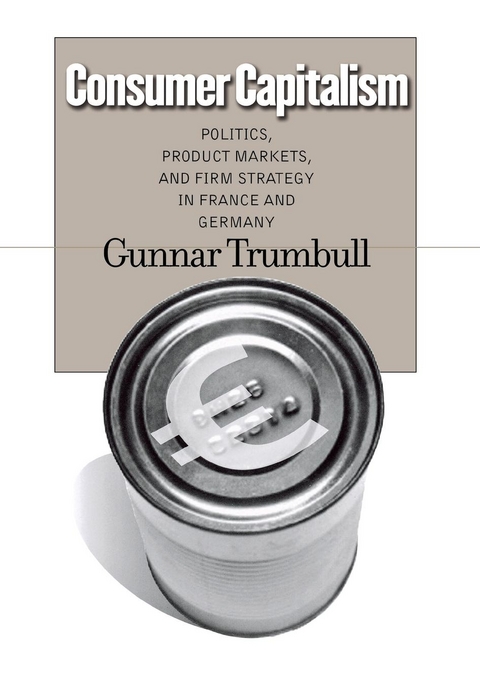
Consumer Capitalism (eBook)
208 Seiten
Cornell University Press (Verlag)
978-1-5017-3003-0 (ISBN)

"The unfettered marketplace, in which uncertainty rules and the admonition caveat emptor ('let the buyer beware') dictates each consumer decision, has today virtually disappeared. Consumers have become the focus of intensive economic policymaking...
The unfettered marketplace, in which uncertainty rules and the admonition caveat emptor ('let the buyer beware') dictates each consumer decision, has today virtually disappeared. Consumers have become the focus of intensive economic policymaking designed to protect them from the risks and disappointments of the market.... Today, arguably no other economic actor in the advanced industrial countries-not the investor, not the worker, not the welfare recipient-enjoys a more thorough set of legal and institutional protections than the modern consumer when he or she enters the corner store.-from the IntroductionGunnar Trumbull investigates the origins of national systems of consumer protection in France and Germany, where, in the early 1970s, consumer groups and producers organized to advance their own ideas about the identity and interests of the affluent consumer. Through a comparison of eight areas of policy-product liability law, product safety standards and recall, misleading advertising, comparative product tests, product labeling, quality standards, consumer contracts, and pricing-Trumbull shows that different conceptions of the consumer interest emerged in the two countries. The result was the development of distinctive national consumption regimes, which have in turn influenced the market strategies of domestic producers. Trumbull's findings help to clarify distinctive national approaches to recent product crises-including cases of BSE and genetically modified foods. His research suggests that, in the age of consumer capitalism, national competitiveness may hinge not only on endowments of labor and capital, but also on the institutional forms of national consumption.
Gunnar Trumbull is an Assistant Professor at the Harvard Business School.
| Erscheint lt. Verlag | 5.7.2018 |
|---|---|
| Reihe/Serie | Cornell Studies in Political Economy | Cornell Studies in Political Economy |
| Verlagsort | Ithaca |
| Sprache | englisch |
| Maße | 160 x 160 mm |
| Themenwelt | Sachbuch/Ratgeber ► Beruf / Finanzen / Recht / Wirtschaft ► Wirtschaft |
| Geisteswissenschaften ► Geschichte ► Regional- / Ländergeschichte | |
| Wirtschaft ► Volkswirtschaftslehre ► Wirtschaftspolitik | |
| ISBN-10 | 1-5017-3003-7 / 1501730037 |
| ISBN-13 | 978-1-5017-3003-0 / 9781501730030 |
| Informationen gemäß Produktsicherheitsverordnung (GPSR) | |
| Haben Sie eine Frage zum Produkt? |
 PDF (Adobe DRM)
Kopierschutz: Adobe-DRM
Adobe-DRM ist ein Kopierschutz, der das eBook vor Mißbrauch schützen soll. Dabei wird das eBook bereits beim Download auf Ihre persönliche Adobe-ID autorisiert. Lesen können Sie das eBook dann nur auf den Geräten, welche ebenfalls auf Ihre Adobe-ID registriert sind.
Details zum Adobe-DRM
Dateiformat: PDF (Portable Document Format)
Mit einem festen Seitenlayout eignet sich die PDF besonders für Fachbücher mit Spalten, Tabellen und Abbildungen. Eine PDF kann auf fast allen Geräten angezeigt werden, ist aber für kleine Displays (Smartphone, eReader) nur eingeschränkt geeignet.
Systemvoraussetzungen:
PC/Mac: Mit einem PC oder Mac können Sie dieses eBook lesen. Sie benötigen eine
eReader: Dieses eBook kann mit (fast) allen eBook-Readern gelesen werden. Mit dem amazon-Kindle ist es aber nicht kompatibel.
Smartphone/Tablet: Egal ob Apple oder Android, dieses eBook können Sie lesen. Sie benötigen eine
Geräteliste und zusätzliche Hinweise
Buying eBooks from abroad
For tax law reasons we can sell eBooks just within Germany and Switzerland. Regrettably we cannot fulfill eBook-orders from other countries.
aus dem Bereich