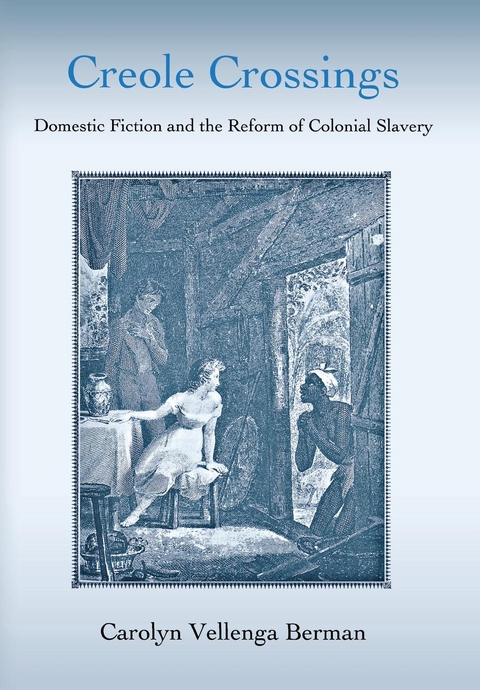
Creole Crossings (eBook)
254 Seiten
Cornell University Press (Verlag)
978-1-5017-2683-5 (ISBN)
The character of the Creole woman—the descendant of settlers or slaves brought up on the colonial frontier—is a familiar one in nineteenth-century French, British, and American literature. In Creole Crossings, Carolyn Vellenga Berman examines the use...
The character of the Creole woman—the descendant of settlers or slaves brought up on the colonial frontier—is a familiar one in nineteenth-century French, British, and American literature. In Creole Crossings, Carolyn Vellenga Berman examines the use of this recurring figure in such canonical novels as Jane Eyre, Uncle Tom's Cabin, and Indiana, as well as in the antislavery discourse of the period. "Creole" in its etymological sense means "brought up domestically," and Berman shows how the campaign to reform slavery in the colonies converged with literary depictions of family life.
Illuminating a literary genealogy that crosses political, familial, and linguistic lines, Creole Crossings reveals how racial, sexual, and moral boundaries continually shifted as the century's writers reflected on the realities of slavery, empire, and the home front. Berman offers compelling readings of the "domestic fiction" of Honoré de Balzac, Charlotte Brontë, Maria Edgeworth, Harriet Jacobs, George Sand, Harriet Beecher Stowe, and others, alongside travel narratives, parliamentary reports, medical texts, journalism, and encyclopedias. Focusing on a neglected social classification in both fiction and nonfiction, Creole Crossings establishes the crucial importance of the Creole character as a marker of sexual norms and national belonging.
The character of the Creole woman—the descendant of settlers or slaves brought up on the colonial frontier—is a familiar one in nineteenth-century French, British, and American literature. In Creole Crossings, Carolyn Vellenga Berman examines the use of this recurring figure in such canonical novels as Jane Eyre, Uncle Tom's Cabin, and Indiana, as well as in the antislavery discourse of the period. "Creole" in its etymological sense means "brought up domestically," and Berman shows how the campaign to reform slavery in the colonies converged with literary depictions of family life. Illuminating a literary genealogy that crosses political, familial, and linguistic lines, Creole Crossings reveals how racial, sexual, and moral boundaries continually shifted as the century's writers reflected on the realities of slavery, empire, and the home front. Berman offers compelling readings of the "domestic fiction" of Honoré de Balzac, Charlotte Brontë, Maria Edgeworth, Harriet Jacobs, George Sand, Harriet Beecher Stowe, and others, alongside travel narratives, parliamentary reports, medical texts, journalism, and encyclopedias. Focusing on a neglected social classification in both fiction and nonfiction, Creole Crossings establishes the crucial importance of the Creole character as a marker of sexual norms and national belonging.
Carolyn Vellenga Berman teaches in the Department of Humanities at The New School, a university in New York City.
| Erscheint lt. Verlag | 5.7.2018 |
|---|---|
| Verlagsort | Ithaca |
| Sprache | englisch |
| Maße | 150 x 150 mm |
| Themenwelt | Literatur ► Essays / Feuilleton |
| Geisteswissenschaften ► Geschichte | |
| Geisteswissenschaften ► Sprach- / Literaturwissenschaft ► Anglistik / Amerikanistik | |
| Geisteswissenschaften ► Sprach- / Literaturwissenschaft ► Literaturgeschichte | |
| Geisteswissenschaften ► Sprach- / Literaturwissenschaft ► Literaturwissenschaft | |
| ISBN-10 | 1-5017-2683-8 / 1501726838 |
| ISBN-13 | 978-1-5017-2683-5 / 9781501726835 |
| Informationen gemäß Produktsicherheitsverordnung (GPSR) | |
| Haben Sie eine Frage zum Produkt? |
 PDF (Adobe DRM)
Kopierschutz: Adobe-DRM
Adobe-DRM ist ein Kopierschutz, der das eBook vor Mißbrauch schützen soll. Dabei wird das eBook bereits beim Download auf Ihre persönliche Adobe-ID autorisiert. Lesen können Sie das eBook dann nur auf den Geräten, welche ebenfalls auf Ihre Adobe-ID registriert sind.
Details zum Adobe-DRM
Dateiformat: PDF (Portable Document Format)
Mit einem festen Seitenlayout eignet sich die PDF besonders für Fachbücher mit Spalten, Tabellen und Abbildungen. Eine PDF kann auf fast allen Geräten angezeigt werden, ist aber für kleine Displays (Smartphone, eReader) nur eingeschränkt geeignet.
Systemvoraussetzungen:
PC/Mac: Mit einem PC oder Mac können Sie dieses eBook lesen. Sie benötigen eine
eReader: Dieses eBook kann mit (fast) allen eBook-Readern gelesen werden. Mit dem amazon-Kindle ist es aber nicht kompatibel.
Smartphone/Tablet: Egal ob Apple oder Android, dieses eBook können Sie lesen. Sie benötigen eine
Geräteliste und zusätzliche Hinweise
Buying eBooks from abroad
For tax law reasons we can sell eBooks just within Germany and Switzerland. Regrettably we cannot fulfill eBook-orders from other countries.
aus dem Bereich