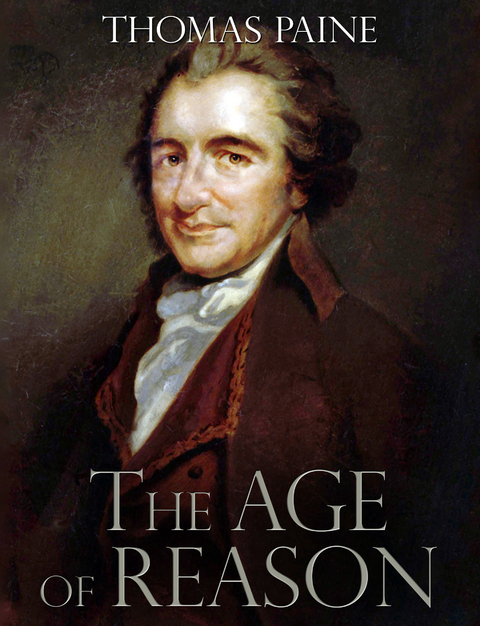
The Age of Reason (eBook)
184 Seiten
Jester House Publishing (Verlag)
978-0-00-008963-2 (ISBN)
To My Fellow-Citizens of the United States of America: I PUT the following work under your protection. It contains my opinions upon Religion. You will do me the justice to remember, that I have always strenuously supported the Right of every Man to his own opinion, however different that opinion might be to mine. He who denies to another this right, makes a slave of himself to his present opinion, because he precludes himself the right of changing it.
The most formidable weapon against errors of every kind is Reason. I have never used any other, and I trust I never shall.
Your affectionate friend and fellow-citizen,
Thomas Paine
Luxembourg, 8th Pluviose,
Second Year of the French Republic, one and indivisible.
January 27, O. S. 1794.
These books, beginning with Genesis and ending with Revelations, (which, by the bye, is a book of riddles that requires a revelation to explain it) are, we are told, the word of God. It is, therefore, proper for us to know who told us so, that we may know what credit to give to the report. The answer to this question is, that nobody can tell, except that we tell one another so. The case, however, historically appears to be as follows:
When the church mythologists established their system, they collected all the writings they could find, and managed them as they pleased. It is a matter altogether of uncertainty to us whether such of the writings as now appear under the name of the Old and the New Testament, are in the same state in which those collectors say they found them; or whether they added, altered, abridged, or dressed them up.
Be this as it may, they decided by vote which of the books out of the collection they had made, should be the Word of God, and which should not. They rejected several; they voted others to be doubtful, such as the books called the Apocrypha; and those books which had a majority of votes, were voted to be the word of God. Had they voted otherwise, all the people since calling themselves Christians had believed otherwise; for the belief of the one comes from the vote of the other. Who the people were that did all this, we know nothing of. They call themselves by the general name of the Church; and this is all we know of the matter.
As we have no other external evidence or authority for believing these books to be the word of God, than what I have mentioned, which is no evidence or authority at all, I come, in the next place, to examine the internal evidence contained in the books themselves.
In the former part of this essay, I have spoken of revelation. I now proceed further with that subject, for the purpose of applying it to the books in question.
Revelation is a communication of something, which the person, to whom that thing is revealed, did not know before. For if I have done a thing, or seen it done, it needs no revelation to tell me I have done it, or seen it, nor to enable me to tell it, or to write it.
Revelation, therefore, cannot be applied to anything done upon earth of which man is himself the actor or the witness; and consequently all the historical and anecdotal part of the Bible, which is almost the whole of it, is not within the meaning and compass of the word revelation, and, therefore, is not the word of God.
When Samson ran off with the gate-posts of Gaza, if he ever did so, (and whether he did or not is nothing to us,) or when he visited his Delilah, or caught his foxes, or did anything else[5], what has revelation to do with these things? If they were facts, he could tell them himself; or his secretary, if he kept one, could write them, if they were worth either telling or writing; and if they were fictions, revelation could not make them true; and whether true or not, we are neither the better nor the wiser for knowing them. When we contemplate the immensity of that Being, who directs and governs the incomprehensible WHOLE, of which the utmost ken of human sight can discover but a part, we ought to feel shame at calling such paltry stories the word of God.
As to the account of the creation, with which the book of Genesis opens, it has all the appearance of being a tradition which the Israelites had among them before they came into Egypt; and after their departure from that country, they put it at the head of their history, without telling, as it is most probable that they did not know, how they came by it. The manner in which the account opens, shows it to be traditionary. It begins abruptly. It is nobody that speaks. It is nobody that hears. It is addressed to nobody. It has neither first, second, nor third person. It has every criterion of being a tradition. It has no voucher. Moses does not take it upon himself by introducing it with the formality that he uses on other occasions, such as that of saying, "The Lord spake unto Moses, saying."
Why it has been called the Mosaic account of the creation, I am at a loss to conceive. Moses, I believe, was too good a judge of such subjects to put his name to that account. He had been educated among the Egyptians, who were a people as well skilled in science, and particularly in astronomy, as any people of their day; and the silence and caution that Moses observes, in not authenticating the account, is a good negative evidence that he neither told it nor believed it.—The case is, that every nation of people has been world-makers, and the Israelites had as much right to set up the trade of world-making as any of the rest; and as Moses was not an Israelite, he might not chuse to contradict the tradition. The account, however, is harmless; and this is more than can be said for many other parts of the Bible.
Whenever we read the obscene stories, the voluptuous debaucheries, the cruel and torturous executions, the unrelenting vindictiveness, with which more than half the Bible[6] is filled, it would be more consistent that we called it the word of a demon, than the Word of God. It is a history of wickedness, that has served to corrupt and brutalize mankind; and, for my own part, I sincerely detest it, as I detest everything that is cruel.
We scarcely meet with anything, a few phrases excepted, but what deserves either our abhorrence or our contempt, till we come to the miscellaneous parts of the Bible. In the anonymous publications, the Psalms, and the Book of Job, more particularly in the latter, we find a great deal of elevated sentiment reverentially expressed of the power and benignity of the Almighty; but they stand on no higher rank than many other compositions on similar subjects, as well before that time as since.
The Proverbs which are said to be Solomon's, though most probably a collection, (because they discover a knowledge of life, which his situation excluded him from knowing) are an instructive table of ethics. They are inferior in keenness to the proverbs of the Spaniards, and not more wise and economical than those of the American Franklin.
All the remaining parts of the Bible, generally known by the name of the Prophets, are the works of the Jewish poets and itinerant preachers, who mixed poetry, anecdote, and devotion together—and those works still retain the air and style of poetry, though in translation.[7]
"Hear, O ye heavens, and give ear, O earth!
'T is God himself that calls attention forth.
Another instance I shall quote is from the mournful Jeremiah, to which I shall add two other lines, for the purpose of carrying out the figure, and showing the intention of the poet.
"O, that mine head were waters and mine eyes"
Were fountains flowing like the liquid skies;
Then would I give the mighty flood release
And weep a deluge for the human race.—Author.
There is not, throughout the whole book called the Bible, any word that describes to us what we call a poet, nor any word that describes what we call poetry. The case is, that the word prophet, to which a later times have affixed a new idea, was the Bible word for poet, and the wordprophesying meant the art of making poetry. It also meant the art of playing poetry to a tune upon any instrument of music.
We read of prophesying with pipes, tabrets, and horns—of prophesying with harps, with psalteries, with cymbals, and with every other instrument of music then in fashion. Were we now to speak of prophesying with a fiddle, or with a pipe and tabor, the expression would have no meaning, or would appear ridiculous, and to some people contemptuous, because we have changed the meaning of the word.
We are told of Saul being among the prophets, and also that he prophesied; but we are not told what they prophesied, nor what he prophesied. The case is, there was nothing to tell; for these prophets were a company of musicians and poets, and Saul joined in the concert, and this was called prophesying.
The account given of this affair in the book called Samuel, is, that Saul met a company of prophets; a whole company of them! coming down with a psaltery, a tabret, a pipe, and a harp, and that they prophesied, and that he prophesied with them. But it appears afterwards, that Saul prophesied badly, that is, he performed his part badly; for it is said that an "evil spirit from God[8] came upon Saul, and he prophesied."
Now, were there no other passage in the book called the Bible, than this, to demonstrate to us that we have lost the original meaning of the word prophesy, and substituted another meaning in its place, this alone would be sufficient; for it is impossible to use and apply the wordprophesy, in the place it is here used and applied, if we give to it the sense which later times have affixed to it. The manner in which it is here used strips it of all religious meaning, and shews that a man might then be a prophet, or he might prophesy, as he may now be a poet or a musician, without any regard to the morality or the immorality of his character. The word was originally a term of science, promiscuously applied to poetry and to music, and not restricted to any subject upon which poetry and music might be exercised.
Deborah and Barak are called prophets, not because they predicted anything, but because they composed the poem or song that bears their name, in celebration of an act already done. David is ranked among the prophets, for he was a musician,...
| Erscheint lt. Verlag | 21.7.2018 |
|---|---|
| Sprache | englisch |
| Themenwelt | Geisteswissenschaften |
| ISBN-10 | 0-00-008963-X / 000008963X |
| ISBN-13 | 978-0-00-008963-2 / 9780000089632 |
| Informationen gemäß Produktsicherheitsverordnung (GPSR) | |
| Haben Sie eine Frage zum Produkt? |
 EPUB (Adobe DRM)
Größe: 308 KB
Kopierschutz: Adobe-DRM
Adobe-DRM ist ein Kopierschutz, der das eBook vor Mißbrauch schützen soll. Dabei wird das eBook bereits beim Download auf Ihre persönliche Adobe-ID autorisiert. Lesen können Sie das eBook dann nur auf den Geräten, welche ebenfalls auf Ihre Adobe-ID registriert sind.
Details zum Adobe-DRM
Dateiformat: EPUB (Electronic Publication)
EPUB ist ein offener Standard für eBooks und eignet sich besonders zur Darstellung von Belletristik und Sachbüchern. Der Fließtext wird dynamisch an die Display- und Schriftgröße angepasst. Auch für mobile Lesegeräte ist EPUB daher gut geeignet.
Systemvoraussetzungen:
PC/Mac: Mit einem PC oder Mac können Sie dieses eBook lesen. Sie benötigen eine
eReader: Dieses eBook kann mit (fast) allen eBook-Readern gelesen werden. Mit dem amazon-Kindle ist es aber nicht kompatibel.
Smartphone/Tablet: Egal ob Apple oder Android, dieses eBook können Sie lesen. Sie benötigen eine
Geräteliste und zusätzliche Hinweise
Buying eBooks from abroad
For tax law reasons we can sell eBooks just within Germany and Switzerland. Regrettably we cannot fulfill eBook-orders from other countries.
aus dem Bereich