


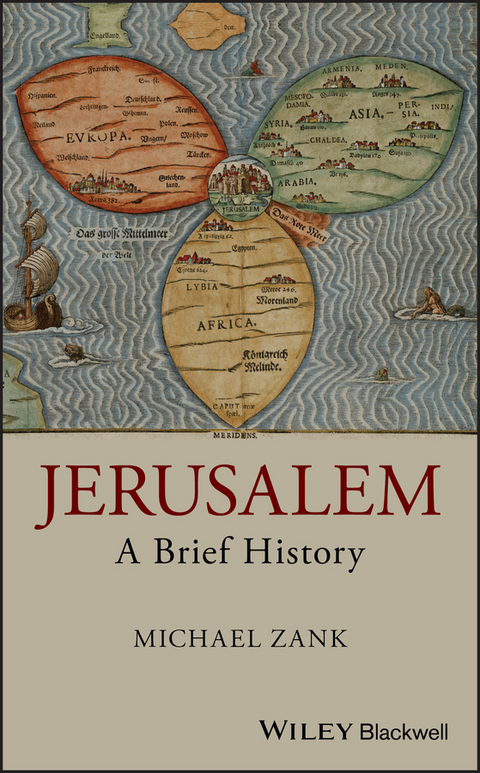
Jerusalem (eBook)
John Wiley & Sons (Verlag)
978-1-118-53332-1 (ISBN)
Provides a short, accessible, and lively introduction to Jerusalem
Jerusalem - A Brief History shows how Jewish, Christian, and Islamic scriptures confer providential meaning to the fate of the city and how modern Jerusalem is haunted by waves of biblical fantasy aiming at mutually exclusive status-quo rectification. It presents the major epochs of the history of Jerusalem's urban transformation, inviting readers to imagine Jerusalem as a city that is not just sacred to the many groups of people who hold it dear, but as a united, unharmed place that is, in this sense, holy.
Jerusalem - A Brief History starts in modern Jerusalem-giving readers a look at the city as it exists today. It goes on to tell of its emergence as a holy city in three different ways, focusing each time on another aspect of the biblical past. Next, it discusses the transformation of Jerusalem from a formerly Jewish temple city, condemned to oblivion by its Roman destroyers, into an imperially sponsored Christian theme park, and the afterlife of that same city under later Byzantine and Muslim rulers. Lastly, the book returns to present day Jerusalem to examine the development of the modern city under the Ottomans and the British, the history of division and reunification, and the ongoing jostling over access to, and sovereignty over, Jerusalem's contested holy places.
- Offers a unique integration of approaches, including urban history, the rhetoric of power, the history of art and architecture, biblical hermeneutics, and modern Middle Eastern Studies
- Places great emphasis on how Jerusalem is a real city where different people live and coexist
- Examines the urban transformation that has taken place since late Ottoman times
- Utilizes numerous line drawings to demonstrate how its monumental buildings, created to illustrate an alliance of divine and human power, are in fact quite ephemeral, transient, and fragile
Jerusalem - A Brief History is a comprehensive and thoughtful introduction to the Holy City that will appeal to any student of religion and/or history.
Michael Zank, PhD, is Professor of Religion and Jewish Studies at Boston University where he teaches a course on Holy City: Jerusalem in Time, Space, and Imagination. He has published a number of volumes including: New Perspectives on Martin Buber and The Idea of Atonement in the Philosophy of Hermann Cohen. He has been recognized twice as an outstanding teacher at Boston University.
Provides a short, accessible, and lively introduction to Jerusalem Jerusalem - A Brief History shows how Jewish, Christian, and Islamic scriptures confer providential meaning to the fate of the city and how modern Jerusalem is haunted by waves of biblical fantasy aiming at mutually exclusive status-quo rectification. It presents the major epochs of the history of Jerusalem s urban transformation, inviting readers to imagine Jerusalem as a city that is not just sacred to the many groups of people who hold it dear, but as a united, unharmed place that is, in this sense, holy. Jerusalem - A Brief History starts in modern Jerusalem giving readers a look at the city as it exists today. It goes on to tell of its emergence as a holy city in three different ways, focusing each time on another aspect of the biblical past. Next, it discusses the transformation of Jerusalem from a formerly Jewish temple city, condemned to oblivion by its Roman destroyers, into an imperially sponsored Christian theme park, and the afterlife of that same city under later Byzantine and Muslim rulers. Lastly, the book returns to present day Jerusalem to examine the development of the modern city under the Ottomans and the British, the history of division and reunification, and the ongoing jostling over access to, and sovereignty over, Jerusalem s contested holy places. Offers a unique integration of approaches, including urban history, the rhetoric of power, the history of art and architecture, biblical hermeneutics, and modern Middle Eastern Studies Places great emphasis on how Jerusalem is a real city where different people live and coexist Examines the urban transformation that has taken place since late Ottoman times Utilizes numerous line drawings to demonstrate how its monumental buildings, created to illustrate an alliance of divine and human power, are in fact quite ephemeral, transient, and fragile Jerusalem - A Brief History is a comprehensive and thoughtful introduction to the Holy City that will appeal to any student of religion and/or history.
Michael Zank, PhD, is Professor of Religion and Jewish Studies at Boston University where he teaches a course on Holy City: Jerusalem in Time, Space, and Imagination. He has published a number of volumes including: New Perspectives on Martin Buber and The Idea of Atonement in the Philosophy of Hermann Cohen. He has been recognized twice as an outstanding teacher at Boston University.
About this Book vii
Acknowledgments xiii
Maps xvi
Part I Introducing Jerusalem 1
1 Location, Recent History, Demography 3
2 Cities Within 14
3 Communities and Meanings 24
Part II Biblical City 35
4 "Holy City": A Clarification of Terms 37
5 The Making of a Memorable Place 47
6 Kings, Priests, and the Politics of "One God Alone" 59
7 Kinship, Covenant, and Sectarian Divide 70
8 City and Scenario 82
Part III Imperial City 93
9 Constantine's Hagiapolis Hierousalem 95
10 Pax Christiana sive Islamica 103
11 Arab Conquest 114
12 City of the Holy House (Madinat Bayt al-Maqdis) 122
13 The Kingdom of Jerusalem: Of Warlords, Popes, and Preachers of Jihad 135
Part IV Modern City 147
14 Ottoman Kudus 149
15 Ethnic Separation, Partition, and Division 160
16 Unholy City 169
Jerusalem: A Timeline 184
References 214
Index 232
About this Book
Cities fascinate us. They move us to travel and make pilgrimage. They give us the terms for citizenship, civilization, politics, and civic‐mindedness. Cities combine the utterly unique and particular with the ideal of the city as such. Each city is a draft of the City of God.
Jerusalem is a remarkable city. It is very ancient (about 4,000 years) and, unlike many other ancient Near Eastern cities, it has been continuously inhabited for virtually this entire duration. Most ancient cities were either abandoned or new, more convenient and greater ones, were established nearby. Cities rebuilt in this fashion were usually strategically located. They served as border fortifications, port cities, or administrative capitals in places begging for settlement and favorable to social, economic, or political aggregation.
The first Jerusalem, nestled on the watershed in the central highlands of the southern Levant between the Jordan Valley and the Mediterranean, was neither conveniently located nor served as border or port city. Commerce, trade, and industry passed it by and its population was sparse, especially as compared to the urban centers of Egypt and Mesopotamia. What made the city stand out over time was the extraordinary reputation it acquired as a sacred place whose fates were perceived as evidence of divine special providence. Out of the ashes of ancient Jerusalem arose a myth that was disseminated to the ends of the earth: through psalms, hymns, and prophecies, represented in word and image, and more recently through mass media and the Internet.
Beginning with the Bible, many books have been written about Jerusalem. Perhaps we should not be writing any more books about the Holy City. If it had been up to the great fourth‐century Christian scholar and translator St. Jerome, no one would write about the earthly Jerusalem at all, nor pay any special attention to it, because no one should think that one is closer to God in one place than in others. In fact, much like his great prophetic predecessors in the Bible who chided Jerusalem, he considered it not a holy city but an unholy city, a city lacking in holiness, because it lacked in justice. From this ancient critical perspective, the holiness of Jerusalem is very much in question.
The study of Jerusalem forces us to think about Judaism, Christianity, and Islam as related phenomena, as a family of religions, with Jerusalem as part of their common inheritance. Jewish, Christian, and Muslim identity formation is implicated in what secular humanists refer to as “religious violence,” a violence vacillating between martyrdom and genocide.1 In Jerusalem, the “kingdom of god on earth” appears in the paradoxical form of rocky outcroppings and caves, signs of absence, that are surrounded by magnificent shrines that commemorate and anticipate divine presence. What kind of city is holy to a god who is both present and absent, hidden and manifest? What kind of religions are these that are jostling over the right to represent an absent god?
In this holy city there is always a temptation to force the end. The ancient Jews produced an unsurpassed world heritage by giving voice to human yearning for the presence of God in His place, a demotic love‐poetry in praise of Zion and its God that inspires hope and faith in many millions of people across the globe.2 But the Jewish attachment to this place is also forever associated with violence suffered and inflicted, Israelite conquest and extirpation, commanded in the laws of Deuteronomy, and the lament over the destruction of Jerusalem and its central symbol, the temple of Solomon. Over the course of the past 1,700 years, Christians and Muslims produced beautiful art and architecture and established profound civilizations, but their drive for empire, especially where frustrated, also gave rise to intra‐ and inter‐communal recrimination, mutual contempt, and perennial resentment that periodically erupts into violence. The history of Jerusalem is thus a story of divinely sanctioned conquest, rule, loss, and the desire for retrieval and rectification.
From a modern perspective, too, perhaps it would be better if there were no more books on Jerusalem. In fact, the very religious conflict that flares up at the holy places on regular occasions might be avoided if everyone turned off their cameras. Perhaps Israelis and Palestinians could relax a bit if we all turned off our devices, ignored our news feeds, and allowed the city to breathe.3
Perhaps there shouldn’t be holy places. But judging by the evidence of folklorists and ethnographers, shrine religion has been around for as long as human civilization.4 People always saw and revered invisible powers, depicted in many forms and invoked by many names, “on every hill and under every leafy tree,” as the Bible says about the Israelites. What Jews, Christians, and Muslims condemn as “paganism” used to be the norm. Ancient Israelite religion was no different. Archaeology tells us that YHWH, the god of the Israelites, wasn’t always alone but had a female partner. Jerusalem’s original god, after whom the city was named, was the Evening Star, twin‐brother of the Morning Star. Those were the days when not even God was a monotheist. Jerusalem’s career as the holy city par excellence commenced when one of its kings decided to banish the worship of all other gods and restricted the worship of YHWH, the nation’s ancestral deity, to the royal shrine in Jerusalem. Thus arises the notion of YHWH as a “jealous” god who demands exclusive veneration. To “appear before the LORD,” as all male Israelites were henceforth commanded, one had to go up to Jerusalem. In those days, veneration of YHWH in Jerusalem alone meant bringing or sending one’s gifts to only one shrine, i.e. to pay one’s taxes to the king and thereby strengthen the royal center of the state. That act made Jerusalem the “Rome” of ancient Israel: omnes vias hierosolymam ducunt, the place to which all roads lead. Later, when that city was nevertheless destroyed, something else happened that made Jerusalem and the god who resided in Jerusalem more consequential. Israelite prophets, lawyers, and scribes began to think of the god of Israel as different (Hebrew: qadosh), discovering the notion of an all‐powerful creator of the universe, the only god there is, inventing the very God Almighty that, to this day, inspires Jews, Christians, and Muslims and holds them in thrall. It was, as philosopher and psychologist Karl Jaspers put it, an “axial age” breakthrough whose consequences are still with us and that, for better or worse, continues to shape our idea of what it means to be human.5 There are important social, political, and historical consequences to biblical monotheism. If God is different, then the people he chooses are different. They are obliged to live and act differently, separate and distinguish themselves from others by dress, conduct, or both. We will have an opportunity to consider the secessionist, sectarian, and utopian apocalyptic implications of monotheism. God, capital ‘G,’ enables us to suffer and die for God as martyrs and he makes us kill for God, because he wants it (deus lo vult, as the Frankish Crusaders used to say in their medieval Latin when they waded in the blood of God’s enemies and theirs, “up to their stirrups”).6 Compared to this God and the forces he unleashed in the souls of believers and in the world of holy war propaganda, the old shrine religions of the peasants were downright harmless. If it weren’t for those kings who condemned the shrines, the Elijahs who wreaked havoc on the priests of Ba’al on Mount Carmel, the prophets who declared there is no God but God, perhaps no one would write books on Jerusalem today.
Before you put aside this book as the work of a cynic, let me quickly assert that I believe that religion can also be a force for good. Even Sigmund Freud – archcritic of religion and Jewish godfather of psychoanalysis – thought religion may be necessary for us to behave in civilized ways, even though he considered the Jewish and Christian religions “illusions” aimed at repressing the violent and libidinous urges that have characterized primate behavior since time immemorial.7 The history of Jerusalem teaches us that many of the great emperors and caliphs who cast themselves as the representatives of God on earth not only did well by Jerusalem materially but also maintained law and order for extended periods of time. Some of them, especially the Muslim ones, were master‐negotiators of the ethno‐religious differences prevalent in late antique and medieval Al‐Quds, the Holy City, and beyond. Jerusalem’s history is not all blood and gore, war and conflict. Even today, there are many wonderful people among the Jews, Christians, and Muslims who call Jerusalem home, who want nothing more than peace and are deeply invested in whatever it takes to make peace and get along with one another. They are part of a global move away from exclusivist narratives and toward ecumenism, dialogue, and conciliation between creeds and nations. In Israel, there are the courageous Rabbis for Human Rights who protect Arab farmers and their fields from aggressive hyper‐nationalist‐religious settlers.8 There is an Israel Interfaith Association9 that brings together Christian, Muslim, and Jewish clerics to discuss matters of common concern. More recently, a Jerusalem music center was transformed...
| Erscheint lt. Verlag | 16.7.2018 |
|---|---|
| Reihe/Serie | Blackwell Brief Histories of Religion |
| Blackwell Brief Histories of Religion | Wiley Blackwell Brief Histories of Religion |
| Sprache | englisch |
| Themenwelt | Geisteswissenschaften ► Geschichte ► Regional- / Ländergeschichte |
| Geschichte ► Teilgebiete der Geschichte ► Religionsgeschichte | |
| Geisteswissenschaften ► Religion / Theologie | |
| Schlagworte | Ancient Jerusalem • biblical cities • Biblical Studies • City of David • Geschichte • History • History of Jerusalem • History of Religion • Holy City • Ideology • Israel • Jerusalem • Jerusalem: A Brief History • Jerusalem /Geschichte • Jerusalem throughout the ages • Judaic Studies • Judaism • Judentum • judgment day location • location of the final judgment on the day of reckoning • modern Jerusalem • Monotheism • Muhammad's ascent to heaven • Near Eastern Studies • Religion • Religion & Culture • Religion & Theology • Religionsgeschichte • Religion u. Kultur • Religion u. Theologie • Religious History • Religious Studies • sacred cities • the city of Jerusalem • the Solomonic Temple |
| ISBN-10 | 1-118-53332-1 / 1118533321 |
| ISBN-13 | 978-1-118-53332-1 / 9781118533321 |
| Informationen gemäß Produktsicherheitsverordnung (GPSR) | |
| Haben Sie eine Frage zum Produkt? |
 EPUB (Adobe DRM)
Kopierschutz: Adobe-DRM
Adobe-DRM ist ein Kopierschutz, der das eBook vor Mißbrauch schützen soll. Dabei wird das eBook bereits beim Download auf Ihre persönliche Adobe-ID autorisiert. Lesen können Sie das eBook dann nur auf den Geräten, welche ebenfalls auf Ihre Adobe-ID registriert sind.
Details zum Adobe-DRM
Dateiformat: EPUB (Electronic Publication)
EPUB ist ein offener Standard für eBooks und eignet sich besonders zur Darstellung von Belletristik und Sachbüchern. Der Fließtext wird dynamisch an die Display- und Schriftgröße angepasst. Auch für mobile Lesegeräte ist EPUB daher gut geeignet.
Systemvoraussetzungen:
PC/Mac: Mit einem PC oder Mac können Sie dieses eBook lesen. Sie benötigen eine
eReader: Dieses eBook kann mit (fast) allen eBook-Readern gelesen werden. Mit dem amazon-Kindle ist es aber nicht kompatibel.
Smartphone/Tablet: Egal ob Apple oder Android, dieses eBook können Sie lesen. Sie benötigen eine
Geräteliste und zusätzliche Hinweise
Buying eBooks from abroad
For tax law reasons we can sell eBooks just within Germany and Switzerland. Regrettably we cannot fulfill eBook-orders from other countries.


