


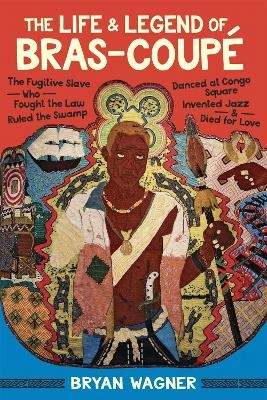
The Life and Legend of Bras-Coupé
The Fugitive Slave Who Fought the Law, Ruled the Swamp, Danced at Congo Square, Invented Jazz, and Died for Love
Seiten
2019
Louisiana State University Press (Verlag)
978-0-8071-7025-0 (ISBN)
Louisiana State University Press (Verlag)
978-0-8071-7025-0 (ISBN)
Although few recognize the name of Bras-Coupe today, Bryan Wagner's riveting history The Life and Legend of Bras-Coupe illustrates why the saga of this notorious escaped slave should be a touchstone among scholars and students of the African diaspora.
Although few recognize the name of Bras-Coupé today, Bryan Wagner's riveting history The Life and Legend of Bras-Coupé illustrates why the saga of this notorious escaped slave should be a touchstone among scholars and students of the African diaspora. After losing an arm in a pitched battle with the New Orleans police in the 1830s, Bras-Coupé hid for several years in a swamp near the city. During this time, law enforcement widely publicized their manhunt for him through newspapers, wanted posters, and other media. Messages from the mayor's office promoted a violent image of Bras-Coupé, casting him as the primary reason police needed the right to use deadly force in the course of their duties. After a former friend betrayed and killed the bandit in July 1837, local officials displayed Bras-Coupé's corpse in the Place d'Armes, where they ordered slaves to bear witness.
The Bras-Coupé legend grew after his death and took on fantastic dimensions. Storytellers gave him superpowers. His skin, it was alleged, could not be punctured by bullets. His gaze could turn men to stone. Folklorists have transcribed many such examples of the tradition, and writers, including George Washington Cable and Robert Penn Warren, have adapted it into novels. Over time, new details appeared in the mythology and the legend transformed. Some said that he was an African prince before he was kidnapped and brought to Louisiana; others, that he was the most famous performer at Congo Square, playing an indispensable role in the preservation of African music and dance. Sidney Bechet, one of the city's most celebrated composers and reed players, even suggested it was Bras-Coupé who invented jazz.
Including fugitive slave advertisements, arrest records, and journalism from the 1830s, this critical edition collects the most important primary materials related to Bras-Coupé's story. Wagner's timely and deft examination of this unique historical figure reveals how a single man's life, shaped by the horrors of slavery and the cultural mélange of Louisiana, can evolve into legend.
Although few recognize the name of Bras-Coupé today, Bryan Wagner's riveting history The Life and Legend of Bras-Coupé illustrates why the saga of this notorious escaped slave should be a touchstone among scholars and students of the African diaspora. After losing an arm in a pitched battle with the New Orleans police in the 1830s, Bras-Coupé hid for several years in a swamp near the city. During this time, law enforcement widely publicized their manhunt for him through newspapers, wanted posters, and other media. Messages from the mayor's office promoted a violent image of Bras-Coupé, casting him as the primary reason police needed the right to use deadly force in the course of their duties. After a former friend betrayed and killed the bandit in July 1837, local officials displayed Bras-Coupé's corpse in the Place d'Armes, where they ordered slaves to bear witness.
The Bras-Coupé legend grew after his death and took on fantastic dimensions. Storytellers gave him superpowers. His skin, it was alleged, could not be punctured by bullets. His gaze could turn men to stone. Folklorists have transcribed many such examples of the tradition, and writers, including George Washington Cable and Robert Penn Warren, have adapted it into novels. Over time, new details appeared in the mythology and the legend transformed. Some said that he was an African prince before he was kidnapped and brought to Louisiana; others, that he was the most famous performer at Congo Square, playing an indispensable role in the preservation of African music and dance. Sidney Bechet, one of the city's most celebrated composers and reed players, even suggested it was Bras-Coupé who invented jazz.
Including fugitive slave advertisements, arrest records, and journalism from the 1830s, this critical edition collects the most important primary materials related to Bras-Coupé's story. Wagner's timely and deft examination of this unique historical figure reveals how a single man's life, shaped by the horrors of slavery and the cultural mélange of Louisiana, can evolve into legend.
Bryan Wagner is associate professor in the English department at the University of California, Berkeley, and author of Disturbing the Peace: Black Culture and the Police Power after Slavery and The Tar Baby: A Global History.
| Erscheinungsdatum | 29.10.2018 |
|---|---|
| Verlagsort | Baton Rouge |
| Sprache | englisch |
| Maße | 233 x 236 mm |
| Gewicht | 544 g |
| Themenwelt | Geisteswissenschaften ► Geschichte |
| Sozialwissenschaften ► Ethnologie ► Volkskunde | |
| Sozialwissenschaften ► Soziologie ► Makrosoziologie | |
| ISBN-10 | 0-8071-7025-9 / 0807170259 |
| ISBN-13 | 978-0-8071-7025-0 / 9780807170250 |
| Zustand | Neuware |
| Informationen gemäß Produktsicherheitsverordnung (GPSR) | |
| Haben Sie eine Frage zum Produkt? |
Mehr entdecken
aus dem Bereich



aus dem Bereich
von grimmschen Märchen, germanischen Mythen und den Gesängen der …
Buch | Hardcover (2024)
Edition Roter Drache (Verlag)
CHF 22,40
die philosophische Würde der Komödie
Buch | Hardcover (2025)
S. Fischer (Verlag)
CHF 36,40
an Ethnography of crowds and unruly sounds
Buch | Softcover (2024)
Oxford University Press Inc (Verlag)
CHF 39,95


