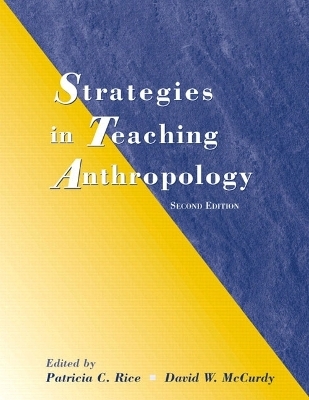
Strategies in Teaching Anthropology
Pearson (Verlag)
978-0-13-034070-2 (ISBN)
- Titel erscheint in neuer Auflage
- Artikel merken

A reference tool for any teacher of Anthropology.
Unique in focus and content, this book focuses on the “how” of teaching anthropology across all of its sub-fields—Cultural-Social, Biological, Archaeology, and Linguistics (and their two dimensions: research and applied studies)—and to provide a wide array of associated learning outcomes and student activities. It is a valuable single-source compendium of strategies and teaching “tricks of the trade” from a group of seasoned teaching anthropologists—working in a variety of teaching settings—who share their pedagogical techniques, knowledge, and observations. Focused on the applied, “how to do it” side of the pedagogical nature of teaching, the text is designed to fill the gap between students who are taking an anthropology class for the first time and instructors who know their subject matter in depth, but who are not sure how to present it to their students in a way that will capture and relay their own excitement with the subject and that will “engage” students in anthropological subject matter and its processes
Foreword, by Conrad Kottak.
Introduction, by Yolanda Moses.
I. GENERAL.
Hands-On Exercises for a Four-Field Introduction to Anthropology, Vicki Bentley-Condit.
Critical Thinking in Anthropology, Mary Pulford.
Strategies for Becoming an Outstanding Anthropology Teacher: From the Student Perspective, Patricia C. Rice.
“TSM Cube:” Illustrating the Scientific Method, Grace Keyes.
Discussion Preparation Guides, Charles O. Ellenbaum.
II. ARCHAEOLOGY AND BIOLOGICAL ANTHROPOLOGY.
Ping Pong Archaeology: A Non-Destructive Field and Lab Exercise, Janet Pollak.
An Introductory Unit on the Illegal Antiquities Trade: Looting and Related Ethical Issues in Archaeology, Harold Juli.
“First Steps” in Hominid Evolution: A Lesson on Walking, Janet Pollak.
The Trouble with the “Race” Concept: It's All in the Cards, Robert Graber.
The Use of “Stories” as Discussion Point for Evolution versus Creationism, Clifton Amsbury.
III. LANGUAGE AND CULTURE.
Gender and Language: A Fieldwork Project, Peter Wogan.
Linguistic Models in Anthropology 101: Give Me The Cup, Michael Sheridan.
IV. CULTURAL ANTHROPOLOGY.
Using Ads to Teach Anthropology, Spyros Spyrou.
Teaching Cultural Anthropology Through Mass and Popular Culture: Seven Pedagogical Methods for the Classroom, Scott Lukas.
Acting Out Anthropological Concepts, Juliana Flinn.
Introductory Fieldwork: The Meaning of the Gift, David Sutton.
Ethnography, Humanity, and Imagination: Seeing a Culture and Society Through the Eyes of an Individual, Phillip Carl Salzman.
Student Experiential Learning on Social Control, Class, and Gender, Carolyn Epple.
Family Altars in Introductory Anthropology: Making Kinship Relevant, Jeffrey Cohen.
Dynamic Ethnography, Methods, and Next-Door Anthropology, Lorenzo Covarrubias.
Getting Into the Act: Using Classroom Role-Playing as a Type of Participant Observation, Mary Riley.
Creating Cultures: Taking the Pain Out of Writing in Introductory Courses, Suzanne LaFont.
Fieldwork and the Observer's Gaze: Teaching the Ups and Downs of Ethnographic Observation, Daniel M. Goldstein.
Reading Textiles for Cultural Messages, Robin O'Brian.
Coming of Age in Statistics, Robert Graber.
Culture as “The Rules of the Game:” Simulating Fieldwork While Playing Cards, Susan Birns.
Reading Between the Lines: The Representation of Diversity, Conflict, and the Broader World in International News Stories, Susan Buck Sutton.
The Cultural Dialog Project (CDP): Approaching Ethnographic Texts Through Playwriting and Performance, Mark Pedelty.
Teaching Culture through Life History: The Spradley Approach, David W. McCurdy.
Using Value Orientations to Understand the Role of Culture in Cross-Cultural Communication, Anne E. Campbell.
Teaching as Theater, Charles F. Urbanowicz.
“Flags”—the Power of Patriotism and Nationalism: The Arbitrariness of Symbols and Significance: A Classroom Exercise That'll Wake 'em Up, Dickie Wallace.
Taking Students on a Walkabout, Michael Oldani.
Building Student Interest, Input, and Engagement: Organizing Small Group Projects in Large Classes, Marilynne Diggs-Thompson.
Nacirema Writing, John M. Coggeshall.
Familiarizing the Exotic in Ethnographic Film, Sam Pack.
Pre-Class Fieldwork: Ethnographic Introductions, Dickie Wallace.
Potlatching Classroom Participation: Using "Prestige" and "Shame" to Encourage Student Involvement, Daniel M. Goldstein.
How to Teach Self Ethnography, John L. Caughey.
Grounding the Culture Concept, or Pulling the Rug Out From Students, Brent Metz.
| Erscheint lt. Verlag | 1.3.2002 |
|---|---|
| Sprache | englisch |
| Maße | 216 x 279 mm |
| Gewicht | 490 g |
| Themenwelt | Geisteswissenschaften ► Archäologie |
| Sozialwissenschaften ► Ethnologie | |
| Sozialwissenschaften ► Soziologie | |
| ISBN-10 | 0-13-034070-7 / 0130340707 |
| ISBN-13 | 978-0-13-034070-2 / 9780130340702 |
| Zustand | Neuware |
| Informationen gemäß Produktsicherheitsverordnung (GPSR) | |
| Haben Sie eine Frage zum Produkt? |
aus dem Bereich