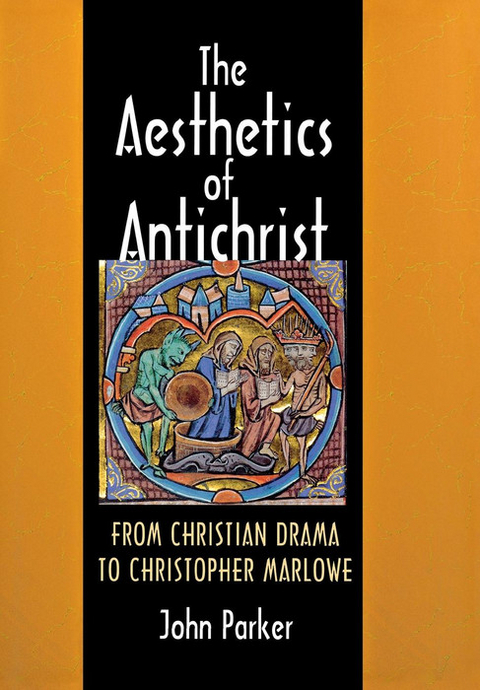
The Aesthetics of Antichrist (eBook)
272 Seiten
Cornell University Press (Verlag)
9780801463549 (ISBN)
Exploring works from the Middle Ages to Marlowe, this book argues that Christian drama and ritual performance had reveled in staging the collapse of Christianity into its historical opponents (paganism, heresy), a tradition Marlowe embraced.
In Dr. Faustus, Christopher Marlowe wrote a profoundly religious drama despite the theater's newfound secularism and his own reputation for anti-Christian irreverence. The Aesthetics of Antichrist explores this apparent paradox by suggesting that, long before Marlowe, Christian drama and ritual performance had reveled in staging the collapse of Christianity into its historical opponents—paganism, Judaism, worldliness, heresy. By embracing this tradition, Marlowe's work would at once demonstrate the theatricality inhering in Christian worship and, unexpectedly, resacralize the commercial theater.
The Antichrist myth in particular tells of an impostor turned prophet: performing Christ's life, he reduces the godhead to a special effect yet in so doing foretells the real second coming. Medieval audiences, as well as Marlowe's, could evidently enjoy the constant confusion between true Christianity and its empty look-alikes for that very reason: mimetic degradation anticipated some final, as yet deferred revelation. Mere theater was a necessary prelude to redemption. The versions of the myth we find in Marlowe and earlier drama actually approximate, John Parker argues, a premodern theory of the redemptive effect of dramatic representation itself. Crossing the divide between medieval and Renaissance theater while drawing heavily on New Testament scholarship, Patristics, and research into the apocrypha, The Aesthetics of Antichrist proposes a wholesale rereading of pre-Shakespearean drama.
In Dr. Faustus, Christopher Marlowe wrote a profoundly religious drama despite the theater's newfound secularism and his own reputation for anti-Christian irreverence. The Aesthetics of Antichrist explores this apparent paradox by suggesting that, long before Marlowe, Christian drama and ritual performance had reveled in staging the collapse of Christianity into its historical opponents—paganism, Judaism, worldliness, heresy. By embracing this tradition, Marlowe's work would at once demonstrate the theatricality inhering in Christian worship and, unexpectedly, resacralize the commercial theater.
The Antichrist myth in particular tells of an impostor turned prophet: performing Christ's life, he reduces the godhead to a special effect yet in so doing foretells the real second coming. Medieval audiences, as well as Marlowe's, could evidently enjoy the constant confusion between true Christianity and its empty look-alikes for that very reason: mimetic degradation anticipated some final, as yet deferred revelation. Mere theater was a necessary prelude to redemption. The versions of the myth we find in Marlowe and earlier drama actually approximate, John Parker argues, a premodern theory of the redemptive effect of dramatic representation itself.
Crossing the divide between medieval and Renaissance theater while drawing heavily on New Testament scholarship, Patristics, and research into the apocrypha, The Aesthetics of Antichrist proposes a wholesale rereading of pre-Shakespearean drama.
John Parker is Associate Professor of English at Macalester College.
| Erscheint lt. Verlag | 5.7.2018 |
|---|---|
| Verlagsort | Ithaca |
| Sprache | englisch |
| Maße | 150 x 150 mm |
| Gewicht | 28 g |
| Themenwelt | Literatur ► Essays / Feuilleton |
| Geisteswissenschaften ► Religion / Theologie ► Weitere Religionen | |
| Geisteswissenschaften ► Sprach- / Literaturwissenschaft ► Anglistik / Amerikanistik | |
| Geisteswissenschaften ► Sprach- / Literaturwissenschaft ► Literaturwissenschaft | |
| ISBN-13 | 9780801463549 / 9780801463549 |
| Informationen gemäß Produktsicherheitsverordnung (GPSR) | |
| Haben Sie eine Frage zum Produkt? |
 PDF (Adobe DRM)
Kopierschutz: Adobe-DRM
Adobe-DRM ist ein Kopierschutz, der das eBook vor Mißbrauch schützen soll. Dabei wird das eBook bereits beim Download auf Ihre persönliche Adobe-ID autorisiert. Lesen können Sie das eBook dann nur auf den Geräten, welche ebenfalls auf Ihre Adobe-ID registriert sind.
Details zum Adobe-DRM
Dateiformat: PDF (Portable Document Format)
Mit einem festen Seitenlayout eignet sich die PDF besonders für Fachbücher mit Spalten, Tabellen und Abbildungen. Eine PDF kann auf fast allen Geräten angezeigt werden, ist aber für kleine Displays (Smartphone, eReader) nur eingeschränkt geeignet.
Systemvoraussetzungen:
PC/Mac: Mit einem PC oder Mac können Sie dieses eBook lesen. Sie benötigen eine
eReader: Dieses eBook kann mit (fast) allen eBook-Readern gelesen werden. Mit dem amazon-Kindle ist es aber nicht kompatibel.
Smartphone/Tablet: Egal ob Apple oder Android, dieses eBook können Sie lesen. Sie benötigen eine
Geräteliste und zusätzliche Hinweise
Buying eBooks from abroad
For tax law reasons we can sell eBooks just within Germany and Switzerland. Regrettably we cannot fulfill eBook-orders from other countries.
aus dem Bereich