


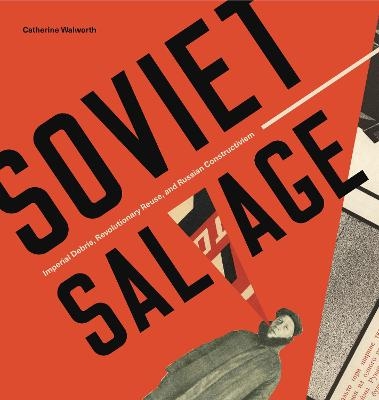
Soviet Salvage
Imperial Debris, Revolutionary Reuse, and Russian Constructivism
Seiten
2018
Pennsylvania State University Press (Verlag)
978-0-271-07770-3 (ISBN)
Pennsylvania State University Press (Verlag)
978-0-271-07770-3 (ISBN)
- Titel z.Zt. nicht lieferbar
- Versandkostenfrei
- Auch auf Rechnung
- Artikel merken
Examines how Russian Constructivist artists in the 1920s imagined a new physical environment through the creation of recycled and reappropriated objects.
In Soviet Salvage, Catherine Walworth explores how artists on the margins of the Constructivist movement of the 1920s rejected “elitist” media and imagined a new world, knitting together avant-garde art, imperial castoffs, and everyday life.
Applying anthropological models borrowed from Claude Lévi-Strauss, Walworth shows that his mythmaker typologies—the “engineer” and “bricoleur”—illustrate, respectively, the canonical Constructivists and artists on the movement’s margins who deployed a wide range of clever make-do tactics. Walworth explores the relationships of Nadezhda Lamanova, Esfir Shub, and others with Constructivists such as Aleksei Gan, Varvara Stepanova, and Aleksandr Rodchenko. Together, the work of these artists reflected the chaotic and often contradictory zeitgeist of the decade from 1918 to 1929 and redefined the concept of mass production. Reappropriated fragments of a former enemy era provided a wide range of play and possibility for these artists, and the resulting propaganda porcelain, film, fashion, and architecture tell a broader story of the unique political and economic pressures felt by their makers.
An engaging multidisciplinary study of objects and their makers during the Soviet Union’s early years, this volume highlights a group of artists who hover like free radicals at the border of existing art-historical discussions of Constructivism and deepens our knowledge of Soviet art and material culture.
In Soviet Salvage, Catherine Walworth explores how artists on the margins of the Constructivist movement of the 1920s rejected “elitist” media and imagined a new world, knitting together avant-garde art, imperial castoffs, and everyday life.
Applying anthropological models borrowed from Claude Lévi-Strauss, Walworth shows that his mythmaker typologies—the “engineer” and “bricoleur”—illustrate, respectively, the canonical Constructivists and artists on the movement’s margins who deployed a wide range of clever make-do tactics. Walworth explores the relationships of Nadezhda Lamanova, Esfir Shub, and others with Constructivists such as Aleksei Gan, Varvara Stepanova, and Aleksandr Rodchenko. Together, the work of these artists reflected the chaotic and often contradictory zeitgeist of the decade from 1918 to 1929 and redefined the concept of mass production. Reappropriated fragments of a former enemy era provided a wide range of play and possibility for these artists, and the resulting propaganda porcelain, film, fashion, and architecture tell a broader story of the unique political and economic pressures felt by their makers.
An engaging multidisciplinary study of objects and their makers during the Soviet Union’s early years, this volume highlights a group of artists who hover like free radicals at the border of existing art-historical discussions of Constructivism and deepens our knowledge of Soviet art and material culture.
Catherine Walworth is Curator at the Columbia Museum of Art and co-author of Silver to Steel: The Modern Designs of Peter Muller-Munk.
Contents
List of Illustrations
Acknowledgments
Note to the Reader
Introduction
1 The Economic Shaping of Constructivism
2 A Blank Slate: The First Years of Soviet Propaganda Porcelain
3 Nadezhda Lamanova: On the Elegant Fringes of Constructivist Dress
4 Esfir Shub: “Magician of the Editing Table”
5 The Five-Year Plan Prompts a Fire Sale
Conclusion
Notes
Bibliography
Index
| Erscheinungsdatum | 16.11.2018 |
|---|---|
| Reihe/Serie | Refiguring Modernism |
| Zusatzinfo | 34 Halftones, color; 66 Halftones, black and white |
| Verlagsort | University Park |
| Sprache | englisch |
| Maße | 229 x 241 mm |
| Gewicht | 1021 g |
| Themenwelt | Kunst / Musik / Theater ► Kunstgeschichte / Kunststile |
| Geschichte ► Allgemeine Geschichte ► Neuzeit (bis 1918) | |
| Geisteswissenschaften ► Geschichte ► Regional- / Ländergeschichte | |
| ISBN-10 | 0-271-07770-0 / 0271077700 |
| ISBN-13 | 978-0-271-07770-3 / 9780271077703 |
| Zustand | Neuware |
| Informationen gemäß Produktsicherheitsverordnung (GPSR) | |
| Haben Sie eine Frage zum Produkt? |
Mehr entdecken
aus dem Bereich

aus dem Bereich
Geschichte einer wilden Handlung
Buch | Hardcover (2024)
C.H.Beck (Verlag)
CHF 47,60


