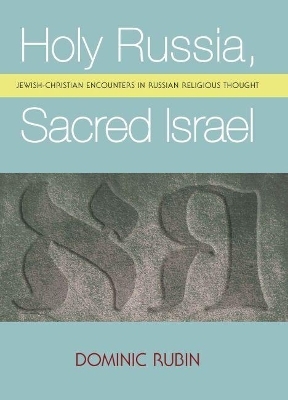
Holy Russia, Sacred Israel
Academic Studies Press (Verlag)
978-1-61811-820-2 (ISBN)
Holy Russia, Sacred Israel examines how Russian religious thinkers, both Jewish and Christian, conceived of Judaism, Jewry and the ‘Old Testament’ philosophically, theologically and personally at a time when the Messianic element in Russian consciousness was being stimulated by events ranging from the pogroms of the 1880s, through two Revolutions and World Wars, to exile in Western Europe. An attempt is made to locate the boundaries between the Jewish and Christian, Russian and Western, Gnostic-pagan and Orthodox elements in Russian thought in this period. The author reflects personally on how the heritage of these thinkers – little analyzed or translated in the West – can help Orthodox (and other) Christians respond to Judaism (including ‘Messianic Judaism’), Zionism, and Christian anti-Semitism today.
Dominic Rubin (Ph.D. in Linguistics, London University) is a lecturer in Philosophy, Biblical Hebrew, Old Testament at St.Philaret’s Orthodox Christian Institute and the Moscow Higher School of Economics.
Preface
Chapter One: Soloviev’s Judeo-Russian Wisdom
Introduction: Russian Jewry in the time of Soloviev
Soloviev’s general development
Soloviev, the Jews and Judaism
The flawed wholeness of the Jewish nation
The encounter with J.Rabinowitz
Judaism, Judeo-Christianity and the Law
Talmudic Judaism and integral Christianity
Sophia (Soph-Jah) and Judaic/Christian pan(en)theism
Jewish responses to Soloviev
Chapter Two: Bulgakov and the sacred blood of Jewry
Bulgakov: wrestling with Soloviev’s heritage
The Jews in Bulgakov’s thought: a preview of the main problem
Judaism and the Old Testament in Bulgakov’s early philosophy
Two Cities (1906-1910)
The Unfading Light (1917)
Bulgakov and Kabbalah
Bulgakov and Jewry (1): in Russia – the shadow of the Revolution
An early essay in Christian Zionism (1915)
The paradox of Bulgakov’s anti-Semitism
Bulgakov’s recollections of the 1905 and 1917 Revolutions
Bulgakov and Jewry (2): in exile – the shadow of the Holocaust
The Biblical conception of blood and nation
Sophiology and sacred blood
The blood-chosenness of the Jews after Christ
The collective fate of Israel and the remnant
A critical development of Bulgakov’s ideas
A Messianic Jewish reading of Bulgakov? A (covert) two-covenant reading of Bulgakov? Judas, Saul, and Paul
Conclusion
Bulgakov in two contemporary Russian-Jewish interpretations
Chapter Three: N
Berdyaev, M
Gershenzon and L
Shestov: Jewish and Russian Nihilists of the Spirit
The three pessimists
Berdyaev and Gershenzon
Nicolai Berdyaev
Mikhail Gershenzon
Between Slavophilism and Bolshevism
Berdyaev and Gershenzon on Slavophilism
Gershenzon, Berdyaev and the Bolshevik Revolution
Gershenzon and Vyacheslav Ivanov aft er the Revolution
1922: Berdyaev and Gershenzon on history
Berdyaev on history and Jewry
Gershenzon and Jewish destiny
Pushkin-Ahasuerus
Apotheosis of Jewishness: Gershenzon against Land, Torah and People
The ‘Judaization’ of Berdyaev
Lev Shestov
Shestov on Gershenzon
Shestov on Buber and Judaism
Shestov on Berdyaev
Shestov, Bulgakov and Steinberg
Bulgakov on Shestov: ‘fi deist without faith’
Steinberg on Shestov: reveal the ‘black man’
Judaism beyond the Pale: superseding both Testaments
Gershenzon and Shestov – differences and similarities
V.V.Zenkovsky: the dialectic of Jewry and Christianity
Chapter Four: Vasily Rozanov (and Pavel Florensky)
‘Sinful slave Vasily….’ Rozanov’s intellectual development
Early Rozanov: Judaism over Christianity
“Judaism” (1903)
The immanent church of conciliar Jewry
1.Circumcision
2.Sabbath
3.Mikveh
Astarte, Egypt and Judaism
The agonies of Marcionism
Middle Rozanov: Russia expels the Jew within
Two Jewish encounters in the Beilis years
Mikhail Gershenzon
Aaron Steinberg
Rozanov’s Judeophobic outpourings (1911-1914)
Florensky: Rozanov’s secret helper
Florensky’s Jewish writings
Ritual murder and the eucharist.The fl aw in Florensky’s two-tiered logic
Florensky, Romans 11 and Jewish blood
Florensky’s ‘Kabbalistic scholarship’ Florensky: the broader context
Occultism and magic
Political totalitarianism
Katsis and Florensky’s ‘Christian exegesis’
Preface
Florensky’s position in Russian religious thought
Name-worship and symbolism
Iosef Davydovich Levin: “I met Florensky once….” Christianity and anti-Semitism: final words
Chapter Five: L
Karsavin and A
Steinberg: Russia and Israel Symphonically
Interwined
Two friends, two worlds
Eurasianism,Volphila, Autonomism
The Karsavin-Steinberg exchange
Karsavin
Steinberg
Inflected philosophy: Jews and Russians among the Greeks
Steinberg, Jewishness and philosophy: How strange that I am a Jew
Jewishness and Russianness in philosophy
Jewish Platonized Kantianism
Steinberg and Jewishness in philosophy
The boundaries between the believer and the world
Core and periphery, Orthodoxy and Revolution
The case of Georgy Fedotov
The case of Alexander Meier
Karsavin: rootless Christianity
“A Study in Apologetics”
Karsavin: experiencing the Jewish vision of God (Poem on Death)
Th e tortured Jewess
Contrary couples
Karsavin’s and Steinberg’s triadology
Israel and the living God
The end of the Poem on Death
The Inquisitor and the Jewess-‘conversa’
The final drama
The role of the Jewess in the final drama
Jews and personality
Final years: London, Lithuania, Siberia
Abez and a final Jewish encounter
Death and burial
Chapter Six: Semyon Frank: from russkiy yevrei to russkiy yevropeetz
Frank: the Jew as universal man
Frank’s philosophy
Frank and Gershenzon
Frank’s universalism
Frank and Gershenzon from Landmarks to Revolution
Gershenzon and Frank: the wisdom of Pushkin
Pushkin between Frank and Gershenzon
Pushkin’s message for contemporary Russia
Russian-Jewish Wisdom
Frank and German-Jewish philosophy
Cohen and Frank
Frank and Cohen on suffering
Frank and Rosenzweig
The argument of The Star and Frank’s critique
The Star
The critique
Evaluation of Frank’s critique
Frank and O.Goldberg
Conclusion
Conclusion: Soloviev’s heirs: the third generation
Alexander Men: Bulgakovian Judeo-Christianity? The polemic against Men’s Jewish Christianity
N.Feingold and S.Lyosov
Men in the context of post-Auschwitz theology
Benevich: no Jew, no gentile – no Russian? Conclusion: Russian Orthodoxy and Jewish-Christian dialogue – a note
Bibliography
Index
| Erscheinungsdatum | 19.06.2018 |
|---|---|
| Zusatzinfo | Illustrations |
| Verlagsort | Brighton |
| Sprache | englisch |
| Maße | 155 x 234 mm |
| Themenwelt | Religion / Theologie ► Christentum ► Kirchengeschichte |
| Geisteswissenschaften ► Religion / Theologie ► Judentum | |
| ISBN-10 | 1-61811-820-X / 161811820X |
| ISBN-13 | 978-1-61811-820-2 / 9781618118202 |
| Zustand | Neuware |
| Informationen gemäß Produktsicherheitsverordnung (GPSR) | |
| Haben Sie eine Frage zum Produkt? |
aus dem Bereich