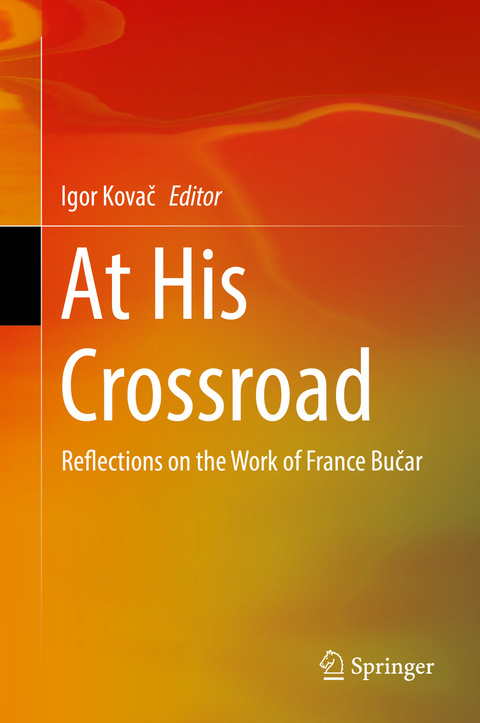
At His Crossroad (eBook)
XXIV, 170 Seiten
Springer International Publishing (Verlag)
978-3-319-78331-4 (ISBN)
This book is a translation and celebration of Slovenian politician France Bučar's seminal work. Divided into two parts, the book first contains several studies of Bučar's arguments. As Bučar applied his system theory to a variety of issues, so too the conglomerate of scholars and issues critically assessed is interdisciplinary, ranging from political science and economics, to law and philosophy, as well as to natural sciences. The contributors and the questions of their essays in the edited volume are as follows. Peter Verovsek (University of Sheffield) examines different branches of Critical Theory and classifies Bučar within them. Mark Hamilton (Inter-American Defense College) discusses system dynamics of Bučar's system theory. Urška Velikonja (Georgetown University) applies Bučar's system theory to the question of the ethics, rules, and regulations in financial economics. Finally, Matej Drev (Georgia Institute of Technology) connects Bučar to the issue of artificial intelligence and inequality.
The second part is the English translation of Bučar's book At A New Crossroads, which addresses the role of ethics in society. Bučar normatively redefines national identity as the crux of his novel understanding of ethics. Using system theory, he addresses the problems of globalization and governance, presenting a post-modern synthesis of the logic of free flow of capital and global citizenship, with national and cultural identity. Speaking to contemporary society, he shows how society and ethical life are reproduced. Bučar provides the reader with new tools to think about national identity and global politics.
Bringing an important work on ethics, government, and identity to an entirely new readership, this book will appeal to a broad academic audience, namely students and practitioners in the fields of economics, social sciences, and humanities.
Igor Kovač is a Ph.D. candidate at the University of Cincinnati. His dissertation develops a new theory of persistence imbalance of power - Pervasive Hegemony. Kovač received his MAIS at Diplomatic Academy of Vienna in 2012. Moreover, in 2010 he also received a MS in Sport Science from University of Ljubljana. His research projects are tied to security studies, grand strategy, power, geopolitics, political economy, intelligence, and cybersecurity.
Prof. France Bucar was born on 2 February 1923 in Bohinjska Bistrica, Slovenia. Being one of the six children of a local shoemaker, the local priest recognized his wit and persuaded the family to send him to Ljubljana to attend the elite Catholic classical college. When he enrolled to study law, the Second World War broke out and Bucar was first arrested by the Fascist occupiers and spend several years in concentration camp in Gonars. While on a train to another concentration camp in Germany, he escaped in 1944 and joined the partisans. After the war, he completed his law studies and became Secretary of the Republican Chamber in the Assembly of Slovenia. In 1959 he was awarded the Eisenhower fellowship and in 1963 became professor at the University of Ljubljana's law school. He was banned from lecturing in 1976 and in 1978 dismissed from the University due to criticism of the social-political situation in Yugoslavia. He worked as a dissident, writing against Marxist and Leninist narratives, emphasizing ethics as a main feedback loop in his system. In 1988 he wrote an article where he outlined the plan for Slovenian independence and on the first free elections in Slovenia, in 1990, he became member and after also president of the Slovenian parliament. He wrote the Slovenian constitution and in 1991 declared the independence of his country. He continued to be socially active as the president of an NGO - Slovenian Paneuropean movement - until 2012. He passed away on 21 October 2015.
Igor Kovač is a Ph.D. candidate at the University of Cincinnati. His dissertation develops a new theory of persistence imbalance of power – Pervasive Hegemony. Kovač received his MAIS at Diplomatic Academy of Vienna in 2012. Moreover, in 2010 he also received a MS in Sport Science from University of Ljubljana. His research projects are tied to security studies, grand strategy, power, geopolitics, political economy, intelligence, and cybersecurity.Prof. France Bucar was born on 2 February 1923 in Bohinjska Bistrica, Slovenia. Being one of the six children of a local shoemaker, the local priest recognized his wit and persuaded the family to send him to Ljubljana to attend the elite Catholic classical college. When he enrolled to study law, the Second World War broke out and Bucar was first arrested by the Fascist occupiers and spend several years in concentration camp in Gonars. While on a train to another concentration camp in Germany, he escaped in 1944 and joined the partisans. After the war, he completed his law studies and became Secretary of the Republican Chamber in the Assembly of Slovenia. In 1959 he was awarded the Eisenhower fellowship and in 1963 became professor at the University of Ljubljana’s law school. He was banned from lecturing in 1976 and in 1978 dismissed from the University due to criticism of the social-political situation in Yugoslavia. He worked as a dissident, writing against Marxist and Leninist narratives, emphasizing ethics as a main feedback loop in his system. In 1988 he wrote an article where he outlined the plan for Slovenian independence and on the first free elections in Slovenia, in 1990, he became member and after also president of the Slovenian parliament. He wrote the Slovenian constitution and in 1991 declared the independence of his country. He continued to be socially active as the president of an NGO – Slovenian Paneuropean movement – until 2012. He passed away on 21 October 2015.
Introduction.- Chapter 1: Prosperity.- Chapter 2: Contemporary Ethics.- Chapter 3: Intolerance.- Chapter 4: Reality and Illusion of Democracy.- Chapter 5: States in the Hands of Oligarchy.- Chapter 6: The Hand of Politics over Production.- Chapter 7: The State As Partner.- Chapter 8: The New Position of Wage Labor.
| Erscheint lt. Verlag | 15.6.2018 |
|---|---|
| Zusatzinfo | XXIV, 170 p. 2 illus. in color. |
| Verlagsort | Cham |
| Sprache | englisch |
| Themenwelt | Geisteswissenschaften ► Philosophie ► Ethik |
| Sozialwissenschaften ► Politik / Verwaltung ► Politische Theorie | |
| Sozialwissenschaften ► Politik / Verwaltung ► Staat / Verwaltung | |
| Schlagworte | Bucar • communism • Development • Economics • ethics • Identity • Positivism • Social Order |
| ISBN-10 | 3-319-78331-9 / 3319783319 |
| ISBN-13 | 978-3-319-78331-4 / 9783319783314 |
| Informationen gemäß Produktsicherheitsverordnung (GPSR) | |
| Haben Sie eine Frage zum Produkt? |
 PDF (Wasserzeichen)
DRM: Digitales Wasserzeichen
Dieses eBook enthält ein digitales Wasserzeichen und ist damit für Sie personalisiert. Bei einer missbräuchlichen Weitergabe des eBooks an Dritte ist eine Rückverfolgung an die Quelle möglich.
Dateiformat: PDF (Portable Document Format)
Mit einem festen Seitenlayout eignet sich die PDF besonders für Fachbücher mit Spalten, Tabellen und Abbildungen. Eine PDF kann auf fast allen Geräten angezeigt werden, ist aber für kleine Displays (Smartphone, eReader) nur eingeschränkt geeignet.
Systemvoraussetzungen:
PC/Mac: Mit einem PC oder Mac können Sie dieses eBook lesen. Sie benötigen dafür einen PDF-Viewer - z.B. den Adobe Reader oder Adobe Digital Editions.
eReader: Dieses eBook kann mit (fast) allen eBook-Readern gelesen werden. Mit dem amazon-Kindle ist es aber nicht kompatibel.
Smartphone/Tablet: Egal ob Apple oder Android, dieses eBook können Sie lesen. Sie benötigen dafür einen PDF-Viewer - z.B. die kostenlose Adobe Digital Editions-App.
Buying eBooks from abroad
For tax law reasons we can sell eBooks just within Germany and Switzerland. Regrettably we cannot fulfill eBook-orders from other countries.
aus dem Bereich