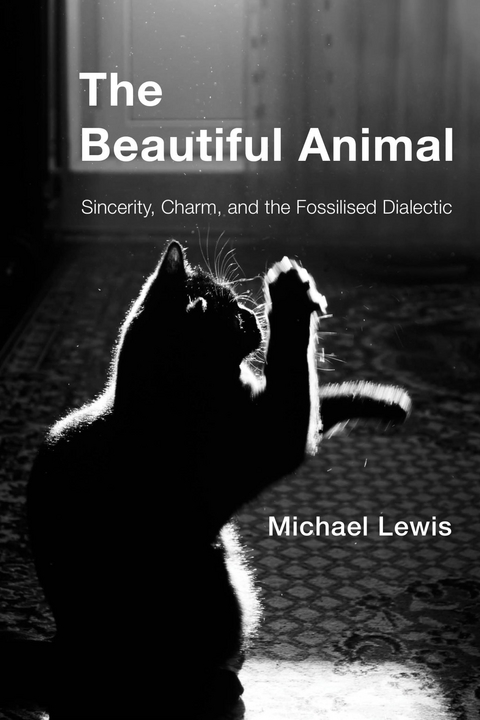
Beautiful Animal (eBook)
226 Seiten
Rowman & Littlefield International (Verlag)
978-1-78660-756-0 (ISBN)
Can philosophy conceive of a perfect animal? Can it think of the animal as anything other than an imperfect human? The book attempts to rethink the Hegelian dialectic so as to render it capable of assigning a proper place to the animal, and in particular the beautiful animal, and to rework the philosophy of nature so as to encompass the fossil. The fossil itself teaches philosophy and in particular the dialectic how it must modify itself in order to encompass the beautiful animal, in the form of what we term the fossilised dialectic, resistant to the spiritualisation which will always leave the animal behind.If philosophy can admit the animal in this way, we might then ask what philosophy can learn from this animal that will have taken up residence in its home? What does a specifically domestic animal teach us? At the very least, it shows us that the function we give to the furnishings of the house is not the only one and perhaps therefore that there is no single unique function. In this way, animals teach us the most philosophical lesson there is: to see the world as it is in itself.
lt;span>Michael Lewis is the author of Heidegger and the Place of Ethics (Bloomsbury), Heidegger beyond Deconstruction: On Nature (Bloomsbury), Derrida and Lacan: Another Writing (Edinburgh University Press), and (with Tanja Staehler), Phenomenology: An Introduction (Bloomsbury), along with articles on Agamben, Bataille, Derrida, Esposito, Lacan, Stiegler, and Žižek among others. Educated in Philosophy at the Universities of Warwick and Essex, he has taught philosophy, film, psychoanalysis, and philosophical anthropology at the University of Sussex (2007–9, 2011), University of Warwick (2010), and the University of the West of England (2011–15). He currently teaches philosophy at the University of Newcastle Upon Tyne.
Introduction / Chapter I The Animal’s Sincerity: Wittgenstein, Levinas, Lacan / Chapter II — Kant and the Animal’s Charm / Chapter III — Hegel and Nature / Chapter IV — Beauty in Nature — Hegel’s Aesthetics / Chapter V — Fossils and the Fossilisation of the Dialectic
| Erscheint lt. Verlag | 20.6.2018 |
|---|---|
| Verlagsort | London |
| Sprache | englisch |
| Themenwelt | Geisteswissenschaften ► Philosophie ► Allgemeines / Lexika |
| Geisteswissenschaften ► Philosophie ► Ethik | |
| Geisteswissenschaften ► Philosophie ► Philosophie der Neuzeit | |
| Schlagworte | Aesthetics • animal philosphy • Continental Philosophy • Critical Animal Studies • German Idealism • Hegel • Kant • Lacan • Levinas • philosophy of nature • Wittgenstein |
| ISBN-10 | 1-78660-756-5 / 1786607565 |
| ISBN-13 | 978-1-78660-756-0 / 9781786607560 |
| Informationen gemäß Produktsicherheitsverordnung (GPSR) | |
| Haben Sie eine Frage zum Produkt? |
 EPUB (Adobe DRM)
Kopierschutz: Adobe-DRM
Adobe-DRM ist ein Kopierschutz, der das eBook vor Mißbrauch schützen soll. Dabei wird das eBook bereits beim Download auf Ihre persönliche Adobe-ID autorisiert. Lesen können Sie das eBook dann nur auf den Geräten, welche ebenfalls auf Ihre Adobe-ID registriert sind.
Details zum Adobe-DRM
Dateiformat: EPUB (Electronic Publication)
EPUB ist ein offener Standard für eBooks und eignet sich besonders zur Darstellung von Belletristik und Sachbüchern. Der Fließtext wird dynamisch an die Display- und Schriftgröße angepasst. Auch für mobile Lesegeräte ist EPUB daher gut geeignet.
Systemvoraussetzungen:
PC/Mac: Mit einem PC oder Mac können Sie dieses eBook lesen. Sie benötigen eine
eReader: Dieses eBook kann mit (fast) allen eBook-Readern gelesen werden. Mit dem amazon-Kindle ist es aber nicht kompatibel.
Smartphone/Tablet: Egal ob Apple oder Android, dieses eBook können Sie lesen. Sie benötigen eine
Geräteliste und zusätzliche Hinweise
Buying eBooks from abroad
For tax law reasons we can sell eBooks just within Germany and Switzerland. Regrettably we cannot fulfill eBook-orders from other countries.
aus dem Bereich