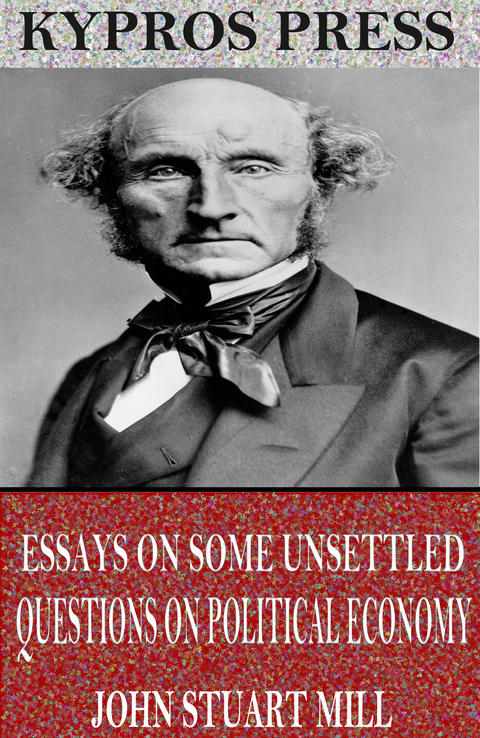
Essays on Some Unsettled Questions on Political Economy (eBook)
203 Seiten
Charles River Editors (Verlag)
978-1-5378-0500-9 (ISBN)
John Stuart Mill was a prominent English philosopher and political economist in the 19th century. Mill is considered to be one of the most influential liberal thinkers in history and he was a significant contributor to many fields such as social theory, political theory, and political economy. Mill is also notable for being the first Member of Parliament to argue in favor of women's suffrage.This is a collection of essays that Mill wrote on political economy. A table of contents is included.
ESSAY II. OF THE INFLUENCE OF CONSUMPTION ON PRODUCTION.
Before the appearance of those great writers whose discoveries have given to political economy its present comparatively scientific character, the ideas universally entertained both by theorists and by practical men, on the causes of national wealth, were grounded upon certain general views, which almost all who have given any considerable attention to the subject now justly hold to be completely erroneous.
Among the mistakes which were most pernicious in their direct consequences, and tended in the greatest degree to prevent a just conception of the objects of the science, or of the test to be applied to the solution of the questions which it presents, was the immense importance attached to consumption. The great end of legislation in matters of national wealth, according to the prevalent opinion, was to create consumers. A great and rapid consumption was what the producers, of all classes and denominations, wanted, to enrich themselves and the country. This object, under the varying names of an extensive demand, a brisk circulation, a great expenditure of money, and sometimes totidem verbis a large consumption, was conceived to be the great condition of prosperity.
It is not necessary, in the present state of the science, to contest this doctrine in the most flagrantly absurd of its forms or of its applications. The utility of a large government expenditure, for the purpose of encouraging industry, is no longer maintained. Taxes are not now esteemed to be “like the dews of heaven, which return again in prolific showers.” It is no longer supposed that you benefit the producer by taking his money, provided you give it to him again in exchange for his goods. There is nothing which impresses a person of reflection with a stronger sense of the shallowness of the political reasonings of the last two centuries, than the general reception so long given to a doctrine which, if it proves anything, proves that the more you take from the pockets of the people to spend on your own pleasures, the richer they grow; that the man who steals money out of a shop, provided he expends it all again at the same shop, is a benefactor to the tradesman whom he robs, and that the same operation, repeated sufficiently often, would make the tradesman’s fortune.
In opposition to these palpable absurdities, it was triumphantly established by political economists, that consumption never needs encouragement. All which is produced is already consumed, either for the purpose of reproduction or of enjoyment. The person who saves his income is no less a consumer than he who spends it: he consumes it in a different way; it supplies food and clothing to be consumed, tools and materials to be used, by productive labourers. Consumption, therefore, already takes place to the greatest extent which the amount of production admits of; but, of the two kinds of consumption, reproductive and unproductive, the former alone adds to the national wealth, the latter impairs it. What is consumed for mere enjoyment, is gone; what is consumed for reproduction, leaves commodities of equal value, commonly with the addition of a profit. The usual effect of the attempts of government to encourage consumption, is merely to prevent saving; that is, to promote unproductive consumption at the expense of reproductive, and diminish the national wealth by the very means which were intended to increase it.
What a country wants to make it richer, is never consumption, but production. Where there is the latter, we may be sure that there is no want of the former. To produce, implies that the producer desires to consume; why else should he give himself useless labour? He may not wish to consume what he himself produces, but his motive for producing and selling is the desire to buy. Therefore, if the producers generally produce and sell more and more, they certainly also buy more and more. Each may not want more of what he himself produces, but each wants more of what some other produces; and, by producing what the other wants, hopes to obtain what the other produces. There will never, therefore, be a greater quantity produced, of commodities in general, than there are consumers for. But there may be, and always are, abundance of persons who have the inclination to become consumers of some commodity, but are unable to satisfy their wish, because they have not the means of producing either that, or anything to give in exchange for it. The legislator, therefore, needs not give himself any concern about consumption. There will always be consumption for everything which can be produced, until the wants of all who possess the means of producing are completely satisfied, and then production will not increase any farther. The legislator has to look solely to two points: that no obstacle shall exist to prevent those who have the means of producing, from employing those means as they find most for their interest; and that those who have not at present the means of producing, to the extent of their desire to consume, shall have every facility afforded to their acquiring the means, that, becoming producers, they may be enabled to consume.
These general principles are now well understood by almost all who profess to have studied the subject, and are disputed by few except those who ostentatiously proclaim their contempt for such studies. We touch upon the question, not in the hope of rendering these fundamental truths clearer than they already are, but to perform a task, so useful and needful, that it is to be wished it were oftener deemed part of the business of those who direct their assaults against ancient prejudices,—that of seeing that no scattered particles of important truth are buried and lost in the ruins of exploded error. Every prejudice, which has long and extensively prevailed among the educated and intelligent, must certainly be borne out by some strong appearance of evidence; and when it is found that the evidence does not prove the received conclusion, it is of the highest importance to see what it does prove. If this be thought not worth inquiring into, an error conformable to appearances is often merely exchanged for an error contrary to appearances; while, even if the result be truth, it is paradoxical truth, and will have difficulty in obtaining credence while the false appearances remain.
Let us therefore inquire into the nature of the appearances, which gave rise to the belief that a great demand, a brisk circulation, a rapid consumption (three equivalent expressions), are a cause of national prosperity.
If every man produced for himself, or with his capital employed others to produce, everything which he required, customers and their wants would be a matter of profound indifference to him. He would be rich, if he had produced and stored up a large supply of the articles which he was likely to require; and poor, if he had stored up none at all, or not enough to last until he could produce more.
The case, however, is different after the separation of employments. In civilized society, a single producer confines himself to the production of one commodity, or a small number of commodities; and his affluence depends, not solely upon the quantity of his commodity which he has produced and laid in store, but upon his success in finding purchasers for that commodity.
It is true, therefore, of every particular producer or dealer, that a great demand, a brisk circulation, a rapid consumption, of the commodities which he sells at his shop or produces in his manufactory, is important to him. The dealer whose shop is crowded with customers, who can dispose of a product almost the very moment it is completed, makes large profits, while his next neighbour, with an equal capital but fewer customers, gains comparatively little.
It was natural that, in this case, as in a hundred others, the analogy of an individual should be unduly applied to a nation: as it has been concluded that a nation generally gains in wealth by the conquest of a province, because an individual frequently does so by the acquisition of an estate; and as, because an individual estimates his riches by the quantity of money which he can command, it was long deemed an excellent contrivance for enriching a country, to heap up artificially the greatest possible quantity of the precious metals within it.
Let us examine, then, more closely than has usually been done, the case from which the misleading analogy is drawn. Let us ascertain to what extent the two cases actually resemble; what is the explanation of the false appearance, and the real nature of the phenomenon which, being seen indistinctly, has led to a false conclusion.
We shall propose for examination a very simple case, but the explanation of which will suffice to clear up all other cases which fall within the same principle. Suppose that a number of foreigners with large incomes arrive in a country, and there expend those incomes: will this operation be beneficial, as respects the national wealth, to the country which receives these immigrants? Yes, say many political economists, if they save any part of their incomes, and employ them reproductively; because then an addition is made to the national capital, and the produce is a clear increase of the national wealth. But if the foreigner expends all his income unproductively, it is no benefit to the country, say they, and for the following reason.
If the foreigner had his income remitted to him in bread and beef, coats and shoes, and all the other articles which he was desirous to consume, it would not be pretended that his eating, drinking, and wearing them, on our shores rather than on...
| Erscheint lt. Verlag | 22.3.2018 |
|---|---|
| Sprache | englisch |
| Themenwelt | Geisteswissenschaften ► Philosophie ► Allgemeines / Lexika |
| Schlagworte | British • Classic • English • Historical • On Liberty • Philosophy • Political • Subjection of Women • women suffrage |
| ISBN-10 | 1-5378-0500-2 / 1537805002 |
| ISBN-13 | 978-1-5378-0500-9 / 9781537805009 |
| Informationen gemäß Produktsicherheitsverordnung (GPSR) | |
| Haben Sie eine Frage zum Produkt? |
 EPUB (Adobe DRM)
Größe: 1,1 MB
Kopierschutz: Adobe-DRM
Adobe-DRM ist ein Kopierschutz, der das eBook vor Mißbrauch schützen soll. Dabei wird das eBook bereits beim Download auf Ihre persönliche Adobe-ID autorisiert. Lesen können Sie das eBook dann nur auf den Geräten, welche ebenfalls auf Ihre Adobe-ID registriert sind.
Details zum Adobe-DRM
Dateiformat: EPUB (Electronic Publication)
EPUB ist ein offener Standard für eBooks und eignet sich besonders zur Darstellung von Belletristik und Sachbüchern. Der Fließtext wird dynamisch an die Display- und Schriftgröße angepasst. Auch für mobile Lesegeräte ist EPUB daher gut geeignet.
Systemvoraussetzungen:
PC/Mac: Mit einem PC oder Mac können Sie dieses eBook lesen. Sie benötigen eine
eReader: Dieses eBook kann mit (fast) allen eBook-Readern gelesen werden. Mit dem amazon-Kindle ist es aber nicht kompatibel.
Smartphone/Tablet: Egal ob Apple oder Android, dieses eBook können Sie lesen. Sie benötigen eine
Geräteliste und zusätzliche Hinweise
Buying eBooks from abroad
For tax law reasons we can sell eBooks just within Germany and Switzerland. Regrettably we cannot fulfill eBook-orders from other countries.
EPUB (Ohne DRM)Digital Rights Management: ohne DRM
Dieses eBook enthält kein DRM oder Kopierschutz. Eine Weitergabe an Dritte ist jedoch rechtlich nicht zulässig, weil Sie beim Kauf nur die Rechte an der persönlichen Nutzung erwerben.
Dateiformat: EPUB (Electronic Publication)
EPUB ist ein offener Standard für eBooks und eignet sich besonders zur Darstellung von Belletristik und Sachbüchern. Der Fließtext wird dynamisch an die Display- und Schriftgröße angepasst. Auch für mobile Lesegeräte ist EPUB daher gut geeignet.
Systemvoraussetzungen:
PC/Mac: Mit einem PC oder Mac können Sie dieses eBook lesen. Sie benötigen dafür die kostenlose Software Adobe Digital Editions.
eReader: Dieses eBook kann mit (fast) allen eBook-Readern gelesen werden. Mit dem amazon-Kindle ist es aber nicht kompatibel.
Smartphone/Tablet: Egal ob Apple oder Android, dieses eBook können Sie lesen. Sie benötigen dafür eine kostenlose App.
Geräteliste und zusätzliche Hinweise
Buying eBooks from abroad
For tax law reasons we can sell eBooks just within Germany and Switzerland. Regrettably we cannot fulfill eBook-orders from other countries.
aus dem Bereich