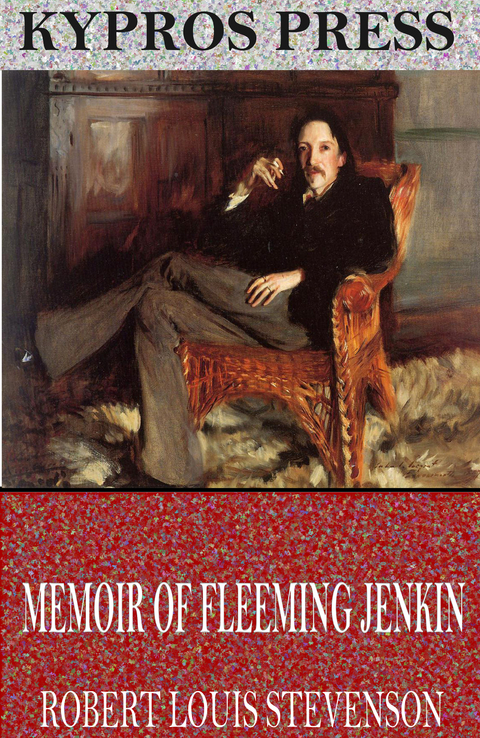
Memoir of Fleeming Jenkin (eBook)
232 Seiten
Charles River Editors (Verlag)
978-1-5312-8799-3 (ISBN)
Robert Louis Stevenson was a Scottish author who is considered to be one of the greatest writers of the nineteenth century. With classics such as Treasure Island, Kidnapped, and The Strange Case of Dr. Jekyll and Mr. Hyde, Stevenson is still one of the most widely read authors today. This edition of Memoir of Fleeming Jenkin includes a table of contents.
CHAPTER II. 1833-1851.
Birth and Childhood — Edinburgh — Frankfort-on-the-Main — Paris — The Revolution of 1848 — The Insurrection — Flight to Italy — Sympathy with Italy — The Insurrection in Genoa — A Student in Genoa — The Lad and his Mother.
Henry Charles Fleeming Jenkin (Fleeming, pronounced Flemming, to his friends and family) was born in a Government building on the coast of Kent, near Dungeness, where his father was serving at the time in the Coastguard, on March 25, 1833, and named after Admiral Fleeming, one of his father’s protectors in the navy.
His childhood was vagrant like his life. Once he was left in the care of his grandmother Jackson, while Mrs. Jenkin sailed in her husband’s ship and stayed a year at the Havannah. The tragic woman was besides from time to time a member of the family she was in distress of mind and reduced in fortune by the misconduct of her sons; her destitution and solitude made it a recurring duty to receive her, her violence continually enforced fresh separations. In her passion of a disappointed mother, she was a fit object of pity; but her grandson, who heard her load his own mother with cruel insults and reproaches, conceived for her an indignant and impatient hatred, for which he blamed himself in later life. It is strange from this point of view to see his childish letters to Mrs. Jackson; and to think that a man, distinguished above all by stubborn truthfulness, should have been brought up to such dissimulation. But this is of course unavoidable in life; it did no harm to Jenkin; and whether he got harm or benefit from a so early acquaintance with violent and hateful scenes, is more than I can guess. The experience, at least, was formative; and in judging his character it should not be forgotten. But Mrs. Jackson was not the only stranger in their gates; the Captain’s sister, Aunt Anna Jenkin, lived with them until her death; she had all the Jenkin beauty of countenance, though she was unhappily deformed in body and of frail health; and she even excelled her gentle and ineffectual family in all amiable qualities. So that each of the two races from which Fleeming sprang, had an outpost by his very cradle; the one he instinctively loved, the other hated; and the life-long war in his members had begun thus early by a victory for what was best.
We can trace the family from one country place to another in the south of Scotland; where the child learned his taste for sport by riding home the pony from the moors. Before he was nine he could write such a passage as this about a Hallowe’en observance: ‘I pulled a middling-sized cabbage-runt with a pretty sum of gold about it. No witches would run after me when I was sowing my hempseed this year; my nuts blazed away together very comfortably to the end of their lives, and when mamma put hers in which were meant for herself and papa they blazed away in the like manner.’ Before he was ten he could write, with a really irritating precocity, that he had been ‘making some pictures from a book called “Les Francais peints par euxmemes.” . . . It is full of pictures of all classes, with a description of each in French. The pictures are a little caricatured, but not much.’ Doubtless this was only an echo from his mother, but it shows the atmosphere in which he breathed. It must have been a good change for this art critic to be the playmate of Mary Macdonald, their gardener’s daughter at Barjarg, and to sup with her family on potatoes and milk; and Fleeming himself attached some value to this early and friendly experience of another class.
His education, in the formal sense, began at Jedburgh. Thence he went to the Edinburgh Academy, where he was the classmate of Tait and Clerk Maxwell, bore away many prizes, and was once unjustly flogged by Rector Williams. He used to insist that all his bad schoolfellows had died early, a belief amusingly characteristic of the man’s consistent optimism. In 1846 the mother and son proceeded to Frankfort-on-the-Main, where they were soon joined by the father, now reduced to inaction and to play something like third fiddle in his narrow household. The emancipation of the slaves had deprived them of their last resource beyond the half-pay of a captain; and life abroad was not only desirable for the sake of Fleeming’s education, it was almost enforced by reasons of economy. But it was, no doubt, somewhat hard upon the captain. Certainly that perennial boy found a companion in his son; they were both active and eager, both willing to be amused, both young, if not in years, then in character. They went out together on excursions and sketched old castles, sitting side by side; they had an angry rivalry in walking, doubtless equally sincere upon both sides; and indeed we may say that Fleeming was exceptionally favoured, and that no boy had ever a companion more innocent, engaging, gay, and airy. But although in this case it would be easy to exaggerate its import, yet, in the Jenkin family also, the tragedy of the generations was proceeding, and the child was growing out of his father’s knowledge. His artistic aptitude was of a different order. Already he had his quick sight of many sides of life; he already overflowed with distinctions and generalisations, contrasting the dramatic art and national character of England, Germany, Italy, and France. If he were dull, he would write stories and poems. ‘I have written,’ he says at thirteen, ‘a very long story in heroic measure, 300 lines, and another Scotch story and innumerable bits of poetry’; and at the same age he had not only a keen feeling for scenery, but could do something with his pen to call it up. I feel I do always less than justice to the delightful memory of Captain Jenkin; but with a lad of this character, cutting the teeth of his intelligence, he was sure to fall into the background.
The family removed in 1847 to Paris, where Fleeming was put to school under one Deluc. There he learned French, and (if the captain is right) first began to show a taste for mathematics. But a far more important teacher than Deluc was at hand; the year 1848, so momentous for Europe, was momentous also for Fleeming’s character. The family politics were Liberal; Mrs. Jenkin, generous before all things, was sure to be upon the side of exiles; and in the house of a Paris friend of hers, Mrs. Turner — already known to fame as Shelley’s Cornelia de Boinville — Fleeming saw and heard such men as Manin, Gioberti, and the Ruffinis. He was thus prepared to sympathise with revolution; and when the hour came, and he found himself in the midst of stirring and influential events, the lad’s whole character was moved. He corresponded at that time with a young Edinburgh friend, one Frank Scott; and I am here going to draw somewhat largely on this boyish correspondence. It gives us at once a picture of the Revolution and a portrait of Jenkin at fifteen; not so different (his friends will think) from the Jenkin of the end — boyish, simple, opinionated, delighting in action, delighting before all things in any generous sentiment.
‘February 23, 1848.
‘When at 7 o’clock today I went out, I met a large band going round the streets, calling on the inhabitants to illuminate their houses, and bearing torches. This was all very good fun, and everybody was delighted; but as they stopped rather long and were rather turbulent in the Place de la Madeleine, near where we live’ [in the Rue Caumartin] ‘a squadron of dragoons came up, formed, and charged at a hand-gallop. This was a very pretty sight; the crowd was not too thick, so they easily got away; and the dragoons only gave blows with the back of the sword, which hurt but did not wound. I was as close to them as I am now to the other side of the table; it was rather impressive, however. At the second charge they rode on the pavement and knocked the torches out of the fellows’ hands; rather a shame, too — wouldn’t be stood in England . . . .
[At] ‘ten minutes to ten . . . I went a long way along the Boulevards, passing by the office of Foreign Affairs, where Guizot lives, and where to-night there were about a thousand troops protecting him from the fury of the populace. After this was passed, the number of the people thickened, till about half a mile further on, I met a troop of vagabonds, the wildest vagabonds in the world — Paris vagabonds, well armed, having probably broken into gunsmiths’ shops and taken the guns and swords. They were about a hundred. These were followed by about a thousand (I am rather diminishing than exaggerating numbers all through), indifferently armed with rusty sabres, sticks, etc. An uncountable troop of gentlemen, workmen, shopkeepers’ wives (Paris women dare anything), ladies’ maids, common women — in fact, a crowd of all classes, though by far the greater number were of the better dressed class — followed. Indeed, it was a splendid sight: the mob in front chanting the “Marseillaise,” the national war hymn, grave and powerful, sweetened by the night air — though night in these splendid streets was turned into day, every window was filled with lamps, dim torches were tossing in the crowd . . . for Guizot has late this night given in his resignation, and this was an improvised illumination.
‘I and my father had turned with the crowd, and were close behind the second troop of vagabonds. Joy was on every face. I remarked to papa that “I would not have missed the scene for anything, I might never see such a splendid...
| Erscheint lt. Verlag | 22.3.2018 |
|---|---|
| Sprache | englisch |
| Themenwelt | Literatur ► Essays / Feuilleton |
| Literatur ► Romane / Erzählungen | |
| Geisteswissenschaften ► Sprach- / Literaturwissenschaft ► Literaturwissenschaft | |
| Schlagworte | Adventure • Catriona • Classic • Historical • Kidnapped • Romantic • Scottish • Travel • Treasure Island |
| ISBN-10 | 1-5312-8799-9 / 1531287999 |
| ISBN-13 | 978-1-5312-8799-3 / 9781531287993 |
| Informationen gemäß Produktsicherheitsverordnung (GPSR) | |
| Haben Sie eine Frage zum Produkt? |
 EPUB (Adobe DRM)
Größe: 1,2 MB
Kopierschutz: Adobe-DRM
Adobe-DRM ist ein Kopierschutz, der das eBook vor Mißbrauch schützen soll. Dabei wird das eBook bereits beim Download auf Ihre persönliche Adobe-ID autorisiert. Lesen können Sie das eBook dann nur auf den Geräten, welche ebenfalls auf Ihre Adobe-ID registriert sind.
Details zum Adobe-DRM
Dateiformat: EPUB (Electronic Publication)
EPUB ist ein offener Standard für eBooks und eignet sich besonders zur Darstellung von Belletristik und Sachbüchern. Der Fließtext wird dynamisch an die Display- und Schriftgröße angepasst. Auch für mobile Lesegeräte ist EPUB daher gut geeignet.
Systemvoraussetzungen:
PC/Mac: Mit einem PC oder Mac können Sie dieses eBook lesen. Sie benötigen eine
eReader: Dieses eBook kann mit (fast) allen eBook-Readern gelesen werden. Mit dem amazon-Kindle ist es aber nicht kompatibel.
Smartphone/Tablet: Egal ob Apple oder Android, dieses eBook können Sie lesen. Sie benötigen eine
Geräteliste und zusätzliche Hinweise
Buying eBooks from abroad
For tax law reasons we can sell eBooks just within Germany and Switzerland. Regrettably we cannot fulfill eBook-orders from other countries.
EPUB (Ohne DRM)Digital Rights Management: ohne DRM
Dieses eBook enthält kein DRM oder Kopierschutz. Eine Weitergabe an Dritte ist jedoch rechtlich nicht zulässig, weil Sie beim Kauf nur die Rechte an der persönlichen Nutzung erwerben.
Dateiformat: EPUB (Electronic Publication)
EPUB ist ein offener Standard für eBooks und eignet sich besonders zur Darstellung von Belletristik und Sachbüchern. Der Fließtext wird dynamisch an die Display- und Schriftgröße angepasst. Auch für mobile Lesegeräte ist EPUB daher gut geeignet.
Systemvoraussetzungen:
PC/Mac: Mit einem PC oder Mac können Sie dieses eBook lesen. Sie benötigen dafür die kostenlose Software Adobe Digital Editions.
eReader: Dieses eBook kann mit (fast) allen eBook-Readern gelesen werden. Mit dem amazon-Kindle ist es aber nicht kompatibel.
Smartphone/Tablet: Egal ob Apple oder Android, dieses eBook können Sie lesen. Sie benötigen dafür eine kostenlose App.
Geräteliste und zusätzliche Hinweise
Buying eBooks from abroad
For tax law reasons we can sell eBooks just within Germany and Switzerland. Regrettably we cannot fulfill eBook-orders from other countries.
aus dem Bereich