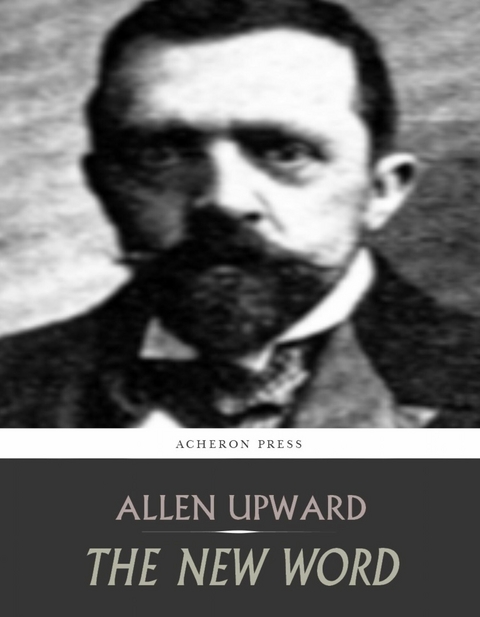
Allen Upward was an author of Welsh descent. The New Word, for which Upward hoped to win a Nobel Prize, was published in 1910.
SECOND HEAD. THE PERSONAL EQUATION
Descartes and the Sorbonne.—1. Useless Literature.—2.—A Personal Explanation.—3. The Blockade of the Schoolmasters.—4. Scientific Philosophy.—5. Truth and Verihood.—6. The White Mind.
AS the astronomer, in order to tell fairly the time kept by a star in heaven, must first record the time taken by his own thought, and thereby correct his reckoning; and as Descartes did not deem it beside the purpose to tell the Sorbonne that he was in his dressing-gown when he sat down to prove the existence of God; so it will not be vain for me to describe with what bias I approached my present task.
I
An eloquent writer upon Art, in a work called The Seven Lamps of Architecture, has chosen Truth to be his second Lamp, and thereby shown that it was not his first wish to tell the truth about architecture. Accordingly it is no surprise to see him begin by defining architecture as useless building, and end, in a preface written long afterwards, by complaining that this very book had proved useless for its purpose. For if architecture be useless building, literature must be useless writing. It is significant, and it will not be found beside the question, that neither in this book, nor in other books treating of Gothic architecture, is there the least allusion to the architecture of the Goths. The origin of the Gothic church, like the origin of everything else in Europe, has been sought on the shores of the Mediterranean Sea. No one has asked why the Italian masons, when they crossed the Alps, as they are still crossing them to-day, in search of work, left off building like the Romans, and began building otherwise. No one seems to know that the Gothic church, in its essential features, features that have been copied in St. Peter’s, is a copy of the Gothic hall as it was built in Iceland in the days of Charlemagne, and as it was built in Gothland in the days of Herod.
To say that truth had been my first lamp in this inquiry would be only to say that I was a Gothic writer, or, as men write it in my native land, a Jute. I have approached the word Idealist in the spirit of a Goth seeking to understand a Mediterranean word. I have approached it in the spirit of a child seeking to understand a schoolmaster’s word. I have been like a sleeper, waking out of an enchanted sleep, and seeking to understand an enchanter’s word.
My first, and, to the best of my endeavour, my only, light in this inquiry has been the light of verihood.
II
The foreword of this Letter was really written thirty years ago, when a mere schoolboy, hardly knowing what he did, chose Truth as being for him the one sacred Name. Afterwards, when I had read the book in which Darwin reminded us clearly of a fact dimly familiar to our forefathers, I laid it down with the reflection that most other books would have to be re-written in the light of that forgotten fact.—The question was how to begin.
I spent the next twenty years in exploring the human mind as it is revealed in literature, and as it is revealed in life. I have not passed the time shut up in libraries. I have been a speaker and a writer; I have been a lawyer and a soldier; I have been a ruler and a judge. I have taught children, and learned from them. I have talked with the learned in their colleges, and talked with the Black men in their own land beside the Black River, in the oldest and most catholic speech, the language of Signs. In a place where no White man had been before me, I found a Black king and his folk withheld by an old curse from planting a medicinal tree; and I broke the curse by showing to them a stone whereon a Greek of long ago had carved the figure of his God.—In such ways I have learned somewhat of the nature of words.
At the same time I have learned somewhat of the feelings that words express, and found the same feeling underlying many different words; as if all men, in all ages, and in all lands, were trying to say much the same thing. And hardly knowing whether I had found anything worth saying, nor how far the words that were right for me would be right for others, I doubted whether I should speak.
In our time there are many honourable men and women who share my doubt. They have been put to sleep in childhood with certain words, most true and beautiful to those who spoke them first; and they have awakened out of that sleep with great pain, and as those who are bereft of hope. Now such a man as I speak of, a Materialist, came to me one day, and told me he had been consulted by a mother, who was also a Materialist, about the education of her child, a child who will one day occupy a great place in the world, and influence the lives of many other children. And, both being Materialists, he had given her the advice, and she had taken it, that the child’s mind should be put to sleep by the words which they themselves both believed to be untrue.
The following day I found in the organ of my trades-union as an author the announcement of Nobel’s Testament.
On reading the Fourth Bequest my first reflection was the sad one that such a Trust was not likely to be carried out. Then I asked myself why? What books did the Testator wish to be written; why were they not being written; and why, if they should be written, must they nevertheless fail of their reward? The answer seemed to lie in the meaning of the word Idealist.—What was its meaning? or rather what was its meaning for other minds than my own?—I turned to the dictionary; what I found led me further; I began to make notes, and presently saw they were the book I had waited for so long to begin.
The natural shape of this inquiry, therefore, is that of a train of thought, and I have not striven to give it any other. As, when the chemical salts are held in solution in the glass, the introduction of some foreign body will cause them to encircle it with crystals, so have the floating thoughts of half a lifetime come together in answer to a single question, and settled into shape.
III
Literature, from the lyric’s pure cry of pain or joy down to the pill-seller’s advertisement, is a communication. There is a personal equation of the reader as well as of the writer, and the fairest language is a bargain between two minds. The counsel’s speech to the jury is not as his speech to the judge. The greatest of playwrights has written for the gallery as well as for the boxes.
It is the second equation in which the difficulty lies. It is that equation the thought of which caused the perfect Idealist to condemn speech. It is that which stands in the way of Nobel’s Fourth Bequest.
My gallery is a gallery of judges; by which I mean that I speak in the hearing of those with whom I am called on to quarrel, whose minds are so much fixed on their own study as to be unable to think freely about that or any other. The ontologist claims all the provinces of knowledge as his fatherland, and he is treated as a trespasser in each. On every frontier the specialist with his fixed bayonet keeps watch and ward, as though he dreaded to give or to receive. The free trader in knowledge bears the smuggler’s brand. But it once made my holiday to take food through the midst of six great navies to starving men on a Mediterranean isle; and shall I now fear to run the blockade of the schoolmasters, if I believe they are keeping children from the bread of life?
The man of letters will need no explanation of why I have found the dogma of philology to be the devil’s leading counsel in this debate. To the philologist, whose history—for I cannot yet call it science—has helped and hindered me by turns, I owe an honourable salute before the foils are crossed.
The sciences fall roughly into two groups, according to whether they come before or after man. The human sciences begin with folk-lore, and Darwin’s book has given them a natural starting-point. The anthropologist holds the key to the position, and without his light all other students of the arts of man are wandering at random in the dark, and letting themselves be thwarted needlessly.
In his broad-minded treatise on the Kalevala, Comparetti has brought together much learning to elucidate the name and nature of the Sampa, the mystic lucky-box whose making and carrying off are main links in the poem. But the Sampa contains no puzzle for the folk-learner. There is just such a lucky-box in every West African hut. The serious-minded Black would no more think of setting up house without it than the Christian without his family Bible, or the scientist without his drain. You can buy a Sampa at any wizard’s for a few cowrie-shells. The wizard makes it while you wait. He takes a bit of clay, and a feather, and a twig of straw, and whatever else strikes his fancy, and sticks them together in a calabash; and the householder puts it in his house to conjure away the spirits of misfortune and disease—one of whom science has now identified with the anopheles mosquito. That is the Sampa, and it is a prayer, written in the old magic letters which the spirits, or the mosquitoes, are most likely to understand; a language in which the wizard is a specialist,—and the philologist not even a...
| Erscheint lt. Verlag | 22.3.2018 |
|---|---|
| Sprache | englisch |
| Themenwelt | Geisteswissenschaften ► Philosophie ► Allgemeines / Lexika |
| Schlagworte | Free • New Age • Nobel prize • Ralph Waldo Trine |
| ISBN-10 | 1-61430-854-3 / 1614308543 |
| ISBN-13 | 978-1-61430-854-6 / 9781614308546 |
| Informationen gemäß Produktsicherheitsverordnung (GPSR) | |
| Haben Sie eine Frage zum Produkt? |
 EPUB (Adobe DRM)
Größe: 622 KB
Kopierschutz: Adobe-DRM
Adobe-DRM ist ein Kopierschutz, der das eBook vor Mißbrauch schützen soll. Dabei wird das eBook bereits beim Download auf Ihre persönliche Adobe-ID autorisiert. Lesen können Sie das eBook dann nur auf den Geräten, welche ebenfalls auf Ihre Adobe-ID registriert sind.
Details zum Adobe-DRM
Dateiformat: EPUB (Electronic Publication)
EPUB ist ein offener Standard für eBooks und eignet sich besonders zur Darstellung von Belletristik und Sachbüchern. Der Fließtext wird dynamisch an die Display- und Schriftgröße angepasst. Auch für mobile Lesegeräte ist EPUB daher gut geeignet.
Systemvoraussetzungen:
PC/Mac: Mit einem PC oder Mac können Sie dieses eBook lesen. Sie benötigen eine
eReader: Dieses eBook kann mit (fast) allen eBook-Readern gelesen werden. Mit dem amazon-Kindle ist es aber nicht kompatibel.
Smartphone/Tablet: Egal ob Apple oder Android, dieses eBook können Sie lesen. Sie benötigen eine
Geräteliste und zusätzliche Hinweise
Buying eBooks from abroad
For tax law reasons we can sell eBooks just within Germany and Switzerland. Regrettably we cannot fulfill eBook-orders from other countries.
EPUB (Ohne DRM)Digital Rights Management: ohne DRM
Dieses eBook enthält kein DRM oder Kopierschutz. Eine Weitergabe an Dritte ist jedoch rechtlich nicht zulässig, weil Sie beim Kauf nur die Rechte an der persönlichen Nutzung erwerben.
Dateiformat: EPUB (Electronic Publication)
EPUB ist ein offener Standard für eBooks und eignet sich besonders zur Darstellung von Belletristik und Sachbüchern. Der Fließtext wird dynamisch an die Display- und Schriftgröße angepasst. Auch für mobile Lesegeräte ist EPUB daher gut geeignet.
Systemvoraussetzungen:
PC/Mac: Mit einem PC oder Mac können Sie dieses eBook lesen. Sie benötigen dafür die kostenlose Software Adobe Digital Editions.
eReader: Dieses eBook kann mit (fast) allen eBook-Readern gelesen werden. Mit dem amazon-Kindle ist es aber nicht kompatibel.
Smartphone/Tablet: Egal ob Apple oder Android, dieses eBook können Sie lesen. Sie benötigen dafür eine kostenlose App.
Geräteliste und zusätzliche Hinweise
Buying eBooks from abroad
For tax law reasons we can sell eBooks just within Germany and Switzerland. Regrettably we cannot fulfill eBook-orders from other countries.
aus dem Bereich