Our Knowledge of the External World (eBook)
287 Seiten
Charles River Editors (Verlag)
978-1-5378-2120-7 (ISBN)
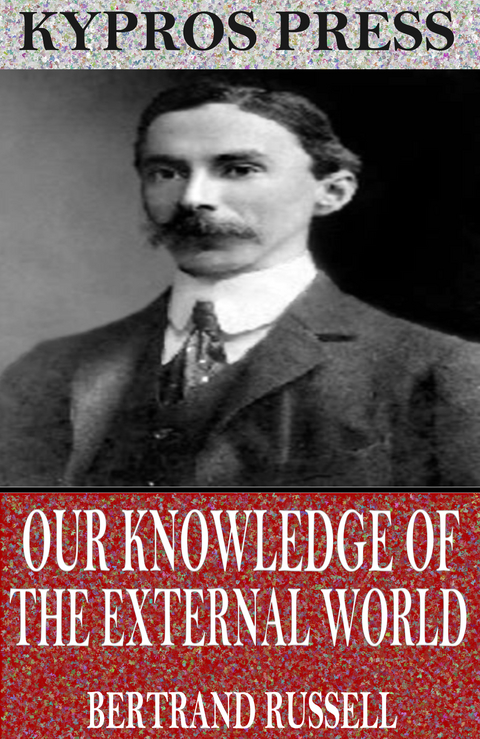
Bertrand Russell was a British philosopher, logician, and mathematician. Russell was one of the leaders in the British "e;revolt against idealism"e; and he is credited for being one of the founders of analytic philosophy. In 1950 Russell received the Nobel Prize in Literature.Our Knowledge of the External World is a book Russell wrote on logical positivism. Russell explains the issues with classical logic compared to modern logic.
LECTURE III. ON OUR KNOWLEDGE OF THE EXTERNAL WORLD
PHILOSOPHY MAY BE APPROACHED BY many roads, but one of the oldest and most travelled is the road which leads through doubt as to the reality of the world of sense. In Indian mysticism, in Greek and modern monistic philosophy from Parmenides onward, in Berkeley, in modern physics, we find sensible appearance criticised and condemned for a bewildering variety of motives. The mystic condemns it on the ground of immediate knowledge of a more real and significant world behind the veil; Parmenides and Plato condemn it because its continual flux is thought inconsistent with the unchanging nature of the abstract entities revealed by logical analysis; Berkeley brings several weapons, but his chief is the subjectivity of sense-data, their dependence upon the organisation and point of view of the spectator; while modern physics, on the basis of sensible evidence itself, maintains a mad dance of electrons which has, superficially at least, very little resemblance to the immediate objects of sight or touch.
Every one of these lines of attack raises vital and interesting problems.
The mystic, so long as he merely reports a positive revelation, cannot be refuted; but when he denies reality to objects of sense, he may be questioned as to what he means by “reality,” and may be asked how their unreality follows from the supposed reality of his super-sensible world. In answering these questions, he is led to a logic which merges into that of Parmenides and Plato and the idealist tradition.
The logic of the idealist tradition has gradually grown very complex and very abstruse, as may be seen from the Bradleian sample considered in our first lecture. If we attempted to deal fully with this logic, we should not have time to reach any other aspect of our subject; we will therefore, while acknowledging that it deserves a long discussion, pass by its central doctrines with only such occasional criticism as may serve to exemplify other topics, and concentrate our attention on such matters as its objections to the continuity of motion and the infinity of space and time—objections which have been fully answered by modern mathematicians in a manner constituting an abiding triumph for the method of logical analysis in philosophy. These objections and the modern answers to them will occupy our fifth, sixth, and seventh lectures.
Berkeley’s attack, as reinforced by the physiology of the sense-organs and nerves and brain, is very powerful. I think it must be admitted as probable that the immediate objects of sense depend for their existence upon physiological conditions in ourselves, and that, for example, the coloured surfaces which we see cease to exist when we shut our eyes. But it would be a mistake to infer that they are dependent upon mind, not real while we see them, or not the sole basis for our knowledge of the external world. This line of argument will be developed in the present lecture.
The discrepancy between the world of physics and the world of sense, which we shall consider in our fourth lecture, will be found to be more apparent than real, and it will be shown that whatever there is reason to believe in physics can probably be interpreted in terms of sense.
The instrument of discovery throughout is modern logic, a very different science from the logic of the text-books and also from the logic of idealism. Our second lecture has given a short account of modern logic and of its points of divergence from the various traditional kinds of logic.
In our last lecture, after a discussion of causality and free will, we shall try to reach a general account of the logical-analytic method of scientific philosophy, and a tentative estimate of the hopes of philosophical progress which it allows us to entertain.
In this lecture, I wish to apply the logical-analytic method to one of the oldest problems of philosophy, namely, the problem of our knowledge of the external world. What I have to say on this problem does not amount to an answer of a definite and dogmatic kind; it amounts only to an analysis and statement of the questions involved, with an indication of the directions in which evidence may be sought. But although not yet a definite solution, what can be said at present seems to me to throw a completely new light on the problem, and to be indispensable, not only in seeking the answer, but also in the preliminary question as to what parts of our problem may possibly have an ascertainable answer.
In every philosophical problem, our investigation starts from what may be called “data,” by which I mean matters of common knowledge, vague, complex, inexact, as common knowledge always is, but yet somehow commanding our assent as on the whole and in some interpretation pretty certainly true. In the case of our present problem, the common knowledge involved is of various kinds. There is first our acquaintance with particular objects of daily life—furniture, houses, towns, other people, and so on. Then there is the extension of such particular knowledge to particular things outside our personal experience, through history and geography, newspapers, etc. And lastly, there is the systematisation of all this knowledge of particulars by means of physical science, which derives immense persuasive force from its astonishing power of foretelling the future. We are quite willing to admit that there may be errors of detail in this knowledge, but we believe them to be discoverable and corrigible by the methods which have given rise to our beliefs, and we do not, as practical men, entertain for a moment the hypothesis that the whole edifice may be built on insecure foundations. In the main, therefore, and without absolute dogmatism as to this or that special portion, we may accept this mass of common knowledge as affording data for our philosophical analysis.
It may be said—and this is an objection which must be met at the outset—that it is the duty of the philosopher to call in question the admittedly fallible beliefs of daily life, and to replace them by something more solid and irrefragable. In a sense this is true, and in a sense it is effected in the course of analysis. But in another sense, and a very important one, it is quite impossible. While admitting that doubt is possible with regard to all our common knowledge, we must nevertheless accept that knowledge in the main if philosophy is to be possible at all. There is not any superfine brand of knowledge, obtainable by the philosopher, which can give us a standpoint from which to criticise the whole of the knowledge of daily life. The most that can be done is to examine and purify our common knowledge by an internal scrutiny, assuming the canons by which it has been obtained, and applying them with more care and with more precision. Philosophy cannot boast of having achieved such a degree of certainty that it can have authority to condemn the facts of experience and the laws of science. The philosophic scrutiny, therefore, though sceptical in regard to every detail, is not sceptical as regards the whole. That is to say, its criticism of details will only be based upon their relation to other details, not upon some external criterion which can be applied to all the details equally. The reason for this abstention from a universal criticism is not any dogmatic confidence, but its exact opposite; it is not that common knowledge must be true, but that we possess no radically different kind of knowledge derived from some other source. Universal scepticism, though logically irrefutable, is practically barren; it can only, therefore, give a certain flavour of hesitancy to our beliefs, and cannot be used to substitute other beliefs for them.
Although data can only be criticised by other data, not by an outside standard, yet we may distinguish different grades of certainty in the different kinds of common knowledge which we enumerated just now. What does not go beyond our own personal sensible acquaintance must be for us the most certain: the “evidence of the senses” is proverbially the least open to question. What depends on testimony, like the facts of history and geography which are learnt from books, has varying degrees of certainty according to the nature and extent of the testimony. Doubts as to the existence of Napoleon can only be maintained for a joke, whereas the historicity of Agamemnon is a legitimate subject of debate. In science, again, we find all grades of certainty short of the highest. The law of gravitation, at least as an approximate truth, has acquired by this time the same kind of certainty as the existence of Napoleon, whereas the latest speculations concerning the constitution of matter would be universally acknowledged to have as yet only a rather slight probability in their favour. These varying degrees of certainty attaching to different data may be regarded as themselves forming part of our data; they, along with the other data, lie within the vague, complex, inexact body of knowledge which it is the business of the philosopher to analyse.
The first thing that appears when we begin to analyse our common knowledge is that some of it is derivative, while some is primitive; that is to say, there is some that we only believe because of something else from which it has been inferred in some sense, though not necessarily in a strict logical sense, while other parts are believed on their own account, without the support of any outside evidence. It is obvious that the senses give knowledge of the latter kind: the immediate facts perceived by sight or touch or hearing do not need to be proved by...
| Erscheint lt. Verlag | 22.3.2018 |
|---|---|
| Sprache | englisch |
| Themenwelt | Geisteswissenschaften ► Philosophie ► Allgemeines / Lexika |
| Schlagworte | Logic • Philosophy • Positivism |
| ISBN-10 | 1-5378-2120-2 / 1537821202 |
| ISBN-13 | 978-1-5378-2120-7 / 9781537821207 |
| Informationen gemäß Produktsicherheitsverordnung (GPSR) | |
| Haben Sie eine Frage zum Produkt? |
 EPUB (Adobe DRM)
Größe: 1,0 MB
Kopierschutz: Adobe-DRM
Adobe-DRM ist ein Kopierschutz, der das eBook vor Mißbrauch schützen soll. Dabei wird das eBook bereits beim Download auf Ihre persönliche Adobe-ID autorisiert. Lesen können Sie das eBook dann nur auf den Geräten, welche ebenfalls auf Ihre Adobe-ID registriert sind.
Details zum Adobe-DRM
Dateiformat: EPUB (Electronic Publication)
EPUB ist ein offener Standard für eBooks und eignet sich besonders zur Darstellung von Belletristik und Sachbüchern. Der Fließtext wird dynamisch an die Display- und Schriftgröße angepasst. Auch für mobile Lesegeräte ist EPUB daher gut geeignet.
Systemvoraussetzungen:
PC/Mac: Mit einem PC oder Mac können Sie dieses eBook lesen. Sie benötigen eine
eReader: Dieses eBook kann mit (fast) allen eBook-Readern gelesen werden. Mit dem amazon-Kindle ist es aber nicht kompatibel.
Smartphone/Tablet: Egal ob Apple oder Android, dieses eBook können Sie lesen. Sie benötigen eine
Geräteliste und zusätzliche Hinweise
Buying eBooks from abroad
For tax law reasons we can sell eBooks just within Germany and Switzerland. Regrettably we cannot fulfill eBook-orders from other countries.
EPUB (Ohne DRM)Digital Rights Management: ohne DRM
Dieses eBook enthält kein DRM oder Kopierschutz. Eine Weitergabe an Dritte ist jedoch rechtlich nicht zulässig, weil Sie beim Kauf nur die Rechte an der persönlichen Nutzung erwerben.
Dateiformat: EPUB (Electronic Publication)
EPUB ist ein offener Standard für eBooks und eignet sich besonders zur Darstellung von Belletristik und Sachbüchern. Der Fließtext wird dynamisch an die Display- und Schriftgröße angepasst. Auch für mobile Lesegeräte ist EPUB daher gut geeignet.
Systemvoraussetzungen:
PC/Mac: Mit einem PC oder Mac können Sie dieses eBook lesen. Sie benötigen dafür die kostenlose Software Adobe Digital Editions.
eReader: Dieses eBook kann mit (fast) allen eBook-Readern gelesen werden. Mit dem amazon-Kindle ist es aber nicht kompatibel.
Smartphone/Tablet: Egal ob Apple oder Android, dieses eBook können Sie lesen. Sie benötigen dafür eine kostenlose App.
Geräteliste und zusätzliche Hinweise
Buying eBooks from abroad
For tax law reasons we can sell eBooks just within Germany and Switzerland. Regrettably we cannot fulfill eBook-orders from other countries.
aus dem Bereich