


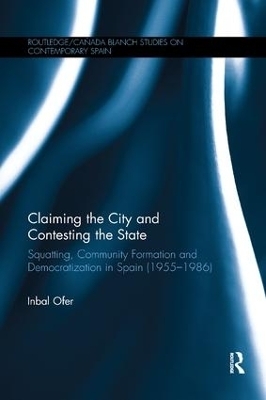
Claiming the City and Contesting the State
Squatting, Community Formation and Democratization in Spain (1955–1986)
Seiten
2018
Routledge (Verlag)
978-1-138-33191-4 (ISBN)
Routledge (Verlag)
978-1-138-33191-4 (ISBN)
The present book analyzes the relationship between internal migration, urbanization and democratization in Spain during the period of General Francisco Franco's dictatorship (1939-1975) and Spain's transition to democracy (1975-1982). Specifically, the book explores the production and management of urban space as one form of political and social repression under the dictatorship, and the threat posed to the official urban planning regimes by the phenomenon of mass squatting (chabolismo).
The growing body of recent literature that analyzes the role of neighborhood associations within Spain's transition to democracy, points to the importance and radicalism of associations that formed within squatters' settlements such as Orcasitas in Madrid, Otxarkoaga in Bilbao or Somorrostro and el Camp de la Bota in Barcelona. However, relatively little is known about the formation of community life in these neighborhoods during the 1950s, and about the ways in which the struggle to control and fashion urban space prior to Spain's transition to democracy generated specific notions of democratic citizenship amongst populations lacking in prior coherent ideological commitment.
The growing body of recent literature that analyzes the role of neighborhood associations within Spain's transition to democracy, points to the importance and radicalism of associations that formed within squatters' settlements such as Orcasitas in Madrid, Otxarkoaga in Bilbao or Somorrostro and el Camp de la Bota in Barcelona. However, relatively little is known about the formation of community life in these neighborhoods during the 1950s, and about the ways in which the struggle to control and fashion urban space prior to Spain's transition to democracy generated specific notions of democratic citizenship amongst populations lacking in prior coherent ideological commitment.
Inbal Ofer is a senior lecturer in modern European history at The Open University of Israel.
List of Figures
Acknowledgements
Introduction
Social Control through Spatial Segregation: Urban Planning under the Franco Regime
Internal Migration in a Post-Civil War Society: from the Countryside to the City in a Search of Better Life
Appropriating Urban Space: Constructing a Chabola and Forming a Community
Becoming Visible: Neighborhood Associations under the Franco Regime
Alternative Visions of Democracy: Urban Space and the Spanish Transition
Conclusion: Some Thoughts on Civic Participation, the Production of Urban Space and the Meaning of the Right to the City
Bibliography
Index
| Erscheinungsdatum | 21.09.2018 |
|---|---|
| Reihe/Serie | Routledge Studies on Contemporary Spain |
| Zusatzinfo | 1 Line drawings, black and white; 26 Halftones, black and white; 26 Illustrations, black and white |
| Verlagsort | London |
| Sprache | englisch |
| Maße | 156 x 234 mm |
| Gewicht | 408 g |
| Themenwelt | Geschichte ► Allgemeine Geschichte ► Neuzeit (bis 1918) |
| Geisteswissenschaften ► Geschichte ► Regional- / Ländergeschichte | |
| Geschichte ► Teilgebiete der Geschichte ► Kulturgeschichte | |
| ISBN-10 | 1-138-33191-0 / 1138331910 |
| ISBN-13 | 978-1-138-33191-4 / 9781138331914 |
| Zustand | Neuware |
| Informationen gemäß Produktsicherheitsverordnung (GPSR) | |
| Haben Sie eine Frage zum Produkt? |
Mehr entdecken
aus dem Bereich
aus dem Bereich
Geschichte einer wilden Handlung
Buch | Hardcover (2024)
C.H.Beck (Verlag)
CHF 47,60


