


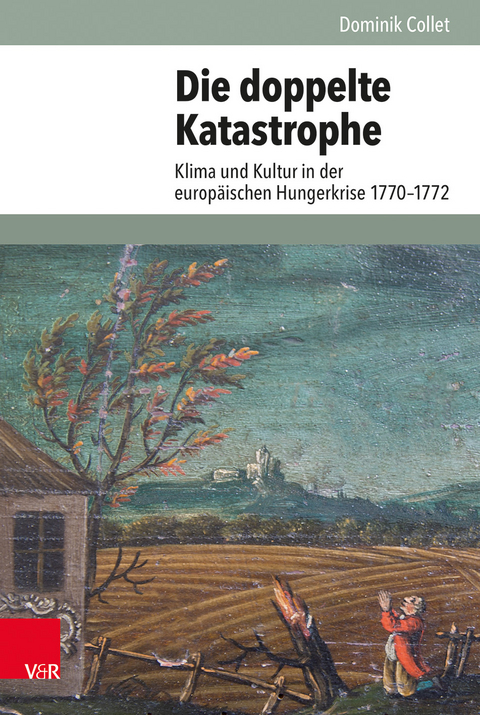
Die doppelte Katastrophe
Klima und Kultur in der europäischen Hungerkrise 1770–1772
Seiten
2018
Vandenhoeck & Ruprecht (Verlag)
978-3-525-35592-3 (ISBN)
Vandenhoeck & Ruprecht (Verlag)
978-3-525-35592-3 (ISBN)
Zusammenhang von Klima und Kultur anhand der schweren europäischen Hungersnot im 18. Jahrhundert
At the end of the 18th century Europe suffered one of the worst subsistence crises of the Little Ice Age. The disastrous fatality of this „double” catastrophe was a result of both climate and culture. The effects of earth and famine were felt throughout Europe and claimed hundreds of thousands of lives. The crisis initiated mass migration, discrimination and bouts of antisemitism but also political reform, early humanitarianism and new fields of science. It linked the revolts of the Steelboys in Ireland with the absolutist coup in Sweden and the bourgeois reform movements in Saxony. Dominik Collet draws on these crises to trace, how climate anomalies have been “socialised” in the past and to highlight the surprising plurality of societal responses.His book calls for a socionatural approach to writing history. It narrates an entangled history of environment and society that pursues the links between short-term events and long-term, socio-ecological structures. Due to these interconnections the crisis of the 1770s reveals the deeper, underlying conflicts of the affected societies in the fields of economy, ecology and governance. They reveal the inherent vulnerability of Europe’s “grain societies” and sketch the actions of governments, subjects and “experts”. In this complex environment catastrophes constitute both social and natural disasters. The study challenges social and climatic determinism and illustrates that more dynamic connections of climate and culture are both necessary and feasible. It calls for a fresh perspective that – instead of separating nature and culture – treats nature as history.
At the end of the 18th century Europe suffered one of the worst subsistence crises of the Little Ice Age. The disastrous fatality of this „double” catastrophe was a result of both climate and culture. The effects of earth and famine were felt throughout Europe and claimed hundreds of thousands of lives. The crisis initiated mass migration, discrimination and bouts of antisemitism but also political reform, early humanitarianism and new fields of science. It linked the revolts of the Steelboys in Ireland with the absolutist coup in Sweden and the bourgeois reform movements in Saxony. Dominik Collet draws on these crises to trace, how climate anomalies have been “socialised” in the past and to highlight the surprising plurality of societal responses.His book calls for a socionatural approach to writing history. It narrates an entangled history of environment and society that pursues the links between short-term events and long-term, socio-ecological structures. Due to these interconnections the crisis of the 1770s reveals the deeper, underlying conflicts of the affected societies in the fields of economy, ecology and governance. They reveal the inherent vulnerability of Europe’s “grain societies” and sketch the actions of governments, subjects and “experts”. In this complex environment catastrophes constitute both social and natural disasters. The study challenges social and climatic determinism and illustrates that more dynamic connections of climate and culture are both necessary and feasible. It calls for a fresh perspective that – instead of separating nature and culture – treats nature as history.
Dr. Dominik Collet ist Professor für Umweltgeschichte an der Universität Oslo.
Prof. Dr. Christof Mauch ist Direktor des Rachel Carson Center for Environment and Society an der LMU München, sowie Ehrenprofessor am Zentrum für Ökologische Geschichte an der Renmin Universität in China und ehemaliger Präsident der Europäischen Gesellschaft für Umweltgeschichte.
Dr. Helmuth Trischler ist Forschungsdirektor des Deutschen Museums in München sowie Professor für Neue und Neuste Geschichte Ludwig-Maximilians Universität München.
| Erscheinungsdatum | 31.10.2018 |
|---|---|
| Reihe/Serie | Umwelt und Gesellschaft ; Band 018 |
| Mitarbeit |
Herausgeber (Serie): Christof U. Mauch, Helmuth Trischler |
| Zusatzinfo | mit 24 Abb. |
| Verlagsort | Göttingen |
| Sprache | deutsch |
| Maße | 160 x 235 mm |
| Gewicht | 939 g |
| Themenwelt | Geschichte ► Allgemeine Geschichte ► Neuzeit (bis 1918) |
| Geschichte ► Teilgebiete der Geschichte ► Kulturgeschichte | |
| Schlagworte | 18. Jahrhundert • Europa • Geschichte/Neuzeit • Kleine Eiszeit • Klimawandel • Kulturgeschichte • Kulturwissenschaft • Naturkatastrophe • Umweltwandel |
| ISBN-10 | 3-525-35592-0 / 3525355920 |
| ISBN-13 | 978-3-525-35592-3 / 9783525355923 |
| Zustand | Neuware |
| Informationen gemäß Produktsicherheitsverordnung (GPSR) | |
| Haben Sie eine Frage zum Produkt? |
Mehr entdecken
aus dem Bereich


aus dem Bereich
Geschichte einer wilden Handlung
Buch | Hardcover (2024)
C.H.Beck (Verlag)
CHF 47,60


