


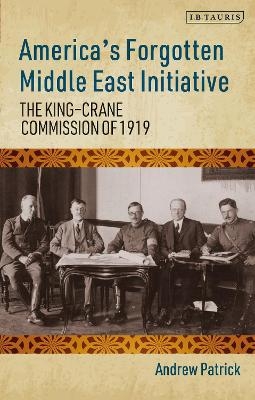
America's Forgotten Middle East Initiative
The King-Crane Commission of 1919
Seiten
2020
I.B. Tauris (Verlag)
9781788314558 (ISBN)
I.B. Tauris (Verlag)
9781788314558 (ISBN)
Sent to the Middle East by Woodrow Wilson to ascertain the viability of self-determination in the disintegrating Ottoman Empire, the King-Crane Commission of 1919 was America’s first foray into the region.
Sent to the Middle East by Woodrow Wilson to ascertain the viability of self-determination in the disintegrating Ottoman Empire, the King-Crane Commission of 1919 was America's first foray into the region. The commission's controversial recommendations included the rejection of the idea of a Jewish state in Syria, US intervention in the Middle East and the end of French colonial aspirations. The Commission's recommendations proved inflammatory, even though its counsel on the question of the Palestinian mandate was eventually disregarded by Lloyd George and Georges Clemenceau in favour of their own national interests. In the ensuing years, the Commission's dismissal of claims by Zionist representatives like David Ben-Gurion on their 'right to Palestine' proved particularly divisive, with some historians labeling it prophetic and accurate, and others arguing that Commission members were biased and ill-informed. Here, in the first book-length analysis of the King-Crane report in nearly 50 years, Andrew Patrick chronicles the history of early US involvement in the region, and challenges extant interpretations of the turbulent relationship between the United States and the Middle East.
Sent to the Middle East by Woodrow Wilson to ascertain the viability of self-determination in the disintegrating Ottoman Empire, the King-Crane Commission of 1919 was America's first foray into the region. The commission's controversial recommendations included the rejection of the idea of a Jewish state in Syria, US intervention in the Middle East and the end of French colonial aspirations. The Commission's recommendations proved inflammatory, even though its counsel on the question of the Palestinian mandate was eventually disregarded by Lloyd George and Georges Clemenceau in favour of their own national interests. In the ensuing years, the Commission's dismissal of claims by Zionist representatives like David Ben-Gurion on their 'right to Palestine' proved particularly divisive, with some historians labeling it prophetic and accurate, and others arguing that Commission members were biased and ill-informed. Here, in the first book-length analysis of the King-Crane report in nearly 50 years, Andrew Patrick chronicles the history of early US involvement in the region, and challenges extant interpretations of the turbulent relationship between the United States and the Middle East.
Andrew Patrick is Lecturer in Middle Eastern History at Tennessee State University. He gained his PhD at the University of Manchester.
1. Introduction
2. Backdrop of the King-Crane Commission
3. Paris Peace Conference 1: The Idea of a Commission
4. Paris Peace Conference 2: Topsy-Turvydom
5.
| Erscheinungsdatum | 08.01.2019 |
|---|---|
| Sprache | englisch |
| Maße | 138 x 214 mm |
| Gewicht | 440 g |
| Themenwelt | Sachbuch/Ratgeber ► Geschichte / Politik ► Allgemeines / Lexika |
| Geschichte ► Allgemeine Geschichte ► Neuzeit (bis 1918) | |
| Geschichte ► Allgemeine Geschichte ► 1918 bis 1945 | |
| Geisteswissenschaften ► Geschichte ► Regional- / Ländergeschichte | |
| Sozialwissenschaften ► Politik / Verwaltung ► Europäische / Internationale Politik | |
| Sozialwissenschaften ► Politik / Verwaltung ► Vergleichende Politikwissenschaften | |
| ISBN-13 | 9781788314558 / 9781788314558 |
| Zustand | Neuware |
| Informationen gemäß Produktsicherheitsverordnung (GPSR) | |
| Haben Sie eine Frage zum Produkt? |
Mehr entdecken
aus dem Bereich


aus dem Bereich
Geschichte einer wilden Handlung
Buch | Hardcover (2024)
C.H.Beck (Verlag)
CHF 47,60


