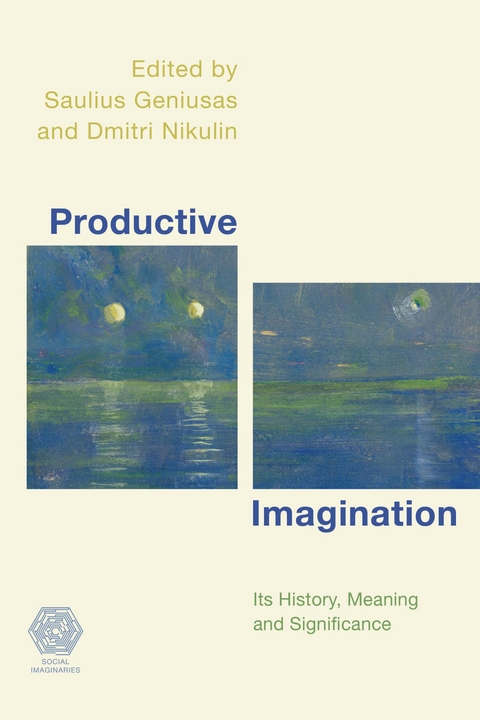
Productive Imagination (eBook)
256 Seiten
Rowman & Littlefield International (Verlag)
978-1-78660-432-3 (ISBN)
Although the concept of productive imagination plays a fundamental role in Kant, German Idealism, Romanticism, Phenomenology and Hermeneutics, the meaning of this central concept remains largely undetermined. The significance of productive imagination is therefore all-too-often either inflated or underrated. The articles collected in this volume trace the development of productive imagination through the history of philosophy, identify the different meanings this concept has been ascribed in different philosophical frameworks, and raise the question anew concerning this concept's philosophical significance. Special attention is given to the historical background that underlies the emergence of productive imagination in modernity, to Kant's concept of productive imagination, to the further development of this concept in German Idealism, Wilhelm Dilthey, Edmund Husserl, Ernst Cassirer and Martin Heidegger, Jean-Paul Sartre and Paul Ricoeur. A group of leading scholars present a systematic and comprehensive reference tool for anyone working in the fields of social imaginaries.
lt;span>Saulius Geniusas is Associate Professor of Philosophy at the Chinese University of Hong Kong. He is the author of The Origins of the Horizon in Husserl’s Phenomenology (2012), co-editor of Hermeneutics and Phenomenology: Figures and Themes (with Paul Fairfield, forthcoming), Relational Hermeneutics: Essays in Comparative Philosophy (with Paul Fairfield, forthcoming), and Phenomenological Ethics (A Special Issue of Santalka: Filosofija, 17/3, 2009).
Dmitri Nikulin is Professor of Philosophy at The New School for Social Research in New York. He is the author of a number of books including Matter, Imagination and Geometry (2002), On Dialogue (2006), Dialectic and Dialogue (2010), Comedy, Seriously (2014), and The Concept of History (2017).
Editors’ Introduction / 1. What is Productive Imagination? Dmitri Nikulin / 2. Productive and Practical Imagination: What Does Productive Imagination Produce? Alfredo Ferrarin / 3. Fantasy as Productive Imagination According to Friedrich Schlegel and Novalis or the Creativity of What is Human, Laura S. Carugati / 4. The Productive Imagination in Hegel and Classical German Philosophy, Angelica Nuzzo / 5. Dilthey’s Typifying Imagination, Rudolf A. Makkreel / 6. Imagination of Stupidity: Jules de Gaultier, Flaubert and Le Bovarysme,Nicolas de Warren / 7. Productive Imagination and the Cassirer-Heidegger Disputation, Saulius Geniusas / 8. The Deeper Significance of Ricoeur’s Philosophy of Productive Imagination: The Role of Figuration, George H. Taylor / Index
| Reihe/Serie | Social Imaginaries |
|---|---|
| Verlagsort | London |
| Sprache | englisch |
| Themenwelt | Geisteswissenschaften ► Philosophie ► Allgemeines / Lexika |
| Geisteswissenschaften ► Philosophie ► Ethik | |
| Geisteswissenschaften ► Philosophie ► Geschichte der Philosophie | |
| Geisteswissenschaften ► Philosophie ► Philosophie der Neuzeit | |
| Schlagworte | Aesthetics • Comparative Literature • Continental Philosophy • ethics • Literary Theory • Moral Philosophy • Phenomenology • Political Philosophy • social imaginaries |
| ISBN-10 | 1-78660-432-9 / 1786604329 |
| ISBN-13 | 978-1-78660-432-3 / 9781786604323 |
| Informationen gemäß Produktsicherheitsverordnung (GPSR) | |
| Haben Sie eine Frage zum Produkt? |
 EPUB (Adobe DRM)
Kopierschutz: Adobe-DRM
Adobe-DRM ist ein Kopierschutz, der das eBook vor Mißbrauch schützen soll. Dabei wird das eBook bereits beim Download auf Ihre persönliche Adobe-ID autorisiert. Lesen können Sie das eBook dann nur auf den Geräten, welche ebenfalls auf Ihre Adobe-ID registriert sind.
Details zum Adobe-DRM
Dateiformat: EPUB (Electronic Publication)
EPUB ist ein offener Standard für eBooks und eignet sich besonders zur Darstellung von Belletristik und Sachbüchern. Der Fließtext wird dynamisch an die Display- und Schriftgröße angepasst. Auch für mobile Lesegeräte ist EPUB daher gut geeignet.
Systemvoraussetzungen:
PC/Mac: Mit einem PC oder Mac können Sie dieses eBook lesen. Sie benötigen eine
eReader: Dieses eBook kann mit (fast) allen eBook-Readern gelesen werden. Mit dem amazon-Kindle ist es aber nicht kompatibel.
Smartphone/Tablet: Egal ob Apple oder Android, dieses eBook können Sie lesen. Sie benötigen eine
Geräteliste und zusätzliche Hinweise
Buying eBooks from abroad
For tax law reasons we can sell eBooks just within Germany and Switzerland. Regrettably we cannot fulfill eBook-orders from other countries.
aus dem Bereich