Aristotle: Poetics, Ethics, Politics, and Categories (eBook)
705 Seiten
Seltzer Books (Verlag)
978-1-4554-2845-8 (ISBN)
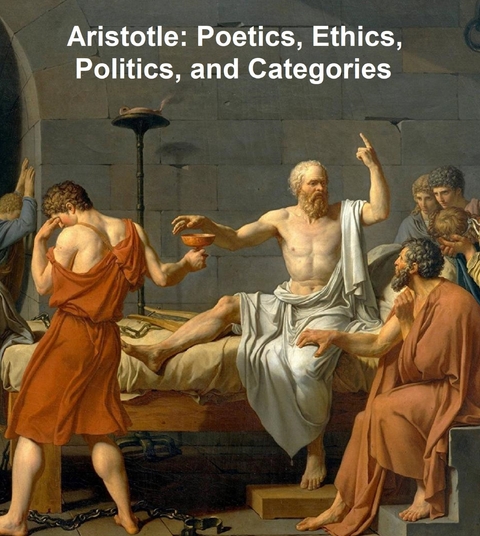
This file includes four books: Poetics, Ethics, Politics, and Categories.According to Wikipedia: 'Aristotle (384 BC - 322 BC)[1] was a Greek philosopher and polymath, a student of Plato and teacher of Alexander the Great. His writings cover many subjects, including physics, metaphysics, poetry, theater, music, logic, rhetoric, linguistics, politics, government, ethics, biology, and zoology. Together with Plato and Socrates (Plato's teacher), Aristotle is one of the most important founding figures in Western philosophy. Aristotle's writings were the first to create a comprehensive system of Western philosophy, encompassing morality, aesthetics, logic, science, politics, and metaphysics.'
This file includes four books: Poetics, Ethics, Politics, and Categories. According to Wikipedia: "e;Aristotle (384 BC - 322 BC)[1] was a Greek philosopher and polymath, a student of Plato and teacher of Alexander the Great. His writings cover many subjects, including physics, metaphysics, poetry, theater, music, logic, rhetoric, linguistics, politics, government, ethics, biology, and zoology. Together with Plato and Socrates (Plato's teacher), Aristotle is one of the most important founding figures in Western philosophy. Aristotle's writings were the first to create a comprehensive system of Western philosophy, encompassing morality, aesthetics, logic, science, politics, and metaphysics."e;
BOOK II
Well: human Excellence is of two kinds, Intellectual and Moral: now the Intellectual springs originally, and is increased subsequently, from teaching (for the most part that is), and needs therefore experience and time; whereas the Moral comes from custom, and so the Greek term denoting it is but a slight deflection from the term denoting custom in that language.
From this fact it is plain that not one of the Moral Virtues comes to be in us merely by nature: because of such things as exist by nature, none can be changed by custom: a stone, for instance, by nature gravitating downwards, could never by custom be brought to ascend, not even if one were to try and accustom it by throwing it up ten thousand times; nor could file again be brought to descend, nor in fact could anything whose nature is in one way be brought by custom to be in another. The Virtues then come to be in us neither by nature, nor in despite of nature, but we are furnished by nature with a capacity for receiving themu and are perfected in them through custom.
Again, in whatever cases we get things by nature, we get the faculties first and perform the acts of working afterwards; an illustration of which is afforded by the case of our bodily senses, for it was not from having often seen or heard that we got these senses, but just the reverse: we had them and so exercised them, but did not have them because we had exercised them. But the Virtues we get by first performing single acts of working, which, again, is the case of other things, as the arts for instance; for what we have to make when we have learned how, these we learn how to make by making: men come to be builders, for instance, by building; harp-players, by playing on the harp: exactly so, by doing just actions we come to be just; by doing the actions of self-mastery we come to be perfected in self-mastery; and by doing brave actions brave.
And to the truth of this testimony is borne by what takes place in communities: because the law-givers make the individual members good men by habituation, and this is the intention certainly of every law-giver, and all who do not effect it well fail of their intent; and herein consists the difference between a good Constitution and a bad.
Again, every Virtue is either produced or destroyed from and by the very same circumstances: art too in like manner; I mean it is by playing the harp that both the good and the bad harp-players are formed: and similarly builders and all the rest; by building well men will become good builders; by doing it badly bad ones: in fact, if this had not been so, there would have been no need of instructors, but all men would have been at once good or bad in their several arts without them.
So too then is it with the Virtues: for by acting in the various relations in which we are thrown with our fellow men, we come to be, some just, some unjust: and by acting in dangerous positions and being habituated to feel fear or confidence, we come to be, some brave, others cowards.
Similarly is it also with respect to the occasions of lust and anger: for some men come to be perfected in self-mastery and mild, others destitute of all self-control and passionate; the one class by behaving in one way under them, the other by behaving in another. Or, in one word, the habits are produced from the acts of working like to them: and so what we have to do is to give a certain character to these particular acts, because the habits formed correspond to the differences of these.
So then, whether we are accustomed this way or that straight from childhood, makes not a small but an important difference, or rather I would say it makes all the difference.
II
Since then the object of the present treatise is not mere speculation, as it is of some others (for we are inquiring not merely that we may know what virtue is but that we may become virtuous, else it would have been useless), we must consider as to the particular actions how we are to do them, because, as we have just said, the quality of the habits that shall be formed depends on these.
Now, that we are to act in accordance with Right Reason is a general maxim, and may for the present be taken for granted: we will speak of it hereafter, and say both what Right Reason is, and what are its relations to the other virtues.
[Sidenote: 1104a]
But let this point be first thoroughly understood between us, that all which can be said on moral action must be said in outline, as it were, and not exactly: for as we remarked at the commencement, such reasoning only must be required as the nature of the subject-matter admits of, and matters of moral action and expediency have no fixedness any more than matters of health. And if the subject in its general maxims is such, still less in its application to particular cases is exactness attainable: because these fall not under any art or system of rules, but it must be left in each instance to the individual agents to look to the exigencies of the particular case, as it is in the art of healing, or that of navigating a ship. Still, though the present subject is confessedly such, we must try and do what we can for it.
First then this must be noted, that it is the nature of such things to be spoiled by defect and excess; as we see in the case of health and strength (since for the illustration of things which cannot be seen we must use those that can), for excessive training impairs the strength as well as deficient: meat and drink, in like manner, in too great or too small quantities, impair the health: while in due proportion they cause, increase, and preserve it.
Thus it is therefore with the habits of perfected Self-Mastery and Courage and the rest of the Virtues: for the man who flies from and fears all things, and never stands up against anything, comes to be a coward; and he who fears nothing, but goes at everything, comes to be rash. In like manner too, he that tastes of every pleasure and abstains from none comes to lose all self-control; while he who avoids all, as do the dull and clownish, comes as it were to lose his faculties of perception: that is to say, the habits of perfected Self-Mastery and Courage are spoiled by the excess and defect, but by the mean state are preserved.
Furthermore, not only do the origination, growth, and marring of the habits come from and by the same circumstances, but also the acts of working after the habits are formed will be exercised on the same: for so it is also with those other things which are more directly matters of sight, strength for instance: for this comes by taking plenty of food and doing plenty of work, and the man who has attained strength is best able to do these: and so it is with the Virtues, for not only do we by abstaining from pleasures come to be perfected in Self-Mastery, but when we have come to be so we can best abstain from them: similarly too with Courage: for it is by accustoming ourselves to despise objects of fear and stand up against them that we come to be brave; and [Sidenote(?): 1104b] after we have come to be so we shall be best able to stand up against such objects.
And for a test of the formation of the habits we must [Sidenote(?): III] take the pleasure or pain which succeeds the acts; for he is perfected in Self-Mastery who not only abstains from the bodily pleasures but is glad to do so; whereas he who abstains but is sorry to do it has not Self-Mastery: he again is brave who stands up against danger, either with positive pleasure or at least without any pain; whereas he who does it with pain is not brave.
For Moral Virtue has for its object-matter pleasures and pains, because by reason of pleasure we do what is bad, and by reason of pain decline doing what is right (for which cause, as Plato observes, men should have been trained straight from their childhood to receive pleasure and pain from proper objects, for this is the right education). Again: since Virtues have to do with actions and feelings, and on every feeling and every action pleasure and pain follow, here again is another proof that Virtue has for its object-matter pleasure and pain. The same is shown also by the fact that punishments are effected through the instrumentality of these; because they are of the nature of remedies, and it is the nature of remedies to be the contraries of the ills they cure. Again, to quote what we said before: every habit of the Soul by its very nature has relation to, and exerts itself upon, things of the same kind as those by which it is naturally deteriorated or improved: now such habits do come to be vicious by reason of pleasures and pains, that is, by men pursuing or avoiding respectively, either such as they ought not, or at wrong times, or in wrong manner, and so forth (for which reason, by the way, some people define the Virtues as certain states of impassibility and utter quietude, but they are wrong because they speak without modification, instead of adding "as they ought," "as they ought not," and "when," and so on). Virtue then is assumed to be that habit which is such, in relation to pleasures and pains, as to effect the best results, and Vice the contrary.
The following considerations may also serve to set this in a clear light. There are principally three things moving us to choice and three to avoidance, the honourable, the expedient, the pleasant; and their three contraries, the dishonourable, the hurtful, and the painful: now the good man is apt to go right, and the bad man wrong, with respect to all these of...
| Erscheint lt. Verlag | 1.3.2018 |
|---|---|
| Sprache | englisch |
| Themenwelt | Geisteswissenschaften ► Philosophie ► Allgemeines / Lexika |
| ISBN-10 | 1-4554-2845-0 / 1455428450 |
| ISBN-13 | 978-1-4554-2845-8 / 9781455428458 |
| Informationen gemäß Produktsicherheitsverordnung (GPSR) | |
| Haben Sie eine Frage zum Produkt? |
 EPUB (Adobe DRM)
Größe: 704 KB
Kopierschutz: Adobe-DRM
Adobe-DRM ist ein Kopierschutz, der das eBook vor Mißbrauch schützen soll. Dabei wird das eBook bereits beim Download auf Ihre persönliche Adobe-ID autorisiert. Lesen können Sie das eBook dann nur auf den Geräten, welche ebenfalls auf Ihre Adobe-ID registriert sind.
Details zum Adobe-DRM
Dateiformat: EPUB (Electronic Publication)
EPUB ist ein offener Standard für eBooks und eignet sich besonders zur Darstellung von Belletristik und Sachbüchern. Der Fließtext wird dynamisch an die Display- und Schriftgröße angepasst. Auch für mobile Lesegeräte ist EPUB daher gut geeignet.
Systemvoraussetzungen:
PC/Mac: Mit einem PC oder Mac können Sie dieses eBook lesen. Sie benötigen eine
eReader: Dieses eBook kann mit (fast) allen eBook-Readern gelesen werden. Mit dem amazon-Kindle ist es aber nicht kompatibel.
Smartphone/Tablet: Egal ob Apple oder Android, dieses eBook können Sie lesen. Sie benötigen eine
Geräteliste und zusätzliche Hinweise
Buying eBooks from abroad
For tax law reasons we can sell eBooks just within Germany and Switzerland. Regrettably we cannot fulfill eBook-orders from other countries.
EPUB (Ohne DRM)Digital Rights Management: ohne DRM
Dieses eBook enthält kein DRM oder Kopierschutz. Eine Weitergabe an Dritte ist jedoch rechtlich nicht zulässig, weil Sie beim Kauf nur die Rechte an der persönlichen Nutzung erwerben.
Dateiformat: EPUB (Electronic Publication)
EPUB ist ein offener Standard für eBooks und eignet sich besonders zur Darstellung von Belletristik und Sachbüchern. Der Fließtext wird dynamisch an die Display- und Schriftgröße angepasst. Auch für mobile Lesegeräte ist EPUB daher gut geeignet.
Systemvoraussetzungen:
PC/Mac: Mit einem PC oder Mac können Sie dieses eBook lesen. Sie benötigen dafür die kostenlose Software Adobe Digital Editions.
eReader: Dieses eBook kann mit (fast) allen eBook-Readern gelesen werden. Mit dem amazon-Kindle ist es aber nicht kompatibel.
Smartphone/Tablet: Egal ob Apple oder Android, dieses eBook können Sie lesen. Sie benötigen dafür eine kostenlose App.
Geräteliste und zusätzliche Hinweise
Buying eBooks from abroad
For tax law reasons we can sell eBooks just within Germany and Switzerland. Regrettably we cannot fulfill eBook-orders from other countries.
aus dem Bereich