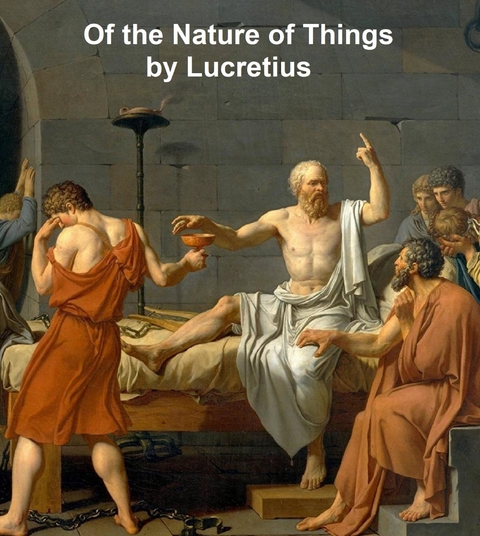
Of the Nature of Things (eBook)
405 Seiten
Seltzer Books (Verlag)
978-1-4554-1877-0 (ISBN)
Classic work of philosophy, in English translation. Titus Lucretius Carus (ca. 99 BC - ca. 55 BC) was a Roman poet and philosopher. His only known work is an epic philosophical poem laying out the beliefs of Epicureanism, De rerum natura, translated into English as On the Nature of Things or 'On the Nature of the Universe'.
Classic work of philosophy, in English translation. Titus Lucretius Carus (ca. 99 BC - ca. 55 BC) was a Roman poet and philosopher. His only known work is an epic philosophical poem laying out the beliefs of Epicureanism, De rerum natura, translated into English as On the Nature of Things or "e;On the Nature of the Universe"e;.
OF THE NATURE OF THINGS BY TITUS LUCRETIUS CARUS
published by Samizdat Express, Orange, CT, USA
established in 1974, offering over 14,000 books
Ancient Greek and Roman culture, literature, and philosophy --
- Plato, Complete Dialogues, translated by Jowett
- The Architecture of Vitruvius
- Cookery and Dining in Imperial Rome by Apicius
- The Geography of Strabo
- Letters of Pliny
- A Selection of the Discourses of Epictetus
- On the Sublime by Longinus
- Treatises on Friendship and Old Age by Cicero
- Thoughts of the Emperor Marcus Aurelius
- The Golden Ass by Apuleius
- The Golden Sayings of Epictetus
- Of the Nature of Things by Lucretius
- Ovid's Metamorphoses
- Plutarch's Morals
- Plutarch's Essays
- Lives of the Poets by Suetonius
- Five comedies by Plautus
- Comedies by Terence
- Trips to the Moon by Lucian
- The True History by Lucian
- Satyricon by Petronius
- Roman Women by Brittain
- Daphnis and Chloe by Longus
- Aristophanes all 11 comedies
- Aeschylus 7 plays
- Sophocles 7 plays
- Euripides 10 plays
- The Consolation of Philosophy by Boethius
- Virgil's Aeneid translated by William Morris
- Homeric Hymns
- Homer's Iliad in prose translated by Andrew Lang
- Homer's Iliad in verse translated by Alexander Pope
- Homer's Odyssey in prose translated by Samuel Butler
- Homer's Odyssey in verse translated by Alexander Pope
- Aristotle's Poetic, Ethics, Politics, and Categories
- The Best of the World's Classics: Greece
- The Best of the World's Classics: Rome
feedback welcome: info@samizdat.com
visit us at samizdat.com
A METRICAL TRANSLATION BY WILLIAM ELLERY LEONARD
BOOK I
PROEM
Mother of Rome, delight of Gods and men,
Dear Venus that beneath the gliding stars
Makest to teem the many-voyaged main
And fruitful lands- for all of living things
Through thee alone are evermore conceived,
Through thee are risen to visit the great sun-
Before thee, Goddess, and thy coming on,
Flee stormy wind and massy cloud away,
For thee the daedal Earth bears scented flowers,
For thee waters of the unvexed deep
Smile, and the hollows of the serene sky
Glow with diffused radiance for thee!
For soon as comes the springtime face of day,
And procreant gales blow from the West unbarred,
First fowls of air, smit to the heart by thee,
Foretoken thy approach, O thou Divine,
And leap the wild herds round the happy fields
Or swim the bounding torrents. Thus amain,
Seized with the spell, all creatures follow thee
Whithersoever thou walkest forth to lead,
And thence through seas and mountains and swift streams,
Through leafy homes of birds and greening plains,
Kindling the lure of love in every breast,
Thou bringest the eternal generations forth,
Kind after kind. And since 'tis thou alone
Guidest the Cosmos, and without thee naught
Is risen to reach the shining shores of light,
Nor aught of joyful or of lovely born,
Thee do I crave co-partner in that verse
Which I presume on Nature to compose
For Memmius mine, whom thou hast willed to be
Peerless in every grace at every hour-
Wherefore indeed, Divine one, give my words
Immortal charm. Lull to a timely rest
O'er sea and land the savage works of war,
For thou alone hast power with public peace
To aid mortality; since he who rules
The savage works of battle, puissant Mars,
How often to thy bosom flings his strength
O'ermastered by the eternal wound of love-
And there, with eyes and full throat backward thrown,
Gazing, my Goddess, open-mouthed at thee,
Pastures on love his greedy sight, his breath
Hanging upon thy lips. Him thus reclined
Fill with thy holy body, round, above!
Pour from those lips soft syllables to win
Peace for the Romans, glorious Lady, peace!
For in a season troublous to the state
Neither may I attend this task of mine
With thought untroubled, nor mid such events
The illustrious scion of the Memmian house
Neglect the civic cause.
Whilst human kind
Throughout the lands lay miserably crushed
Before all eyes beneath Religion- who
Would show her head along the region skies,
Glowering on mortals with her hideous face-
A Greek it was who first opposing dared
Raise mortal eyes that terror to withstand,
Whom nor the fame of Gods nor lightning's stroke
Nor threatening thunder of the ominous sky
Abashed; but rather chafed to angry zest
His dauntless heart to be the first to rend
The crossbars at the gates of Nature old.
And thus his will and hardy wisdom won;
And forward thus he fared afar, beyond
The flaming ramparts of the world, until
He wandered the unmeasurable All.
Whence he to us, a conqueror, reports
What things can rise to being, what cannot,
And by what law to each its scope prescribed,
Its boundary stone that clings so deep in Time.
Wherefore Religion now is under foot,
And us his victory now exalts to heaven.
I know how hard it is in Latian verse
To tell the dark discoveries of the Greeks,
Chiefly because our pauper-speech must find
Strange terms to fit the strangeness of the thing;
Yet worth of thine and the expected joy
Of thy sweet friendship do persuade me on
To bear all toil and wake the clear nights through,
Seeking with what of words and what of song
I may at last most gloriously uncloud
For thee the light beyond, wherewith to view
The core of being at the centre hid.
And for the rest, summon to judgments true,
Unbusied ears and singleness of mind
Withdrawn from cares; lest these my gifts, arranged
For thee with eager service, thou disdain
Before thou comprehendest: since for thee
I prove the supreme law of Gods and sky,
And the primordial germs of things unfold,
Whence Nature all creates, and multiplies
And fosters all, and whither she resolves
Each in the end when each is overthrown.
This ultimate stock we have devised to name
Procreant atoms, matter, seeds of things,
Or primal bodies, as primal to the world.
I fear perhaps thou deemest that we fare
An impious road to realms of thought profane;
But 'tis that same religion oftener far
Hath bred the foul impieties of men:
As once at Aulis, the elected chiefs,
Foremost of heroes, Danaan counsellors,
Defiled Diana's altar, virgin queen,
With Agamemnon's daughter, foully slain.
She felt the chaplet round her maiden locks
And fillets, fluttering down on either cheek,
And at the altar marked her grieving sire,
The priests beside him who concealed the knife,
And all the folk in tears at sight of her.
With a dumb terror and a sinking knee
She dropped; nor might avail her now that first
'Twas she who gave the king a father's name.
They raised her up, they bore the trembling girl
On to the altar- hither led not now
With solemn rites and hymeneal choir,
But sinless woman, sinfully foredone,
A parent felled her on her bridal day,
Making his child a sacrificial beast
To give the ships auspicious winds for Troy:
Such are the crimes to which Religion leads.
And there shall come the time when even thou,
Forced by the soothsayer's terror-tales, shalt seek
To break from us. Ah, many a dream even now
Can they concoct to rout thy plans of life,
And trouble all thy fortunes with base fears.
I own with reason: for, if men but knew
Some fixed end to ills, they would be strong
By some device unconquered to withstand
Religions and the menacings of seers.
But now nor skill nor instrument is theirs,
Since men must dread eternal pains in death.
For what the soul may be they do not know,
Whether 'tis born, or enter in at birth,
And whether, snatched by death, it die with us,
Or visit the shadows and the vasty caves
Of Orcus, or by some divine decree
Enter the brute herds, as our Ennius sang,
Who first from lovely Helicon...
| Erscheint lt. Verlag | 1.3.2018 |
|---|---|
| Sprache | englisch |
| Themenwelt | Geisteswissenschaften ► Philosophie ► Allgemeines / Lexika |
| ISBN-10 | 1-4554-1877-3 / 1455418773 |
| ISBN-13 | 978-1-4554-1877-0 / 9781455418770 |
| Informationen gemäß Produktsicherheitsverordnung (GPSR) | |
| Haben Sie eine Frage zum Produkt? |
 EPUB (Adobe DRM)
Größe: 404 KB
Kopierschutz: Adobe-DRM
Adobe-DRM ist ein Kopierschutz, der das eBook vor Mißbrauch schützen soll. Dabei wird das eBook bereits beim Download auf Ihre persönliche Adobe-ID autorisiert. Lesen können Sie das eBook dann nur auf den Geräten, welche ebenfalls auf Ihre Adobe-ID registriert sind.
Details zum Adobe-DRM
Dateiformat: EPUB (Electronic Publication)
EPUB ist ein offener Standard für eBooks und eignet sich besonders zur Darstellung von Belletristik und Sachbüchern. Der Fließtext wird dynamisch an die Display- und Schriftgröße angepasst. Auch für mobile Lesegeräte ist EPUB daher gut geeignet.
Systemvoraussetzungen:
PC/Mac: Mit einem PC oder Mac können Sie dieses eBook lesen. Sie benötigen eine
eReader: Dieses eBook kann mit (fast) allen eBook-Readern gelesen werden. Mit dem amazon-Kindle ist es aber nicht kompatibel.
Smartphone/Tablet: Egal ob Apple oder Android, dieses eBook können Sie lesen. Sie benötigen eine
Geräteliste und zusätzliche Hinweise
Buying eBooks from abroad
For tax law reasons we can sell eBooks just within Germany and Switzerland. Regrettably we cannot fulfill eBook-orders from other countries.
EPUB (Ohne DRM)Digital Rights Management: ohne DRM
Dieses eBook enthält kein DRM oder Kopierschutz. Eine Weitergabe an Dritte ist jedoch rechtlich nicht zulässig, weil Sie beim Kauf nur die Rechte an der persönlichen Nutzung erwerben.
Dateiformat: EPUB (Electronic Publication)
EPUB ist ein offener Standard für eBooks und eignet sich besonders zur Darstellung von Belletristik und Sachbüchern. Der Fließtext wird dynamisch an die Display- und Schriftgröße angepasst. Auch für mobile Lesegeräte ist EPUB daher gut geeignet.
Systemvoraussetzungen:
PC/Mac: Mit einem PC oder Mac können Sie dieses eBook lesen. Sie benötigen dafür die kostenlose Software Adobe Digital Editions.
eReader: Dieses eBook kann mit (fast) allen eBook-Readern gelesen werden. Mit dem amazon-Kindle ist es aber nicht kompatibel.
Smartphone/Tablet: Egal ob Apple oder Android, dieses eBook können Sie lesen. Sie benötigen dafür eine kostenlose App.
Geräteliste und zusätzliche Hinweise
Buying eBooks from abroad
For tax law reasons we can sell eBooks just within Germany and Switzerland. Regrettably we cannot fulfill eBook-orders from other countries.
aus dem Bereich