Medieval Hebrew: The Midrash, the Kabbalah (eBook)
501 Seiten
Seltzer Books (Verlag)
9781455371433 (ISBN)
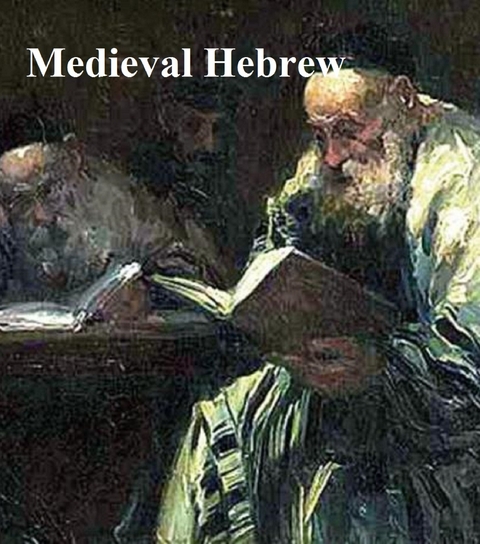
Medieval collections of Jewish biblical lore and legend. From Volume 4 of The Sacred Books and Early Literature of the East. This volulme includes the Tanhuma Midrash, poems of Judah Halevi, the Book Cusari, Commentaries of Rabbi Ben Ezra, Advice of Maimonides, and The Travels of Benjamin of Tudela.
Medieval collections of Jewish biblical lore and legend. From Volume 4 of The Sacred Books and Early Literature of the East. This volulme includes the Tanhuma Midrash, poems of Judah Halevi, the Book Cusari, Commentaries of Rabbi Ben Ezra, Advice of Maimonides, and The Travels of Benjamin of Tudela.
THE BERESHITH OR GENESIS RABBA
It is forbidden to inquire what existed before creation, as Moses distinctly tells us (Deut. iv. 32): "Ask now of the days that are past which were before thee, since the day God created man upon earth." Thus the scope of inquiry is limited to the time since the Creation.
The unity of God is at once set before us in the history of creation, where we are told he, not they, created.
The Torah was to God, when he created the world, what the plan is to an architect when he erects a building.
The aleph, being the first letter of the Hebrew alphabet, demurred at her place being usurped by the letter beth, which is second to her, at the creation; the history of which commences with the latter, instead of with the former. She was, however, quite satisfied when told that, in the history of giving the Decalogue, she would be placed at the beginning, for the world has only been created on account of the Torah, which, indeed, existed anterior to creation; and had the Creator not foreseen that Israel would consent to receive and diffuse the Torah, creation would not have taken place.
There is a difference of opinion as to the day on which angels were created; one authority decides for the second day, on the ground that they are mentioned in connection with water (Ps. civ. 3, 4), which was created on that day; while another, arguing from the fact that they are said to fly (Isa. vi.), assigns their creation to the fifth day, on which all other flying things were created. But all authorities are agreed that they did not exist on the first day of creation, so that skeptics can not say that they were helpers in the work of creation.
The title of an earthly king precedes his name, for instance, Emperor Augustus, etc. Not so was the will of the King of kings; He is only known as God after creating heaven and earth. Thus it is not said, "God created," but "In the beginning created God heavens and earth"; He is not mentioned as God before he created.
Even the new heavens and earth, spoken of by the Prophet Isaiah (lxv. 17), were created in the six days of creation. When any divergence is found in the Scriptures it must not be thought that it is by mere accident, for it is done advisedly. Thus, for instance, we invariably find Abraham, Isaac, and Jacob; but once, as an exception, Jacob is mentioned before the other patriarchs (Lev. xxvi. 42). Again, whilst Moses has always precedence over Aaron, in one instance we find Aaron's name placed before that of Moses (Exod. vi. 26). This is also the case with Joshua and Caleb; whilst the former normally precedes the name of Caleb, there is one exception (Numb. xiv. 30).
This is to show us that these men were equally beloved by God. The same is the case with the love and honor due to parents; whilst the father is as a rule mentioned first in this connection, once (in Lev. xix. 3) the mother is mentioned before the father. This is also intended to indicate that children owe the same love and honor to the mother as to the father. The man that gloats over another man's disgrace and thinks himself raised in dignity by it, is unworthy of future bliss.
Light is mentioned five times in the opening chapter of the Bible. This points to the five books of Moses. "God said, let there be light," refers to the book of Genesis, which enlightens us as to how creation was carried out. The words, "And there was light," bear reference to the book of Exodus, which contains the history of the transition of Israel from darkness to light. "And God saw the light that it was good": this alludes to the book of Leviticus, which contains numerous statutes. "And God divided between the light and between the darkness": this refers to the book of Numbers, divided as that book is between the history of those who came out of Egypt and that of those who were on their way to possess the promised land. "And God called the light day": this bears reference to the book of Deuteronomy, which is not only a rehearsal of the four earlier books, but contains Moses's eloquent dying charge to Israel and many laws not mentioned in the preceding books.
"And the earth was without form and void." There seems to be some reason for the earth's despondency, as though she was aware of her lot beforehand. This may be illustrated by the following parable: A king acquired two servants on precisely the same conditions, but made a distinction in their treatment. Regarding the one, he decreed that she should be fed and maintained at the expense of the king. For the other, he decided that she must maintain herself by her own labor. In the same way, the earth was sad because she saw that the heavens and the earth were equally and at the same time called into being by the same "let there be," or will of God, and yet the heavenly bodies feast on: and are maintained by divine glory; whilst earthly bodies, unless they labor and produce their own sustenance, are not sustained. Or, again, it is as though the king decreed that the one servant should be a constant dweller in his palace, whilst the other should be a fugitive and a wanderer; or gave to the one perpetuity or eternity, and to the other, death. Thus, the earth knowing--as though by inspiration--God's words spoken afterward to Adam (Gen. iii. 17): "Cursed is the ground for thy sake," put on mourning, and thus was "without form and void." In the words, "And there was evening and there was morning one day," the "one day" referred to is the Day of Atonement--the day of expiation.
There seems to be a covenant made with the waters that whenever the heat is excessive and there is scarcely a breath of air moving on land, there is always some breeze, however slight, on the waters.
God knew beforehand that the world would contain both righteous and wicked men, and there is an allusion to this in the story of creation. "The earth without form," means the wicked, and the words, "and there was light," refers to the righteous.
Other worlds were created and destroyed ere this present one was decided on as a permanent one.
Rain is produced by the condensed effusion of the upper firmament.
"How is it," asked an inquisitive matron of Rabbi José, "that your Scriptures crown every day of creation with the words: 'And God saw that it was good,' but the second day is deprived of this phrase?" The Rabbi sought to satisfy her by pointing out that at the end of the creation it is said: "And God saw all that he had made, and it was exceedingly good," so that the second day shares in this commendation. "But," insisted the matron, "there is still an unequal division, since every day has an additional sixth part of the praise, whilst the second day has only the sixth part without the whole one, which the others have for themselves." The sage then mentioned the opinion of Rabbi Samuel, that the reason for the omission is to be found in the fact that the work begun on the second day was not finished before the following (the third) day; hence we find the expression "it was good" twice on that day.
Three were accused: Adam, Eve, and the Serpent; but four were sentenced, viz., the earth, as well as those three. The earth received her sentence as the element out of which rebellious and fallen man was formed.
The waters of the various seas are apparently the same, but the different taste of the fish coming from the various seas seems to contradict this.
God made a condition with Nature at the creation, that the sea should divide to let the Israelites pass through it at the Exodus, and that Nature should alter her course when emergency should arise.
When iron was found the trees began to tremble, but the iron reassured them: "Let no handle made from you enter into anything made from me, and I shall be powerless to injure you."
The following are God's presents, or free gifts, to the world: The Torah (Exod. xxxi. 18), light (Gen. i. 17), Rain (Lev. xxvi. 4), Peace (Lev. xxvi. 6), Salvation (Ps. xviii. 36), Mercy (Ps. cvi. 46). Some add also the knowledge of navigation.
When creation was all but ended, the world with all its grandeur and splendor stood out in its glorious beauty. There was but one thing wanting to consummate the marvelous work called into existence by the mere "let there be," and that was a creature with thought and understanding able to behold, reflect, and marvel on this great handiwork of God, who now sat on his divine throne surrounded by hosts of angels and seraphim singing hymns before him. Then God said, "Let us make man in our likeness, and let there be a creature not only the product of earth, but also gifted with heavenly, spiritual elements, which will bestow on him reason, intellect,...
| Erscheint lt. Verlag | 1.3.2018 |
|---|---|
| Übersetzer | Anonymous |
| Sprache | englisch |
| Themenwelt | Geisteswissenschaften ► Religion / Theologie ► Judentum |
| ISBN-13 | 9781455371433 / 9781455371433 |
| Informationen gemäß Produktsicherheitsverordnung (GPSR) | |
| Haben Sie eine Frage zum Produkt? |
 EPUB (Adobe DRM)
Größe: 501 KB
Kopierschutz: Adobe-DRM
Adobe-DRM ist ein Kopierschutz, der das eBook vor Mißbrauch schützen soll. Dabei wird das eBook bereits beim Download auf Ihre persönliche Adobe-ID autorisiert. Lesen können Sie das eBook dann nur auf den Geräten, welche ebenfalls auf Ihre Adobe-ID registriert sind.
Details zum Adobe-DRM
Dateiformat: EPUB (Electronic Publication)
EPUB ist ein offener Standard für eBooks und eignet sich besonders zur Darstellung von Belletristik und Sachbüchern. Der Fließtext wird dynamisch an die Display- und Schriftgröße angepasst. Auch für mobile Lesegeräte ist EPUB daher gut geeignet.
Systemvoraussetzungen:
PC/Mac: Mit einem PC oder Mac können Sie dieses eBook lesen. Sie benötigen eine
eReader: Dieses eBook kann mit (fast) allen eBook-Readern gelesen werden. Mit dem amazon-Kindle ist es aber nicht kompatibel.
Smartphone/Tablet: Egal ob Apple oder Android, dieses eBook können Sie lesen. Sie benötigen eine
Geräteliste und zusätzliche Hinweise
Buying eBooks from abroad
For tax law reasons we can sell eBooks just within Germany and Switzerland. Regrettably we cannot fulfill eBook-orders from other countries.
EPUB (Ohne DRM)Digital Rights Management: ohne DRM
Dieses eBook enthält kein DRM oder Kopierschutz. Eine Weitergabe an Dritte ist jedoch rechtlich nicht zulässig, weil Sie beim Kauf nur die Rechte an der persönlichen Nutzung erwerben.
Dateiformat: EPUB (Electronic Publication)
EPUB ist ein offener Standard für eBooks und eignet sich besonders zur Darstellung von Belletristik und Sachbüchern. Der Fließtext wird dynamisch an die Display- und Schriftgröße angepasst. Auch für mobile Lesegeräte ist EPUB daher gut geeignet.
Systemvoraussetzungen:
PC/Mac: Mit einem PC oder Mac können Sie dieses eBook lesen. Sie benötigen dafür die kostenlose Software Adobe Digital Editions.
eReader: Dieses eBook kann mit (fast) allen eBook-Readern gelesen werden. Mit dem amazon-Kindle ist es aber nicht kompatibel.
Smartphone/Tablet: Egal ob Apple oder Android, dieses eBook können Sie lesen. Sie benötigen dafür eine kostenlose App.
Geräteliste und zusätzliche Hinweise
Buying eBooks from abroad
For tax law reasons we can sell eBooks just within Germany and Switzerland. Regrettably we cannot fulfill eBook-orders from other countries.
aus dem Bereich