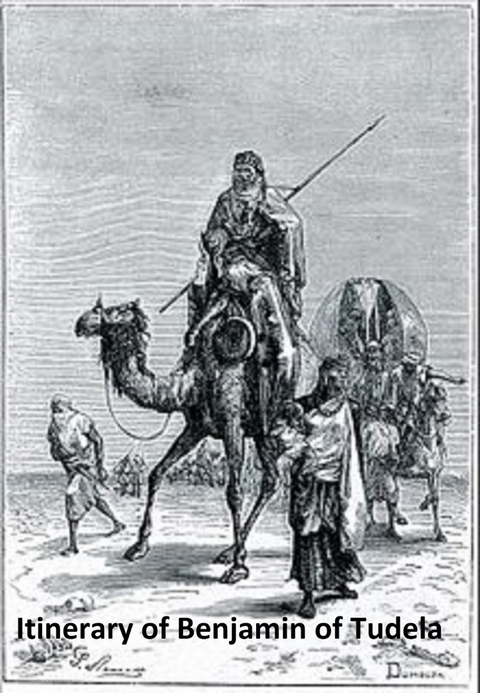
Itinerary of Benjamin of Tudela (eBook)
618 Seiten
Seltzer Books (Verlag)
9781455366231 (ISBN)
First-hand account of a pilgrimage to the Holy Land in the twelfth century. The introduction begins: 'The Itinerary of Benjamin of Tudela throws a flashlight upon one of the most interesting stages in the development of nations. The history of the civilized world from the downfall of the Roman Empire to the present day may be summarized as the struggle between Cross and Crescent. This struggle is characterized by a persistent ebb and flow. Mohammed in 622 A.D. transformed, as if by magic, a cluster of Bedouin tribes into a warlike people. An Arabian Empire was formed, which reached from the Ebro to the Indus. Its further advance was stemmed in the year 732, just a hundred years after Mohammed's death, by Charles Martel, in the seven days' battle of Tours. The progress of the culture of the Arabs was as rapid as had been that of their arms. Great cities such as Cairo and Bagdad were built. Commerce and manufactures flourished. The Jews, who enjoyed protection under the benign rule of the Caliphs...'
First-hand account of a pilgrimage to the Holy Land in the twelfth century. The introduction begins: "e;The Itinerary of Benjamin of Tudela throws a flashlight upon one of the most interesting stages in the development of nations. The history of the civilized world from the downfall of the Roman Empire to the present day may be summarized as the struggle between Cross and Crescent. This struggle is characterized by a persistent ebb and flow. Mohammed in 622 A.D. transformed, as if by magic, a cluster of Bedouin tribes into a warlike people. An Arabian Empire was formed, which reached from the Ebro to the Indus. Its further advance was stemmed in the year 732, just a hundred years after Mohammed's death, by Charles Martel, in the seven days' battle of Tours. The progress of the culture of the Arabs was as rapid as had been that of their arms. Great cities such as Cairo and Bagdad were built. Commerce and manufactures flourished. The Jews, who enjoyed protection under the benign rule of the Caliphs..."e;
FOOTNOTES:
[Footnote 1: Tudela was called in Benjamin's time Tuteila. Sepharad is Spain.]
[Footnote 2: There is a considerable difference of opinion as to the exact dates at which Benjamin began and completed his journey. In my opinion, the period can be placed within a very narrow compass. Early in his journey he visited Rome, where he found R. Jechiel to be the steward of the household of Pope Alexander. This can be no other than Pope Alexander III, who played so important a part in the struggle between King Henry II and Thomas a Becket. The German Emperor, Frederick Barbarossa, supported the anti-Pope Victor IV, and in consequence Alexander had to leave Rome soon after his election in 1159 and before his consecration. He did not return to settle down permanently in Rome until November 23, 1165, but was forced to leave again in 1167. Consequently Benjamin must have been in Rome between the end of 1165 and 1167. Benjamin terminated his travels by passing from Egypt to Sicily and Italy, then crossing the Alps and visiting Germany. In Cairo he found that the Fatimite Caliph was the acknowledged ruler. The Caliph here referred to must have been El-'Adid, who died on Monday, September 13, 1171--being the last of the Fatimite line. A short time before his death, Saladin had become the virtual ruler of Egypt, and had ordered the Khotba to be read in the name of the Abbaside Caliph el-Mostadi of Bagdad. (See the Life of Saladin, by Bohadin: Palestine Pilgrims' Text Society.) It is clear, therefore, that Benjamin's absence from Europe must be placed between the years 1166 and 1171. Benjamin on his return journey passed through Sicily when the island was no longer governed by a viceroy. King William II (the Good) attained his majority in 1169, and Benjamin's visit took place subsequently. It will be found in the course of the narrative that not a single statement by Benjamin is inconsistent with this determination of date; see, n. 4;, n. 2;, n. 4;, n. 1; and, n. 2.]
[Footnote 3: Saragossa was called in Benjamin's time Sarakosta (= Caesar-Augusta). Charisi, in Tachkemoni, 46, refers to some of the Rabbis.]
[Footnote 4: The imposing ruins at Tarragona comprise prehistoric walls of enormous unhewn blocks of stone, as well as the remains of Roman aqueducts, tombs, amphitheatres, &c. Here and generally in this narrative the letter R is used as an abbreviation for Rabbi.]
[Footnote 5: See Graetz, Geschichte der Juden, vol. VI, et seq.; also notes 1 and 10 at the end of vol. VI.]
[Footnote 6: The ancient name of Gerona was Gerunda.]
[Footnote 7: See Geiger's Juedische Zeitschrift fuer Wissenschaft und Leben. The Records of Narbonne bear evidence of sales of lands standing in the name of R. Kalonymos ( Archives Israelites, 1861,). His ancestor, R. Machir, came to Europe in the time of Charlemagne.]
[Footnote 8: R. Abraham ben Isaac (Rabad II) was author of the Rabbinic code; Ha-Eshkol, and was one of the intermediaries between the Talmudists of France and the Scholars of Spain. He died 1178.]
[Footnote 9: A parasang is about 3-2/5 English miles, and the distance from Narbonne to Beziers is correctly given. 10 parasangs make a day's journey.]
[Footnote 10: The King of Portugal is even now styled King of the Algarves.]
[Footnote 11: Cf. Graetz, VI, also Joseph Jacob's Angevin Jews. R. Asher was one of a group of pious Rabbis known as Perushim--who might be styled Jewish monks. His father, Rabbenu Meshullam, died 1170.]
[Footnote 12: He is referred to in Tosafoth Temurah, fol. 12a and b.]
[Footnote 13: This eminent Talmudist, known as the Rabad, was son-in-law of the R. Abraham of Narbonne before referred to. See Graetz, VI, 243.]
[Footnote 14: The Abbey of St. Aegidius was much resorted to in the Middle Ages. The Jews of Beaucaire, and the neighbourhood, enjoyed the patronage of Raymond V, Count of Toulouse, called by the Troubadour poets "the good Duke." See Graetz, VI, note I. It is impossible to enlarge in these notes upon the several Jewish scholars referred to by Benjamin. An interesting article by Professor Israel Levi on the "Jews in Mediaeval France," and other articles, in the Jewish Encyclopaedia, also Gross, Gallia Judaica, might be consulted with advantage.]
[Footnote 15: The BM. MS. calls R. Abba Mari dead, which statement, unless qualified, as in a few other instances, by the insertion of the word "since," would be unintelligible.]
[Footnote 16: Asher's Text and Epstein's MS. give the distance between Arles and Marseilles as three days' journey. The actual distance is about fifty-three English miles. Probably the Roman roads were still in use.]
[Footnote 17: R. Isaac, son of Abba Mari, is the celebrated author of "Baal Haittur"; he wrote this work at Marseilles, 1179. It is doubtful whether he was the son of Count Raymond's bailiff.]
[Footnote 18: His full name is R. Jacob Perpignano. See Graetz, VI, note 1.]
[Footnote 19: The meaning of course is that the Genoese pillage Christian and Mohammedan places alike.]
[Footnote 20: See Dr. H. Berliner's work Die Geschichte der Juden in Rom. His derivation of the Hebrew word used for Pope, [Hebrew:] from Peter, is questionable. It is the Greek [Greek: hepiphoros]. See Talmud, Aboda Zarah, 11 a.]
[Footnote 21: The great work alluded to is the Talmudical Dictionary, completed in 1101. See Graetz, VI.]
[Footnote 22: The palace of the Caesars on the Palatine Hill is no doubt here referred to.]
[Footnote 23: [Hebrew:], quoted by E and Asher, is a corrupt reading for [Hebrew:].]
[Footnote 24: This is Josippon's story. Benjamin occasionally embodies in his work fantastic legends told him, or recorded by his predecessors. His authorities lived in the darkest period of the Middle Ages. Josippon, Book I, Chap, iv, speaks of 320 senators. I have followed Breithaupt, and rendered [Hebrew:] "consul."]
[Footnote 25: Having regard to the various readings, it is possible that the Thermae of Diocletian or more probably the Flavian amphitheatre, which early in the Middle Ages began to be called the Colosseum, is here referred to. It had four stories, each floor composed of arcades containing eighty separate compartments, making 320 in all. Our author in the course of his narrative speaks more than once of buildings erected on a uniform plan corresponding with the days of the year.]
[Footnote 26: I. Heilprin, the author of Seder Hadoroth (Warsaw, 1897 edition,) as well as Zunz, appear to have here fallen into error, assuming as they do that Benjamin refers to the ten teachers of the Mishna, R. Gamaliel, R. Akiba and the other sages who suffered martyrdom in Palestine at the hands of the Roman Emperors. The ten martyrs here alluded to are those referred to in the Preface to Hakemoni, published by Geiger in [Hebrew:], Berlin, 1840, and [Hebrew:], Berlin edition, fols. 151-2 [Hebrew:] Rome, as so many other cities, had its own martyrs.]
[Footnote 27: This is the statue of Marcus Aurelius now before the Capitol.]
[Footnote 28: Even in Benjamin's time the Campagna was noted for malaria.]
[Footnote 29: Professor Ray Lankester, in a lecture given on Dec. 29, 1903, at the Royal Institution, illustrated changes in the disposition of land and water by pointing to the identical ruined Temple referred to by Benjamin. It now stands high above the sea, and did so in the second and third centuries of the present era, but in the eighth and ninth centuries was so low, owing to the sinking of the land, that the lower parts of its marble pillars stood in the sea, and sea-shells grew in the crevices.]
[Footnote 30: Josippon gives these legends in Book I, chaps. iii and iv, when speaking of Zur, whom he associates with Sorrento. Benjamin had few other sources of information. In the immediate neighbourhood of Pozzuoli is Solfatara, where sulphur is found. A destructive eruption from the crater took place in 1198. Hot springs abound, and the baths at Bagnoli are much frequented to the present day. The underground road is the Piedi grotta of Posilipo, constructed by Augustus.]
[Footnote 31: R. Isaac, the father of R. Judah, must be the "Greek Locust" against whom Ibn Ezra directed his satire when visiting Salerno some twenty years before R. Benjamin. See Graetz, VI.]
[Footnote 32: Cf. Isaiah lxvi. 19.]
[Footnote 33: This city was destroyed by William the Bad in 1156. It was ordered to be restored by William the Good in 1169, so that Benjamin must have visited Bari before that date. See, note 2. We have here another clue as to the date of Benjamin's travels.]
[Footnote 34: See H.M. Adler's article on Jews in Southern Italy, J.Q.R., XIV. Gibbon, Decline and Fall of the Roman Empire, chap. lvi, describing the reconquest of the southern provinces of Italy by the Byzantine Emperor Manuel, 1155, says. "The natives of Calabria were still attached to the Greek language and worship."]
[Footnote 35: The river Achelous falls into the Ionian Sea opposite to Ithaca.]
[Footnote 36: Anatolica is now known as Aetolicum.]
[Footnote 37: Patras, the ancient Patrae, was founded long before the time of Antipater. Josippon, II, chap. xxiii, is again...
| Erscheint lt. Verlag | 1.3.2018 |
|---|---|
| Übersetzer | Benjamin of Tudela |
| Sprache | englisch |
| Themenwelt | Geisteswissenschaften ► Religion / Theologie ► Judentum |
| ISBN-13 | 9781455366231 / 9781455366231 |
| Informationen gemäß Produktsicherheitsverordnung (GPSR) | |
| Haben Sie eine Frage zum Produkt? |
 EPUB (Adobe DRM)
Größe: 618 KB
Kopierschutz: Adobe-DRM
Adobe-DRM ist ein Kopierschutz, der das eBook vor Mißbrauch schützen soll. Dabei wird das eBook bereits beim Download auf Ihre persönliche Adobe-ID autorisiert. Lesen können Sie das eBook dann nur auf den Geräten, welche ebenfalls auf Ihre Adobe-ID registriert sind.
Details zum Adobe-DRM
Dateiformat: EPUB (Electronic Publication)
EPUB ist ein offener Standard für eBooks und eignet sich besonders zur Darstellung von Belletristik und Sachbüchern. Der Fließtext wird dynamisch an die Display- und Schriftgröße angepasst. Auch für mobile Lesegeräte ist EPUB daher gut geeignet.
Systemvoraussetzungen:
PC/Mac: Mit einem PC oder Mac können Sie dieses eBook lesen. Sie benötigen eine
eReader: Dieses eBook kann mit (fast) allen eBook-Readern gelesen werden. Mit dem amazon-Kindle ist es aber nicht kompatibel.
Smartphone/Tablet: Egal ob Apple oder Android, dieses eBook können Sie lesen. Sie benötigen eine
Geräteliste und zusätzliche Hinweise
Buying eBooks from abroad
For tax law reasons we can sell eBooks just within Germany and Switzerland. Regrettably we cannot fulfill eBook-orders from other countries.
EPUB (Ohne DRM)Digital Rights Management: ohne DRM
Dieses eBook enthält kein DRM oder Kopierschutz. Eine Weitergabe an Dritte ist jedoch rechtlich nicht zulässig, weil Sie beim Kauf nur die Rechte an der persönlichen Nutzung erwerben.
Dateiformat: EPUB (Electronic Publication)
EPUB ist ein offener Standard für eBooks und eignet sich besonders zur Darstellung von Belletristik und Sachbüchern. Der Fließtext wird dynamisch an die Display- und Schriftgröße angepasst. Auch für mobile Lesegeräte ist EPUB daher gut geeignet.
Systemvoraussetzungen:
PC/Mac: Mit einem PC oder Mac können Sie dieses eBook lesen. Sie benötigen dafür die kostenlose Software Adobe Digital Editions.
eReader: Dieses eBook kann mit (fast) allen eBook-Readern gelesen werden. Mit dem amazon-Kindle ist es aber nicht kompatibel.
Smartphone/Tablet: Egal ob Apple oder Android, dieses eBook können Sie lesen. Sie benötigen dafür eine kostenlose App.
Geräteliste und zusätzliche Hinweise
Buying eBooks from abroad
For tax law reasons we can sell eBooks just within Germany and Switzerland. Regrettably we cannot fulfill eBook-orders from other countries.
aus dem Bereich