Hebraic Literature (eBook)
638 Seiten
Seltzer Books (Verlag)
978-1-4554-0445-2 (ISBN)
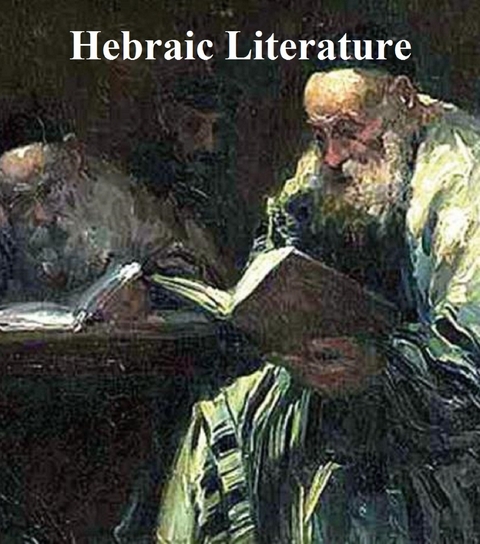
Chapters cover: Talmud, Midrashim, Kabbala, Rabinical Ana, Proverbial Saying and Traditions, and Fasts and Festivals. The Introduction begins: 'AMONG the absurd notions as to what the Talmud was, given credence in the Middle Ages, one was that it was a man! The medieval priest or peasant was perhaps wiser than he knew. Almost, might we say, the Talmud was Man, for it is a record of the doings, the beliefs, the usages, the hopes, the sufferings, the patience, the humor, the mentality, and the morality of the Jewish people for half a millennium.'
Chapters cover: Talmud, Midrashim, Kabbala, Rabinical Ana, Proverbial Saying and Traditions, and Fasts and Festivals. The Introduction begins: "e;AMONG the absurd notions as to what the Talmud was, given credence in the Middle Ages, one was that it was a man! The medieval priest or peasant was perhaps wiser than he knew. Almost, might we say, the Talmud was Man, for it is a record of the doings, the beliefs, the usages, the hopes, the sufferings, the patience, the humor, the mentality, and the morality of the Jewish people for half a millennium."e;
THE TALMUD
THE TALMUD, THE MIDRASHIM, AND KABBALA
WHERE do we learn that the Shechinah rests even upon one who studies the law? In Exodus xx. 24, where it is written, "In all places where I record my name I will come unto thee, and I will bless thee." Berachoth, fol. 6, col. 1. One pang of remorse at a man's heart is of more avail than many stripes applied to him. (See Prov. xvii. 10.) Ibid., fol. 7, col. 1. "Here, O Israel, the Lord our God is one Lord!" (Deut. vi. 4.) Whosoever prolongs the utterance of the word one, shall have his days and years prolonged to him. So also Zohar, syn. tit. ii. Ibid., fol. 13, col. 2. Once, as the Rabbis tell us, the Roman Government issued a decree forbidding Israel to study the law. Whereupon Pappus, the son of Yehudah, one day found Rabbi Akiva teaching it openly to multitudes, whom he had gathered round him to hear it. "Akiva," said he, "art thou not afraid of the Government?" "List," was the reply, "and I will tell thee how it is by a parable. It is with me as with the fishes whom a fox, walking once by a river's side, saw darting distractedly to and fro in the stream; and, addressing, inquired, 'From what, pray, are ye fleeing?' 'From the nets,' they replied, 'which the children of men have set to ensnare us.' 'Why, then,' rejoined the fox, 'not try the dry land with me, where you and I can live together, as our fathers managed to do before us?' 'Surely,' exclaimed they, 'thou art not he of whom we have heard so much as the most cunning of animals, for herein thou art not wise, but foolish. For if we have cause to fear where it is natural for us to live, how much more reason have we to do so where we needs must die!' {p. 4} Just so," continued Akiva, "is it with us who study the law, in which (Deut. xxx. 20) it is written, 'He is thy life and the length of thy days;' for if we suffer while we study the law, how much more shall we if we neglect it?" Not many days after, it is related, this Rabbi Akiva was apprehended and thrown into prison. As it happened, they led him out for execution just at the time when "Hear, O Israel!" fell to be repeated, and as they tore his flesh with currycombs, and as he was with long-drawn breath sounding forth the word one, his soul departed from him. Then came forth a voice from heaven which said, "Blessed art thou, Rabbi Akiva, for thy soul and the word one left thy body together." Berachoth, fol. 61, col. 2. The badger, as it existed in the days of Moses, was an animal of unique type, and the learned are not agreed whether it was a wild one or a domestic. It had only one horn on its forehead; and was assigned for the time to Moses, who made a covering of its skin for the tabernacle; after which it became extinct, having served the purpose of its existence. Rabbi Yehudah says, "The ox, also, which the first man, Adam, sacrificed, had but one horn on its forehead." Shabbath, fol. 28, col. 2. Once a Gentile came to Shamai, and said, "Proselytize me, but on condition that thou teach me the whole law, even the whole of it, while I stand upon one leg." Shamai drove him off with the builder's rod which he held in his hand. When he came to Hillel with the same challenge, Hillel converted him by answering him on the spot, "That which is hateful to thyself, do not do to thy neighbor. This is the whole law, and the rest is its commentary." (Tobit, iv. 15; Matt. vii. 12.) Ibid., fol. 31, col. 1. When Rabbi Shimon ben Yochai and his son, Rabbi Elazar, came out of their cave on a Friday afternoon, they saw an old man hurrying along with two bunches of myrtle in his hand. "What," said they, accosting him, "dost thou want with these?" "To smell them in honor of the Sabbath," was the reply. "Would not one bunch," they remarked, "be enough for that purpose?" "Nay," the old man replied; "one is in honor of 'Remember' (Exod. xxii. 28); {p. 5} and one in honor of 'Keep' (Deut. v. 8)." Thereupon Rabbi Shimon remarked to his son, "Behold how the commandments are regarded by Israel!" Ibid., fol. 33, col. 2. Not one single thing has God created in vain. He created the snail as a remedy for a blister; the fly for the sting of a wasp; the gnat for the bite of a serpent; the serpent itself for healing the itch (or the scab); and the lizard (or the spider) for the sting of a scorpion. Ibid., fol. 77. col. 2. When a man is dangerously ill, the law grants dispensation, for it says, "You may break one Sabbath on his behalf, that he may be preserved to keep many Sabbaths." Shabbath, fol. 151, col. 2. Once when Rabbi Ishmael paid a visit to Rabbi Shimon, he was offered a cup of wine, which he at once, without being asked twice, accepted, and drained at one draught. "Sir," said his host, "dost thou not know the proverb, that he who drinks off a cup of wine at a draught is a greedy one?" "Ah!" was the answer, "that fits not this case; for thy cup is small, thy wine is sweet, and my stomach is capacious." P'sachim, fol. 86, col. 2. At the time when Nimrod the wicked had cast our Father Abraham into the fiery furnace, Gabriel stood forth in the presence of the Holy One--blessed be He!--and said, "Lord of the universe, let me, I pray thee, go down and cool the furnace, and deliver that righteous one from it." Then the Holy One--blessed be He!--said unto him, "I am One in my world and he is one in his world; it is more becoming that He who is one should deliver him who is one." But as God does not withhold His reward from any creature, He said to Gabriel, "For this thy good intention, be thine the honor of rescuing three of his descendants." At the time when Nebuchadnezzar the wicked cast Hananiah, Mishael, and Azariah into the fiery furnace, Yourkami, the prince of hail, arose before God and said, "Lord of the universe, let me, I pray thee, go down and cool the fiery furnace, and rescue these righteous men from its fury." Whereupon Gabriel interposed, and said, "God's power is not to be demonstrated thus, for thou art the prince of hail, and everybody knows that water quenches fire; but I, the prince of fire, will go down and cool the flame within and intensify it without (so as to consume the executioners), and thus will I perform a miracle within a miracle." Then the Holy One--blessed be He!--said to him, "Go down." Upon which Gabriel exclaimed, "Verily the truth of the Lord endureth forever!" (Ps. cxvii. 2.) P'sachim, fol. 118, col. 1. One peppercorn to-day is better than a basketful of pumpkins to-morrow. Chaggigah, fol. 10, col. 1. One day of a year is counted for a whole year. Rosh Hashanah, fol. 2, col. 2. If a king be crowned on the twenty-ninth of Adar (the last month of the sacred year), on the morrow--the first of Nissan--it is reckoned that he commences his second year, that being the new year's day for royal and ecclesiastical affairs. For the sake of one righteous man the whole world is preserved in existence, as it is written (Prov. x. 25), "The righteous man is an everlasting foundation." Yoma, fol. 38, col. 2. Rabbi Meyer saith, "Great is repentance, because for the sake of one that truly repenteth the whole world is pardoned; as it is written (Hosea xiv. 4), 'I will heal their backsliding, I will love them freely, for mine anger is turned away from him. It is not said, "from them," but "from him." Ibid., fol. 86, col. 2. He who observes one precept, in addition to those which, as originally laid upon him, he has discharged, shall receive favor from above, and is equal to him who has fulfilled the whole law. Kiddushin, fol. 39, col. 2. If any man vow a vow by only one of all the utensils of the altar, he has vowed by the corban, even although be did not mention the word in his oath. Rabbi Yehuda says, "He who swears by the word Jerusalem is as though he had said nothing." Nedarim, fol. 10, col. 2. Balaam was lame in one foot and blind in one eye. Soteh, fol. 10, col. 1, and Sanhedrin, fol. 105, col. 1. One wins eternal life after a struggle of years, another finds it in one hour (see Luke xxiii. 43). Avodah Zarah, fol. 17, Col. This saying is applied by Rabbi the Holy to Rabbi Eliezar, the son of Durdia, a profligate who recommended himself to the favor of heaven by one prolonged act of determined penitence, placing his head between his knees and groaning and weeping till his soul departed from him, and his sin and misery along with it; for at the moment of death a voice from heaven came forth and said, "Rabbi Eliezar, the son of Durdia, is appointed to life everlasting." When Rabbi the Holy heard this, he wept, and said, "One wins eternal life after a struggle of years; another finds it in one hour." (Compare Luke xv. 11-32.) Whosoever destroyeth one soul of Israel, Scripture counts it to him as though he had destroyed the whole world; and whoso preserveth one soul of Israel, Scripture counts it as though he had preserved the whole world. Sanhedrin, fol. 37, col. 1. The greatness of God is infinite; for while with one die man impresses many coins and all are exactly alike,...
| Erscheint lt. Verlag | 1.3.2018 |
|---|---|
| Sprache | englisch |
| Themenwelt | Geisteswissenschaften ► Religion / Theologie ► Judentum |
| ISBN-10 | 1-4554-0445-4 / 1455404454 |
| ISBN-13 | 978-1-4554-0445-2 / 9781455404452 |
| Informationen gemäß Produktsicherheitsverordnung (GPSR) | |
| Haben Sie eine Frage zum Produkt? |
 EPUB (Adobe DRM)
Größe: 638 KB
Kopierschutz: Adobe-DRM
Adobe-DRM ist ein Kopierschutz, der das eBook vor Mißbrauch schützen soll. Dabei wird das eBook bereits beim Download auf Ihre persönliche Adobe-ID autorisiert. Lesen können Sie das eBook dann nur auf den Geräten, welche ebenfalls auf Ihre Adobe-ID registriert sind.
Details zum Adobe-DRM
Dateiformat: EPUB (Electronic Publication)
EPUB ist ein offener Standard für eBooks und eignet sich besonders zur Darstellung von Belletristik und Sachbüchern. Der Fließtext wird dynamisch an die Display- und Schriftgröße angepasst. Auch für mobile Lesegeräte ist EPUB daher gut geeignet.
Systemvoraussetzungen:
PC/Mac: Mit einem PC oder Mac können Sie dieses eBook lesen. Sie benötigen eine
eReader: Dieses eBook kann mit (fast) allen eBook-Readern gelesen werden. Mit dem amazon-Kindle ist es aber nicht kompatibel.
Smartphone/Tablet: Egal ob Apple oder Android, dieses eBook können Sie lesen. Sie benötigen eine
Geräteliste und zusätzliche Hinweise
Buying eBooks from abroad
For tax law reasons we can sell eBooks just within Germany and Switzerland. Regrettably we cannot fulfill eBook-orders from other countries.
EPUB (Ohne DRM)Digital Rights Management: ohne DRM
Dieses eBook enthält kein DRM oder Kopierschutz. Eine Weitergabe an Dritte ist jedoch rechtlich nicht zulässig, weil Sie beim Kauf nur die Rechte an der persönlichen Nutzung erwerben.
Dateiformat: EPUB (Electronic Publication)
EPUB ist ein offener Standard für eBooks und eignet sich besonders zur Darstellung von Belletristik und Sachbüchern. Der Fließtext wird dynamisch an die Display- und Schriftgröße angepasst. Auch für mobile Lesegeräte ist EPUB daher gut geeignet.
Systemvoraussetzungen:
PC/Mac: Mit einem PC oder Mac können Sie dieses eBook lesen. Sie benötigen dafür die kostenlose Software Adobe Digital Editions.
eReader: Dieses eBook kann mit (fast) allen eBook-Readern gelesen werden. Mit dem amazon-Kindle ist es aber nicht kompatibel.
Smartphone/Tablet: Egal ob Apple oder Android, dieses eBook können Sie lesen. Sie benötigen dafür eine kostenlose App.
Geräteliste und zusätzliche Hinweise
Buying eBooks from abroad
For tax law reasons we can sell eBooks just within Germany and Switzerland. Regrettably we cannot fulfill eBook-orders from other countries.
aus dem Bereich