Sayings of the Jewish Fathers (eBook)
390 Seiten
Seltzer Books (Verlag)
978-1-4553-9575-0 (ISBN)
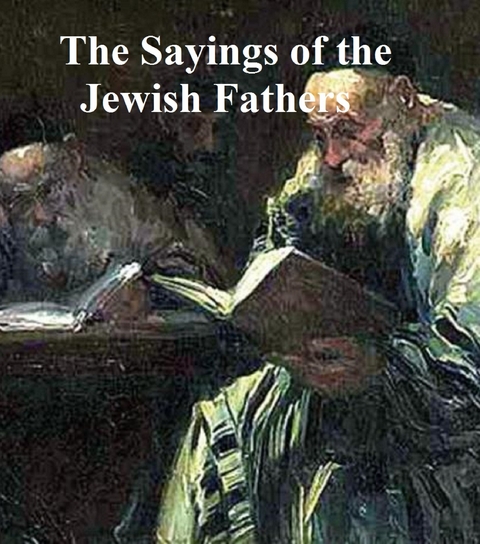
Volume 3 of the Library of Jewish Classics. From the Preface:'Notwithstanding the fact that there are many editions of the Sayings of the Jewish Fathers, and that it has been translated innumerable times in all modern tongues, no apology need be given for the appearance of this little volume in the series of Jewish Classics. The Pirke Abot is indeed a classical bit of that ancient Jewish classic, the Mishnah. The translation in this edition is based largely upon that of Taylor, in his Sayings of the Jewish Fathers, and upon the excellent version of Singer, in his Authorized Daily Prayer Book.'
Volume 3 of the Library of Jewish Classics. From the Preface: "e;Notwithstanding the fact that there are many editions of the Sayings of the Jewish Fathers, and that it has been translated innumerable times in all modern tongues, no apology need be given for the appearance of this little volume in the series of Jewish Classics. The Pirke Abot is indeed a classical bit of that ancient Jewish classic, the Mishnah. The translation in this edition is based largely upon that of Taylor, in his Sayings of the Jewish Fathers, and upon the excellent version of Singer, in his Authorized Daily Prayer Book."e;
CHAPTER I
1. Moses received the Torah (4) from Sinai (5), and handed it down to Joshua, and Joshua to the elders (6), and the elders to the prophets, and the prophets delivered it to the men of the Great Synagogue (7). They said three things, "Be deliberate in judgment; raise up many disciples; and make a fence about the Torah" (8).
(4) The word Torah is usually translated by "law," but it means rather "teaching," "instruction" of any kind, or "doctrine." This term is generally used to designate the Five Books of Moses or the Pentateuch, called the "written law" ([torah shebichtav]), but it is also employed as a designation of the whole of the Old Testament. Besides the "written law," according to tradition, there was also communicated to Moses, on Mt. Sinai, the "oral law" ([torah she'b'al peh]), supplementing the former and other laws and maxims, and explaining it. This "oral law" was handed down by word of mouth from generation to generation, but subsequently, after the destruction of the second Temple, it was committed to writing, and constitutes the Mishnah, the Talmud, and the Midrashim. The "oral law" develops, illuminates, and comments upon the "written law." Here, Torah means the "oral law," which Moses communicated to Joshua, Joshua, in turn, to the elders, and so on. See Taylor, Sayings of the Jewish Fathers, p. 105 et seq., and 134-135; Friedlander, The Jewish Religion, p. 136 et seq.; Jewish Encyclopedia, arts. Law and Oral Law; Schechter, Some Aspects of Rabbinic Theology, Chapter VIII; Strack, Einleitung, pp. 9-10, and Herford, Pharisaism, chapter on "the Theory of Torah," p. 57 et seq.
(5) I.e., from God. Compare the expression [halacha l'moshe misinai], "the law to Moses from Sinai (God)," Peah, II, 6, Eduyot, VIII, 7, etc.
(6) The elders were the wise men who were the members of the supreme national tribunal. See Joshua XXIV, 31.
(7) The Great Synagogue, whose establishment, after the return from Babylonian captivity, tradition attributes to Ezra the Scribe, consisted of 120 men, who comprised the highest judicial tribunal, and who occupied a position in the early days of the Temple similar to that of the later Sanhedrin. The historical foundation of this tradition is Nehemiah VIII-X, in which is recounted the solemn acceptance of the Law by a great assembly of the people. The men of the Great Synagogue appear here in Abot as the depositaries of the tradition of the Torah, coming in the chain between the last prophets and the earliest scribes. From this chapter and other Rabbinical sources, we gather that the men of the Great Synagogue constituted a sort of college of teachers, one of the last survivors being Simon, the Just (Chapter I, 2). Their work was to interpret, teach, and develop the Torah, and to them were ascribed all kinds of legal enactments. They instituted the Shemoneh Esrah (the Eighteen Benedictions) and other prayers, and cast the entire ritual into definite shape. They admitted Proverbs, the Song of Songs, and Ecclesiastes into the Old Testament canon. A number of modern scholars, notably Kuenen, are of the opinion that this body never existed in the form represented by Jewish tradition (see Schurer, History, I, ii, pp. 354-355). On the controversy regarding the existence of the Great Synagogue see Schechter, Studies, II, 105-106. Consult Taylor, ibid., pp. 110-111; Graetz, History of the Jews, vol. I, p. 381, 394, vol. II, p. 19. For further bibliography, see Strack, Spruche, p. 11. See especially Herford, Pharisaism. pp. 18-28.
(8) Take measures to prevent the breaking of any of the divine precepts. Thereby, certain things which are in themselves lawful are prohibited in order to enforce the observance of things the doing of which is unlawful. Compare Leviticus XVIII, 30, "make a mishmeret to my mishmeret" (Yabamot, 21a), and Abot, III, 17, "the Massorah is a fence to the Torah."
2. Simon, the Just (9), was of the last survivors of the Great Synagogue. He used to say, "Upon three things the world rests: upon the Torah, upon the Temple service (10), and upon the doing of acts of kindness" (11).
(9) Simon, the Just, son of Onias, was high-priest about 300 B.C.E. See Josephus, Antiquities, XII, ii, 5. Consult Sammter, Mischnaioth Ordnung Zeraim (Berlin, 1887), Introduction, pp. 10-22; Meilziner, Introduction to the Talmud, pp. 22-39; the Jewish Encyclopedia, and Strack, Einleitung, p. 82 et seq., for the lives of the authorities mentioned in Abot and for bibliographies.
(10) Cf. Nedarim, 32b, "Great is the Torah, for if it did not exist, the heaven and the earth would have no permanence." Abodah is the service and sacrifice of the Temple which was then standing. After the destruction of the Temple, this word was used to designate the service of prayer. It is used in one of the benedictions after the reading of the Haftarah: al ha-torah we-al ha-abodah, "for the law and for the divine service," see Prayer-book, ed. Singer, p. 149. See Friedlander, ibid., p. 413 et seq.
(11) [g'milut chasadim] "benevolence," "the doing of kindnesses," consists of practical deeds of personal service, as visiting the sick, burying the dead, comforting mourners, peacemaking, etc. It is greater than [tzedakah] "charity" in its narrower sense, as benevolence may be shown to the rich as well as to the poor. See Friedlander, ibid., pp. 301-305. On this verse, see Herford, ibid., p. 22 et seq.
3. Antigonus of Soko (12) received (the tradition) from Simon, the Just. He used to say, "Be not like hirelings who work for their master for the sake of receiving recompense; but be like servants who minister to their master without any thought of receiving a reward; and let the fear of Heaven (13) be upon you."
(12) According to Abot de-Rabbi Natan, Chapter V, ed. Schechter, p. 26, Antigonus had two disciples, Zadok and Boethos, from whom arose the Sadducees and the heretical sect of Boethusians, from their misinterpretation of this verse, both denying the doctrines of immortality of the soul and resurrection. Se Kohut, The Ethics of the Fathers, p. 43; Schurer, History, II, ii. p. 29 et seq.; Geiger, Judaism and Its History, p. 99 et seq.; and Jewish Encyclopedia, arts. Boethusians and Sadducees.
(13) "The fear of Heaven" does not mean dread of punishment, but rather awe at the greatness and might of God, and is identical with love and service (see Deuteronomy, VI, 13 and X, 12). It is produced by following out the practices ordained in the Torah (Maimonides, Guide for the Perplexed, ed. Friedlander, p. 392). Consult Friedlander, Jewish Religion, pp. 273-274, the Jewish Encyclopedia, art. Fear of God, and Schechter, Aspects, p. 72.
4. Jose, the son of Joezer, of Zeredah, and Jose, the son of Jochanan (14), of Jerusalem received (the tradition) from them (15). Jose, the son of Joezer, of Zeredah said, "Let thy house be a meeting-place for the wise; cover thyself with the dust of their feet (16), and drink in their words with thirst."
(14) In Chagigah, II, 2, we are told that when two leading teachers are named in the Mishnah as having received the Torah, they constitute a "pair" ([zug]), the first being the president([nasi]), and the second the vice-president ([av beit din]) of the Sanhedrin. There were five pairs of such teachers, flourishing between 170 and 30 B.C.E., the first being Jose b. Joezer and Jose b. Jochanan, and the last being Hillel and Shammai. See Frankel, Monatschrift, 1852, pp. 405-421, Mielziner, Introduction, pp. 22-23, and Strack, Spruche, p. 13.
(15) Some texts read "from him" ([mimenu]). "From them" must refer to disciples of Antigonus whose sayings have been lost.
(16) It was the custom of pupils to sit at the feet of their teachers.
5. Jose, the son of Jochanan, of Jerusalem said, "Let thy house be open wide; let the poor be members of thy household, and engage not in much gossip with woman." This applies to one's own wife; how much more (17), then, to the wife of one's neighbor? Hence the sages say, "Whoso engages in much gossip with woman brings evil upon himself, neglects the study of the Torah, and will in the end inherit gehinnom" (18).
(17) On the kalwa-chomer, "a conclusion a minori ad majus," see Meilziner, Introduction to the Talmud, p. 130 et seq., and Strack, Einleitung in den Talmud, p. 120. Cf. Chapter VI, 3. The equivalent biblical expression is [af ki].
(18) [gey-hinim (gimil-yud hey-nun-yud-mem(sofit))], [gei ben-hinim], a glen south of Jerusalem where Moloch was worshipped, whence a place where the wicked were punished in the hereafter; "hell, being the opposite of 'the Garden of Eden,'" "paradise." Cf. chapter V, 22 and 23. See Friedlander, Jewish Religion, p. 223.
6. Joshua, the son of Perachyah, and Nittai, the Arbelite, received (the tradition) from them. Joshua, the son of Perachyah, said, "Provide thyself with a teacher, and possess thyself of a companion (19); and judge every man in the scale of...
| Erscheint lt. Verlag | 1.3.2018 |
|---|---|
| Sprache | englisch |
| Themenwelt | Geisteswissenschaften ► Religion / Theologie ► Judentum |
| ISBN-10 | 1-4553-9575-7 / 1455395757 |
| ISBN-13 | 978-1-4553-9575-0 / 9781455395750 |
| Informationen gemäß Produktsicherheitsverordnung (GPSR) | |
| Haben Sie eine Frage zum Produkt? |
 EPUB (Adobe DRM)
Größe: 389 KB
Kopierschutz: Adobe-DRM
Adobe-DRM ist ein Kopierschutz, der das eBook vor Mißbrauch schützen soll. Dabei wird das eBook bereits beim Download auf Ihre persönliche Adobe-ID autorisiert. Lesen können Sie das eBook dann nur auf den Geräten, welche ebenfalls auf Ihre Adobe-ID registriert sind.
Details zum Adobe-DRM
Dateiformat: EPUB (Electronic Publication)
EPUB ist ein offener Standard für eBooks und eignet sich besonders zur Darstellung von Belletristik und Sachbüchern. Der Fließtext wird dynamisch an die Display- und Schriftgröße angepasst. Auch für mobile Lesegeräte ist EPUB daher gut geeignet.
Systemvoraussetzungen:
PC/Mac: Mit einem PC oder Mac können Sie dieses eBook lesen. Sie benötigen eine
eReader: Dieses eBook kann mit (fast) allen eBook-Readern gelesen werden. Mit dem amazon-Kindle ist es aber nicht kompatibel.
Smartphone/Tablet: Egal ob Apple oder Android, dieses eBook können Sie lesen. Sie benötigen eine
Geräteliste und zusätzliche Hinweise
Buying eBooks from abroad
For tax law reasons we can sell eBooks just within Germany and Switzerland. Regrettably we cannot fulfill eBook-orders from other countries.
EPUB (Ohne DRM)Digital Rights Management: ohne DRM
Dieses eBook enthält kein DRM oder Kopierschutz. Eine Weitergabe an Dritte ist jedoch rechtlich nicht zulässig, weil Sie beim Kauf nur die Rechte an der persönlichen Nutzung erwerben.
Dateiformat: EPUB (Electronic Publication)
EPUB ist ein offener Standard für eBooks und eignet sich besonders zur Darstellung von Belletristik und Sachbüchern. Der Fließtext wird dynamisch an die Display- und Schriftgröße angepasst. Auch für mobile Lesegeräte ist EPUB daher gut geeignet.
Systemvoraussetzungen:
PC/Mac: Mit einem PC oder Mac können Sie dieses eBook lesen. Sie benötigen dafür die kostenlose Software Adobe Digital Editions.
eReader: Dieses eBook kann mit (fast) allen eBook-Readern gelesen werden. Mit dem amazon-Kindle ist es aber nicht kompatibel.
Smartphone/Tablet: Egal ob Apple oder Android, dieses eBook können Sie lesen. Sie benötigen dafür eine kostenlose App.
Geräteliste und zusätzliche Hinweise
Buying eBooks from abroad
For tax law reasons we can sell eBooks just within Germany and Switzerland. Regrettably we cannot fulfill eBook-orders from other countries.
aus dem Bereich