Babylonian Talmud (eBook)
3904 Seiten
Seltzer Books (Verlag)
9781455366668 (ISBN)
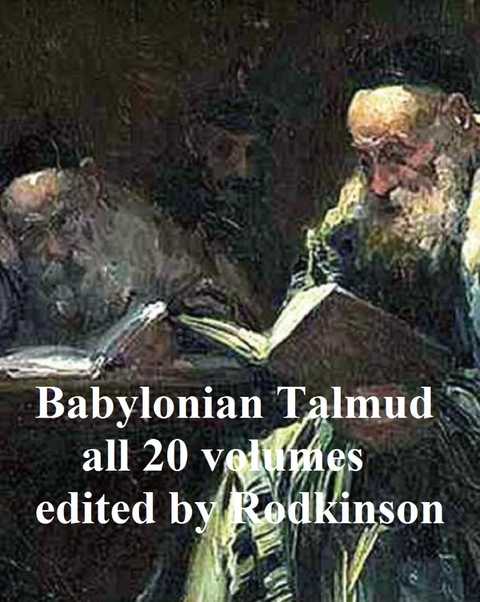
The Talmud, from the 1903 and 1918 editions of the translation by Michael Rodkinson, all 20 volumes. This edition is intended for modern readers. Rodkinson omitted sections where the debate becomes extremely obscure. He points out wherever he did so. The introduction, by Gustav Karpeles, is from the book 'Jewish Literature and Other Essays'.
The Talmud, from the 1903 and 1918 editions of the translation by Michael Rodkinson, all 20 volumes. This edition is intended for modern readers. Rodkinson omitted sections where the debate becomes extremely obscure. He points out wherever he did so. The introduction, by Gustav Karpeles, is from the book "e;Jewish Literature and Other Essays"e;.
VOLUME I TRACT SABBATH
EXPLANATORY REMARKS
In our translation we adopted these principles: 1. Tenan of the original--We have learned in a Mishna; Tania--We have learned in a Boraitha; Itemar--It was taught. 2. Questions are indicated by the interrogation point, and are immediately followed by the answers, without being so marked. 3. When in the original there occur two statements separated by the phrase, Lisna achrena or Waïbayith Aema or Ikha d'amri (literally, "otherwise interpreted"), we translate only the second. 4. As the pages of the original are indicated in our new Hebrew edition, it is not deemed necessary to mark them in the English edition, this being only a translation from the latter. 5. Words or passages enclosed in round parentheses ( ) denote the explanation rendered by Rashi to the foregoing sentence or word. Square parentheses [ ] contain commentaries by authorities of the last period of construction of the Gemara.
COPYRIGHT, 1903, BY MICHAEL L. RODKINSON.
__________________
TO EDWIN R. A. SELIGMAN, PH.D. PROFESSOR OF POLITICAL SCIENCE AT COLUMBIA UNIVERSITY IN RECOGNITION OF HIS WARM INTEREST AND VALUABLE SERVICES IN PROMOTING THE STUDY OF LITERATURE, AND HIS GREAT INSTRUMENTALITY IN ASSISTING YOUNG MEN AND WOMEN TO BROADEN THEIR MINDS, AND REACH A HIGHER SOCIAL PLANE, AND FOR HIS MANY WORKS FOR THE COMMUNAL WELFARE, ESPECIALLY THOSE IN BEHALF OF THE EDUCATIONAL ALLIANCE THIS VOLUME IS MOST RESPECTFULLY DEDICATED BY THE EDITOR AND TRANSLATOR MICHAEL L. RODKINSON. June 15, 1901. New York City.
_________________________
BRIEF GENERAL INTRODUCTION TO THE BABYLONIAN TALMUD
SYNOPSIS OF SUBJECTS OF VOLUME I: TRACT SABBATH
CHAPTER I: REGULATIONS CONCERNING TRANSFER ON SABBATH
CHAPTER II: REGULATIONS CONCERNING THE SABBATH AND 'HANUKAH LIGHT
CHAPTER III: REGULATIONS CONCERNING STOVES, HEARTHS, AND OVENS
CHAPTER IV: REGULATIONS CONCERNING THE DEPOSITING OF VICTUALS ON THE SABBATH
CHAPTER V: REGULATIONS CONCERNING GEAR WHICH MAY AND MAY NOT BE WORN BY ANIMALS ON THE SABBATH
CHAPTER VII: THE GENERAL RULE CONCERNING THE PRINCIPAL ACTS OF LABOR ON SABBATH
CHAPTER IX: RABBI AQIBA'S REGULATIONS ON DIFFERENT SUBJECTS154
CHAPTER X: FURTHER REGULATIONS CONCERNING THE PRESCRIBED QUANTITY OF THINGS TO BE STORED
____________________
PREFACE TO THE SECOND EDITION
The translator of the Talmud, who has now reached the thirteenth volume of his task, covering twenty-one tracts of this great work, certainly cannot point with any great pride to the fact that this is the second edition of his translation which first appeared in 1896, for he believes that the opening and bringing to light of a book so long withheld from the gaze of the curious, and even the learned, should have attracted more attention and deserved greater consideration than it has received. However, he is glad to see that thousands of readers have at last taken advantage of the opportunity of looking into the "sealed book," and to such an extent that second editions have become necessary, both of this volume and of the Tract Rosh Hashana of the fourth volume, which he has reëdited and enlarged upon, adding many historical facts and legends, so that they now appear as practically new works.
This is certainly an encouragement to him to continue his work, with the hope that in time it will gain the proper recognition and proper attention which he thinks this great work of the sixth century should receive at the hands of all scholars and even laymen.
In revising this volume the translator had in mind the many criticisms which have been passed upon his effort and which have appeared in various papers throughout different countries, but he gave his attention to those only which were not prompted by animosity and jealousy. He begs to call the attention of all critics to the dictum of the Talmud, "Kal Hat'haloth Kashoth" (all beginnings are difficult); for, bearing this in mind, they would no doubt have been more moderate.
The translator will be very grateful to critics who will call his attention to any mistakes made in the translation of the original text. However, he will positively ignore criticisms of the kind described above.
The translator further hopes that this and the succeeding volumes will meet with the favor and approval of the public, which will be sufficient reward to repay him for his efforts.
M. L. R. NEW YORK, June, 1901.
_____________________
EDITOR'S PREFACE. [To the first edition]
THE Hebrew edition of Rosh Hashana contains an elaborate introduction in three chapters, the translation of which does not appear as yet. Its contents include many important rules which we have followed in the entire work, but we do not feel called upon at this time to engross the time of the English reader by reciting them. We, however, deem it a duty to say a few words, so that the reader may understand our position and the reason why we have undertaken a work which will probably be productive of much adverse criticism in certain quarters. The fate of the Talmud has been the fate of the Jews. As soon as the Hebrew was born 1 he was surrounded by enemies. His whole history has been one of struggle against persecution and attack. Defamation and deformation have been his lot. So too, has it been with the Talmud. At the beginning of its formative period, viz., the development of the Mishna, it was beset by such enemies as the Sadducees, the Boëthusians, and other sects, not to mention the Roman Government. 2 When its canon was fixed, the Karaites tried to destroy or belittle its influence, and since that time it has been subjected to an experience of unvarying difficulty. Yet, with remarkable truth, the words of Isaiah [xliii. 2] may be applied to both: "When thou passest through the waters, I will be with thee; and through the rivers, they shall not overflow thee; when thou walkest through the fire, thou shalt not be burned; neither shall the flame kindle upon thee." There is, however, one point concerning which this simile is not true. The Jew has advanced; the Talmud has remained stationary.
Since the time of Moses Mendelssohn the Jew has made vast strides forward. There is to-day no branch of human activity in which his influence is not felt. Interesting himself in the affairs of the world, he has been enabled to bring a degree of intelligence and industry to bear upon modern life that has challenged the admiration of the world. But with the Talmud it is not so. That vast encyclopædia of Jewish lore remains as it was. No improvement has been possible; no progress has been made with it. Issue after issue has appeared, but it has always been called the Talmud Babli, as chaotic as it was when its canon was originally appointed. 1 Commentary upon commentary has appeared; every issue of the Talmud contains new glosses from prominent scholars, proposing textual changes, yet the text of the Talmud has not received that heroic treatment that will alone enable us to say that the Talmud has been improved. Few books have ever received more attention than this vast storehouse of Jewish knowledge. Friends and enemies it has had. Attack after attack has been made upon it, and defence after defence made for it; yet whether its enemies or its defenders have done it more harm it would be hard to tell. Not, forsooth, that we do not willingly recognize that there have been many learned and earnest spirits who have labored faithfully in its behalf; but for the most part, if the Talmud could speak, it would say, "God save me from my friends!" For the friends have, generally, defended without due knowledge of that stupendous monument of rabbinical lore; and the enemies have usually attacked it by using single phrases or epigrams disconnected from their context, by which method anything could be proven. In both cases ignorance has been fatal. For, how many have read the whole Talmud through and are thus competent to judge of its merits? Is it right to attack or defend without sufficient information? Is it not a proof of ignorance and unfairness to find fault with that of which we are not able to give proper testimony?
Let us take the case of those persons in particular who attacked the Talmud and made it the object of their venomous vituperation. Is it possible that they could have believed it a work capable of...
| Erscheint lt. Verlag | 1.3.2018 |
|---|---|
| Übersetzer | Michael Rodkinson |
| Sprache | englisch |
| Themenwelt | Geisteswissenschaften ► Religion / Theologie ► Judentum |
| ISBN-13 | 9781455366668 / 9781455366668 |
| Informationen gemäß Produktsicherheitsverordnung (GPSR) | |
| Haben Sie eine Frage zum Produkt? |
 EPUB (Adobe DRM)
Größe: 3,9 MB
Kopierschutz: Adobe-DRM
Adobe-DRM ist ein Kopierschutz, der das eBook vor Mißbrauch schützen soll. Dabei wird das eBook bereits beim Download auf Ihre persönliche Adobe-ID autorisiert. Lesen können Sie das eBook dann nur auf den Geräten, welche ebenfalls auf Ihre Adobe-ID registriert sind.
Details zum Adobe-DRM
Dateiformat: EPUB (Electronic Publication)
EPUB ist ein offener Standard für eBooks und eignet sich besonders zur Darstellung von Belletristik und Sachbüchern. Der Fließtext wird dynamisch an die Display- und Schriftgröße angepasst. Auch für mobile Lesegeräte ist EPUB daher gut geeignet.
Systemvoraussetzungen:
PC/Mac: Mit einem PC oder Mac können Sie dieses eBook lesen. Sie benötigen eine
eReader: Dieses eBook kann mit (fast) allen eBook-Readern gelesen werden. Mit dem amazon-Kindle ist es aber nicht kompatibel.
Smartphone/Tablet: Egal ob Apple oder Android, dieses eBook können Sie lesen. Sie benötigen eine
Geräteliste und zusätzliche Hinweise
Buying eBooks from abroad
For tax law reasons we can sell eBooks just within Germany and Switzerland. Regrettably we cannot fulfill eBook-orders from other countries.
EPUB (Ohne DRM)Digital Rights Management: ohne DRM
Dieses eBook enthält kein DRM oder Kopierschutz. Eine Weitergabe an Dritte ist jedoch rechtlich nicht zulässig, weil Sie beim Kauf nur die Rechte an der persönlichen Nutzung erwerben.
Dateiformat: EPUB (Electronic Publication)
EPUB ist ein offener Standard für eBooks und eignet sich besonders zur Darstellung von Belletristik und Sachbüchern. Der Fließtext wird dynamisch an die Display- und Schriftgröße angepasst. Auch für mobile Lesegeräte ist EPUB daher gut geeignet.
Systemvoraussetzungen:
PC/Mac: Mit einem PC oder Mac können Sie dieses eBook lesen. Sie benötigen dafür die kostenlose Software Adobe Digital Editions.
eReader: Dieses eBook kann mit (fast) allen eBook-Readern gelesen werden. Mit dem amazon-Kindle ist es aber nicht kompatibel.
Smartphone/Tablet: Egal ob Apple oder Android, dieses eBook können Sie lesen. Sie benötigen dafür eine kostenlose App.
Geräteliste und zusätzliche Hinweise
Buying eBooks from abroad
For tax law reasons we can sell eBooks just within Germany and Switzerland. Regrettably we cannot fulfill eBook-orders from other countries.
aus dem Bereich