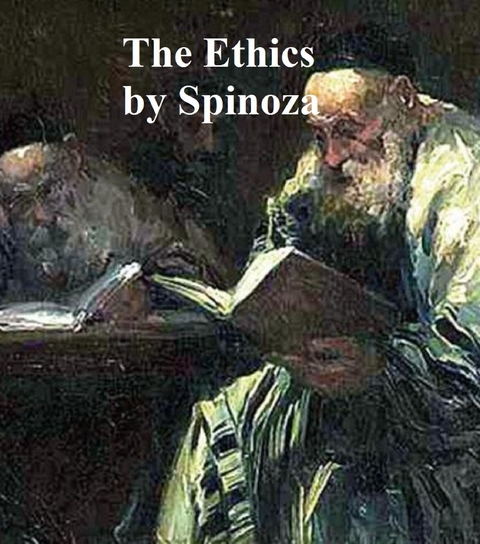

According to Wikipedia: 'Ethics, Demonstrated in Geometrical Order (Latin: Ethica, ordine geometrico demonstrata), usually known as the Ethics, is a philosophical treatise written by Benedict de Spinoza. It was first published in 1677. The book closely resembles Euclid's Elements. At the beginning of Part 1, Spinoza defines key terms and lists axioms. On the basis of these and other definitions and axioms provided in the remaining four parts of the book, Spinoza offers proofs of hundreds of propositions and corollaries, such as 'When the Mind imagines its own lack of power, it is saddened by it', 'A free man thinks of nothing less than of death', and 'The human Mind cannot be absolutely destroyed with the Body, but something of it remains which is eternal.' The impersonal style is frequently interrupted by stretches of informal and at times pugnacious prose, criticizing the views of philosophers such as René Descartes... Baruch or Benedict de Spinoza(November 24, 1632 - February 21, 1677) was a Dutch philosopher of Portuguese Jewish origin. Revealing considerable scientific aptitude, the breadth and importance of Spinoza's work was not fully realized until years after his death. Today, he is considered one of the great rationalists of 17th-century philosophy, laying the groundwork for the 18th century Enlightenment and modern biblical criticism. By virtue of his magnum opus, the posthumous Ethics, in which he opposed Descartes' mind-body dualism, Spinoza is considered to be one of Western philosophy's most important philosophers. Philosopher and historian Georg Wilhelm Friedrich Hegel said of all modern philosophers, 'You are either a Spinozist or not a philosopher at all.' All of Spinoza's works were listed on the Index Librorum Prohibitorum (List of Prohibited Books) by the Roman Catholic Church. Spinoza lived quietly as a lens grinder, turning down rewards and honors throughout his life, including prestigious teaching positions, and gave his family inheritance to his sister.'
According to Wikipedia: "e;Ethics, Demonstrated in Geometrical Order (Latin: Ethica, ordine geometrico demonstrata), usually known as the Ethics, is a philosophical treatise written by Benedict de Spinoza. It was first published in 1677. The book closely resembles Euclid's Elements. At the beginning of Part 1, Spinoza defines key terms and lists axioms. On the basis of these and other definitions and axioms provided in the remaining four parts of the book, Spinoza offers proofs of hundreds of propositions and corollaries, such as "e;When the Mind imagines its own lack of power, it is saddened by it"e;, "e;A free man thinks of nothing less than of death"e;, and "e;The human Mind cannot be absolutely destroyed with the Body, but something of it remains which is eternal."e; The impersonal style is frequently interrupted by stretches of informal and at times pugnacious prose, criticizing the views of philosophers such as Rene Descartes... Baruch or Benedict de Spinoza (November 24, 1632 - February 21, 1677) was a Dutch philosopher of Portuguese Jewish origin. Revealing considerable scientific aptitude, the breadth and importance of Spinoza's work was not fully realized until years after his death. Today, he is considered one of the great rationalists of 17th-century philosophy, laying the groundwork for the 18th century Enlightenment and modern biblical criticism. By virtue of his magnum opus, the posthumous Ethics, in which he opposed Descartes' mind-body dualism, Spinoza is considered to be one of Western philosophy's most important philosophers. Philosopher and historian Georg Wilhelm Friedrich Hegel said of all modern philosophers, "e;You are either a Spinozist or not a philosopher at all."e; All of Spinoza's works were listed on the Index Librorum Prohibitorum (List of Prohibited Books) by the Roman Catholic Church. Spinoza lived quietly as a lens grinder, turning down rewards and honors throughout his life, including prestigious teaching positions, and gave his family inheritance to his sister."e;
POSTULATES
I. The human body can be affected in many ways, whereby its power of activity is increased or diminished, and also in other ways which do not render its power of activity either greater or less. N.B. This postulate or axiom rests on Postulate i. and Lemmas v. and vii., which see after II. xiii.
II. The human body can undergo many changes, and, nevertheless, retain the impressions or traces of objects (cf. II. Post. v.), and, consequently, the same images of things (see note II. xvii.).
PROP. I. Our mind is in certain cases active, and in certain cases passive. In so far as it has adequate ideas it is necessarily active, and in so far as it has inadequate ideas, it is necessarily passive. Proof.-In every human mind there are some adequate ideas, and some ideas that are fragmentary and confused (II. xl. note). Those ideas which are adequate in the mind are adequate also in God, inasmuch as he constitutes the essence of the mind (II. xl. Coroll.), and those which are inadequate in the mind are likewise (by the same Coroll.) adequate in God, not inasmuch as he contains in himself the essence of the given mind alone, but as he, at the same time, contains the minds of other things. Again, from any given idea some effect must necessarily follow (I. 36); of this effect God is the adequate cause (III. Def. i.), not inasmuch as he is infinite, but inasmuch as he is conceived as affected by the given idea (II. ix.). But of that effect whereof God is the cause, inasmuch as he is affected by an idea which is adequate in a given mind, of that effect, I repeat, the mind in question is the adequate cause (II. xi. Coroll.). Therefore our mind, in so far as it has adequate ideas (III. Def. ii.), is in certain cases necessarily active; this was our first point. Again, whatsoever necessarily follows from the idea which is adequate in God, not by virtue of his possessing in himself the mind of one man only, but by virtue of his containing, together with the mind of that one man, the minds of other things also, of such an effect (II. xi. Coroll.) the mind of the given man is not an adequate, but only a partial cause; thus (III. Def. ii.) the mind, inasmuch as it has inadequate ideas, is in certain cases necessarily passive; this was our second point. Therefore our mind, &c. Q.E.D. Corollary.-Hence it follows that the mind is more or less liable to be acted upon, in proportion as it possesses inadequate ideas, and, contrariwise, is more or less active in proportion as it possesses adequate ideas.
PROP. II. Body cannot determine mind to think, neither can mind determine body to motion or rest or any state different from these, if such there be. Proof.-All modes of thinking have for their cause God, by virtue of his being a thinking thing, and not by virtue of his being displayed under any other attribute (II. vi.). That, therefore, which determines the mind to thought is a mode of thought, and not a mode of extension; that is (II. Def. i.), it is not body. This was our first point. Again, the motion and rest of a body must arise from another body, which has also been determined to a state of motion or rest by a third body, and absolutely everything which takes place in a body must spring from God, in so far as he is regarded as affected by some mode of extension, and not by some mode of thought (II. vi.); that is, it cannot spring from the mind, which is a mode of thought. This was our second point. Therefore body cannot determine mind, &c. Q.E.D. Note.-This is made more clear by what was said in the note to II. vii., namely, that mind and body are one and the same thing, conceived first under the attribute of thought, secondly, under the attribute of extension. Thus it follows that the order or concatenation of things is identical, whether nature be conceived under the one attribute or the other; consequently the order of states of activity and passivity in our body is simultaneous in nature with the order of states of activity and passivity in the mind. The same conclusion is evident from the manner in which we proved II. xii. Nevertheless, though such is the case, and though there be no further room for doubt, I can scarcely believe, until the fact is proved by experience, that men can be induced to consider the question calmly and fairly, so firmly are they convinced that it is merely at the bidding of the mind, that the body is set in motion or at rest, or performs a variety of actions depending solely on the mind's will or the exercise of thought. However, no one has hitherto laid down the limits to the powers of the body, that is, no one has as yet been taught by experience what the body can accomplish solely by the laws of nature, in so far as she is regarded as extension. No one hitherto has gained such an accurate knowledge of the bodily mechanism, that he can explain all its functions; nor need I call attention to the fact that many actions are observed in the lower animals, which far transcend human sagacity, and that somnambulists do many things in their sleep, which they would not venture to do when awake: these instances are enough to show, that the body can by the sole laws of its nature do many things which the mind wonders at. Again, no one knows how or by what means the mind moves the body, nor how many various degrees of motion it can impart to the body, nor how quickly it can move it. Thus, when men say that this or that physical action has its origin in the mind, which latter has dominion over the body, they are using words without meaning, or are confessing in specious phraseology that they are ignorant of the cause of the said action, and do not wonder at it. But, they will say, whether we know or do not know the means whereby the mind acts on the body, we have, at any rate, experience of the fact that unless the human mind is in a fit state to think, the body remains inert. Moreover, we have experience, that the mind alone can determine whether we speak or are silent, and a variety of similar states which, accordingly, we say depend on the mind's decree. But, as to the first point, I ask such objectors, whether experience does not also teach, that if the body be inactive the mind is simultaneously unfitted for thinking? For when the body is at rest in sleep, the mind simultaneously is in a state of torpor also, and has no power of thinking, such as it possesses when the body is awake. Again, I think everyone's experience will confirm the statement, that the mind is not at all times equally fit for thinking on a given subject, but according as the body is more or less fitted for being stimulated by the image of this or that object, so also is the mind more or less fitted for contemplating the said object. But, it will be urged, it is impossible that solely from the laws of nature considered as extended substance, we should be able to deduce the causes of buildings, pictures, and things of that kind, which are produced only by human art; nor would the human body, unless it were determined and led by the mind, be capable of building a single temple. However, I have just pointed out that the objectors cannot fix the limits of the body's power, or say what can be concluded from a consideration of its sole nature, whereas they have experience of many things being accomplished solely by the laws of nature, which they would never have believed possible except under the direction of mind: such are the actions performed by somnambulists while asleep, and wondered at by their performers when awake. I would further call attention to the mechanism of the human body, which far surpasses in complexity all that has been put together by human art, not to repeat what I have already shown, namely, that from nature, under whatever attribute she be considered, infinite results follow. As for the second objection, I submit that the world would be much happier, if men were as fully able to keep silence as they are to speak. Experience abundantly shows that men can govern anything more easily than their tongues, and restrain anything more easily than their appetites; when it comes about that many believe, that we are only free in respect to objects which we moderately desire, because our desire for such can easily be controlled by the thought of something else frequently remembered, but that we are by no means free in respect to what we seek with violent emotion, for our desire cannot then be allayed with the remembrance of anything else. However, unless such persons had proved by experience that we do many things which we afterwards repent of, and again that we often, when assailed by contrary emotions, see the better and follow the worse, there would be nothing to prevent their believing that we are free in all things. Thus an infant believes that of its own free will it desires milk, an angry child believes that it freely desires vengeance, a timid child believes that it freely desires to run away; further, a drunken man believes that he utters from the free decision of his mind words which, when he is sober, he would willingly have withheld: thus, too, a delirious man, a garrulous woman, a child, and others of like complexion, believe that they speak from the free decision of their mind, when they are in reality unable to restrain their impulse to talk. Experience teaches us no less clearly than reason, that men believe themselves to be free, simply because they are conscious of their actions, and unconscious of the causes...
| Erscheint lt. Verlag | 1.3.2018 |
|---|---|
| Übersetzer | Benedict de Spinoza |
| Sprache | englisch |
| Themenwelt | Geisteswissenschaften ► Philosophie ► Allgemeines / Lexika |
| ISBN-10 | 1-4553-0813-7 / 1455308137 |
| ISBN-13 | 978-1-4553-0813-2 / 9781455308132 |
| Informationen gemäß Produktsicherheitsverordnung (GPSR) | |
| Haben Sie eine Frage zum Produkt? |
 EPUB (Adobe DRM)
Größe: 456 KB
Kopierschutz: Adobe-DRM
Adobe-DRM ist ein Kopierschutz, der das eBook vor Mißbrauch schützen soll. Dabei wird das eBook bereits beim Download auf Ihre persönliche Adobe-ID autorisiert. Lesen können Sie das eBook dann nur auf den Geräten, welche ebenfalls auf Ihre Adobe-ID registriert sind.
Details zum Adobe-DRM
Dateiformat: EPUB (Electronic Publication)
EPUB ist ein offener Standard für eBooks und eignet sich besonders zur Darstellung von Belletristik und Sachbüchern. Der Fließtext wird dynamisch an die Display- und Schriftgröße angepasst. Auch für mobile Lesegeräte ist EPUB daher gut geeignet.
Systemvoraussetzungen:
PC/Mac: Mit einem PC oder Mac können Sie dieses eBook lesen. Sie benötigen eine
eReader: Dieses eBook kann mit (fast) allen eBook-Readern gelesen werden. Mit dem amazon-Kindle ist es aber nicht kompatibel.
Smartphone/Tablet: Egal ob Apple oder Android, dieses eBook können Sie lesen. Sie benötigen eine
Geräteliste und zusätzliche Hinweise
Buying eBooks from abroad
For tax law reasons we can sell eBooks just within Germany and Switzerland. Regrettably we cannot fulfill eBook-orders from other countries.
EPUB (Ohne DRM)Digital Rights Management: ohne DRM
Dieses eBook enthält kein DRM oder Kopierschutz. Eine Weitergabe an Dritte ist jedoch rechtlich nicht zulässig, weil Sie beim Kauf nur die Rechte an der persönlichen Nutzung erwerben.
Dateiformat: EPUB (Electronic Publication)
EPUB ist ein offener Standard für eBooks und eignet sich besonders zur Darstellung von Belletristik und Sachbüchern. Der Fließtext wird dynamisch an die Display- und Schriftgröße angepasst. Auch für mobile Lesegeräte ist EPUB daher gut geeignet.
Systemvoraussetzungen:
PC/Mac: Mit einem PC oder Mac können Sie dieses eBook lesen. Sie benötigen dafür die kostenlose Software Adobe Digital Editions.
eReader: Dieses eBook kann mit (fast) allen eBook-Readern gelesen werden. Mit dem amazon-Kindle ist es aber nicht kompatibel.
Smartphone/Tablet: Egal ob Apple oder Android, dieses eBook können Sie lesen. Sie benötigen dafür eine kostenlose App.
Geräteliste und zusätzliche Hinweise
Buying eBooks from abroad
For tax law reasons we can sell eBooks just within Germany and Switzerland. Regrettably we cannot fulfill eBook-orders from other countries.
aus dem Bereich