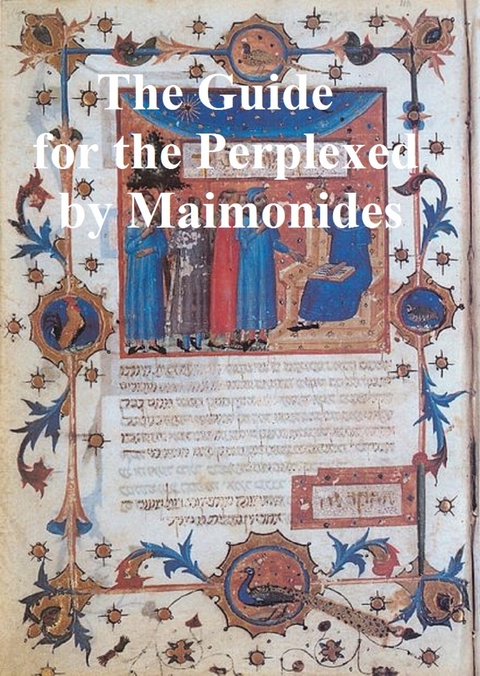
Guide for the Perplexed (eBook)
1090 Seiten
Seltzer Books (Verlag)
9781455303823 (ISBN)
According to Wikipedia, ''The Guide for the Perplexed is one of the major works of Rabbi Moshe ben Maimon, better known as Maimonides or 'the Rambam'. It was written in the 12th century in the form of a three-volume letter to his student, Rabbi Joseph ben Judah of Ceuta, the son of Rabbi Judah, and is the main source of the Rambam's philosophical views, as opposed to his opinions on Jewish law... Moses Maimonides (March 30, 1135 Cordoba, Spain ? December 13, 1204 Fostat, Egypt), was a rabbi, physician, and philosopher in Andalusia, Morocco and Egypt during the Middle Ages. He was one of the various medieval Jewish philosophers who also influenced the non-Jewish world. Although his copious works on Jewish law and ethics were initially met with opposition during his lifetime, he was posthumously acknowledged to be one of the foremost rabbinical arbiters and philosophers in Jewish history. Today, his works and his views are considered a cornerstone of Jewish thought and study.'
According to Wikipedia, "e;"e;The Guide for the Perplexed is one of the major works of Rabbi Moshe ben Maimon, better known as Maimonides or "e;the Rambam"e;. It was written in the 12th century in the form of a three-volume letter to his student, Rabbi Joseph ben Judah of Ceuta, the son of Rabbi Judah, and is the main source of the Rambam's philosophical views, as opposed to his opinions on Jewish law... Moses Maimonides (March 30, 1135 Cordoba, Spain ? December 13, 1204 Fostat, Egypt), was a rabbi, physician, and philosopher in Andalusia, Morocco and Egypt during the Middle Ages. He was one of the various medieval Jewish philosophers who also influenced the non-Jewish world. Although his copious works on Jewish law and ethics were initially met with opposition during his lifetime, he was posthumously acknowledged to be one of the foremost rabbinical arbiters and philosophers in Jewish history. Today, his works and his views are considered a cornerstone of Jewish thought and study."e;
THE LIFE OF MOSES MAIMONIDES
"BEFORE the sun of Eli had set the son of Samuel had risen." Before the voice of the prophets had ceased to guide the people, the Interpreters of the Law, the Doctors of the Talmud, had commenced their labours, and before the Academies of Sura and of Pumbadita were closed, centres of Jewish thought and learning were already flourishing in the far West. The circumstances which led to the transference of the head-quarters of Jewish learning from the East to the West in the tenth century are thus narrated in the Sefer ha-kabbalah of Rabbi Abraham ben David:
"After the death of Hezekiah, the head of the Academy and Prince of the Exile, the academies were closed and no new Geonim were appointed. But long before that time Heaven had willed that there should be a discontinuance of the pecuniary gifts which used to be sent from Palestine, North Africa and Europe. Heaven had also decreed that a ship sailing from Bari should be captured by Ibn Romahis, commander of the naval forces of Abd-er-rahman al-nasr. Four distinguished Rabbis were thus made prisoners -- Rabbi Hushiel, father of Rabbi Hananel, Rabbi Moses, father of Rabbi Hanok, Rabbi Shemarjahu, son of Rabbi Ellisanan, and a fourth whose name has not been recorded. They were engaged in a mission to collect subsidies in aid of the Academy in Sura. The captor sold them as slaves; Rabbi Tiushiel was carried to Kairuan, R. Shemarjahu was left in Alexandria, and R. Moses was brought to Cordova. These slaves were ransomed by their brethren and were soon placed in important positions. When Rabbi Moses was brought to Cordova, it was supposed that he was uneducated. In that city there was a synagogue known at that time by the name of Keneseet ha-midrash, and Rabbi Nathan, renowned for his great piety, was the head of the congregation. The members of the community used to hold meetings at which the Talmud was read and discussed. One day when Rabbi Nathan was expounding the Talmud and was unable to give a satisfactory explanation of the passage under discussion, Rabbi Moses promptly removed the difficulty and at the same time answered several questions whch were submitted to him. Thereupon R. Nathan thus addressed the assembly :--'I am no longer your leader; that stranger in sackcloth shall henceforth be my teacher, and you shall appoint him to be your chief.' The admiral, on hearing of the high attainments of his prisoner, desired to revoke the sale, but the king would not permit this retraction, being pleased to learn that his Jewish subjects were no longer dependent for their religious instruction on the schools in the East?
Henceforth the schools in the West asserted their independence, and even surpassed the parent institutions. The Caliphs, mostly opulent, gave every encouragement to philosophy and poetry; and, being generally liberal in sentiment, they enrertained kindly feelings towards their Jewish subjects. These were allowed to compete for the acquisition of wealth and honour on equal terms with their Mohammedan fellow-citizens. Philosophy and poetry were consequently cultivated by the Jews with the same zest as by the Arabs. Ibn Gabirol, Ibn Hasdai, Judah ha-levi, Hananel, Alfasi, the Ibn Ezras, and others who flourished in that period were the ornament of their age, and the pride of the Jews at all times. The same favourable condition was maintained during the reign of the Omeyades; but when the Moravides and the Almohades came into power, the horizon darkened once more, and misfortunes threatened to destroy the fruit of several centuries. Amidst this gloom there appeared a brilliant luminary which sent forth rays of light and comfort: this was Moses Maimonides.
Moses, the son of Maimon, was born at Cordova, on the 14th of Nisan, 4895 (March 30, 1135). Although the date of his birth has been recorded with the utmost accuracy, no trustworthy notice has been preserved concerning the early period of his life. But his entire career is a proof that he did not pass his youth in idleness; his education must have been in harmony with the hope of his parents, that one day he would, like his father and forefathers, hold the honourable office of Dayyan or Rabbi, and distinguish himself in theological learning. It is probable that the Bible and the Talmud formed the chief subjects of his study; but he unquestionably made the best use of the opportunities which Mohammedan Spain, and especially Cordova, afforded him for the acquisition of general knowledge. It is not mentioned in any of his writings who were his teachers ; his father, as it seems, was his principal guide and instructor in many branches of knowledge. David Conforte, in his historical work, Kore ha-dorot, states that Maimonides was the pupil of two eminent men, namely, Rabbi Joseph Ibn Migash and Ibn Roshd (Averroes); that by the former he was instructed in the Talmud, and by the latter in philosophy. This statement seems to be erroneous, as Maimonides was only a child at the time when Rabbi Joseph died, and already far advanced in years when he became acquainted with the writings of Ibn Roshd. The origin of this mistake, as regards Rabbi Joseph, can easily be traced. Maimonides in his Mishneh Tora, employs, in reference to R. Isaac Alfasi and R. Joseph, the expression "my teachers" (rabbotai), and this expression, by which he merely describes his indebtedness to their writings, has been taken in its literal meaning.
Whoever his teachers may have been, it is evident that he was well prepared by them for his future mission. At the age of twenty-three he entered upon his literary career with a treatise on the Jewish Calendar. It is unknown where this work was composed, whether in Spain or in Africa. The author merely states that he wrote it at the request of a friend, whom he, however, leaves unnamed. The subject was generally considered to be very abstruse, and to involve a thorough knowledge of mathematics. Maimonides must, therefore, even at this early period, have been regarded as a profound scholar by those who knew him. The treatise is of an elementary character.--It was probably about the same time that he wrote, in Arabic, an explanation of Logical terms, Millot higgayon, which Moses Ibn Tibbon translated into Hebrew.
The earlier period of his life does not seem to have been marked by any incident worth noticing. It may, however, be easily conceived that the later period of his life, which was replete with interesting incidents, engaged the exclusive attention of his biographers. So much is certain, that his youth was beset with trouble and anxiety ; the peaceful development of science and philosophy was disturbed by wars raging between Mohammedans and Christians, and also between the several Mohammedan sects. The Moravides, who had succeeded the Omeyades, were opposed to liberality and toleration ; but they were surpassed in cruelty and fanaticism by their successors. Cordova was taken by the Almohades in the year 1148, when Maimonides was about thirteen years old. The victories of the Almohades, first under the leadership of the Mahadi Ibn Tamurt, and then under Abd-almumen, were, according to all testimonies, attended by acts of excessive intolerance. Abd-al-mumen would not suffer in his dominions any other faith but the one which he himself confessed. Jews and Christians had the choice between Islam and emigration or a martyr's death. The Sefer kabbalah contains the following description of one of the persecutions which then occurred: "After the death of R. Joseph ha-levi the study of the Torah was interrupted, although he left a son and a nephew, both of whom had under his tuition become profound scholars. 'The righteous man (R. Joseph) was taken away on account of the approaching evils. After the death of R. Joseph there came for the Jews a time of oppression and distress. They quitted their homes, ' Such as were for death, to death, and such as were for the sword, to the sword ; and such as were for the famine, to the famine, and such as were for the captivity, to the captivity' ; and--it might be added to the words of Jeremiah (xv. 2)-- 'such as were for apostasy, to apostasy.' All this happened through the sword of Ibn Tamurt, who, in 4902 (1142), determined to blot out the name of Israel, and actually left no trace of the Jews in any part of his empire."
Ibn Verga in his work on Jewish martyrdom, in Shebet Jehudah, gives the following account of events then happening:-- "In the year 4902 the armies of Ibn Tamurt made their appearance. A proclamation was issued that any one who refused to adopt Islam would be put to death, and his property would be confiscated. Thereupon the Jews assembled at the gate of the royal palace and implored the king for mercy. He answered -- 'It is because I have compassion on you, that I command you to become Muslemim; for I desire to save you from eternal punishment.' The Jews replied -- 'Our salvation depends on our observance of the Divine Law; you are the master of our bodies and of our property, but our souls will be judged by the King who gave them to us, and to whom they will return; whatever be our future fate, you, O king, will not be held responsible for it.' 'I do not desire to argue with you,' said the king; 'for I know you will argue according to your own religion. It is my absolute will that you either adopt my religion or be put to death. The Jews then proposed to emigrate, but the king would not allow his subjects to serve another king. In vain did the Jews implore the nobles to intercede in their behalf; the king remained inexorable. Thus many congregations forsook their religion; but within a month the king came to a sudden death ; the son, believing that his father had met with an untimely...
| Erscheint lt. Verlag | 1.3.2018 |
|---|---|
| Übersetzer | Moses Maimonides |
| Sprache | englisch |
| Themenwelt | Geisteswissenschaften ► Religion / Theologie ► Judentum |
| ISBN-13 | 9781455303823 / 9781455303823 |
| Informationen gemäß Produktsicherheitsverordnung (GPSR) | |
| Haben Sie eine Frage zum Produkt? |
 EPUB (Adobe DRM)
Größe: 1,1 MB
Kopierschutz: Adobe-DRM
Adobe-DRM ist ein Kopierschutz, der das eBook vor Mißbrauch schützen soll. Dabei wird das eBook bereits beim Download auf Ihre persönliche Adobe-ID autorisiert. Lesen können Sie das eBook dann nur auf den Geräten, welche ebenfalls auf Ihre Adobe-ID registriert sind.
Details zum Adobe-DRM
Dateiformat: EPUB (Electronic Publication)
EPUB ist ein offener Standard für eBooks und eignet sich besonders zur Darstellung von Belletristik und Sachbüchern. Der Fließtext wird dynamisch an die Display- und Schriftgröße angepasst. Auch für mobile Lesegeräte ist EPUB daher gut geeignet.
Systemvoraussetzungen:
PC/Mac: Mit einem PC oder Mac können Sie dieses eBook lesen. Sie benötigen eine
eReader: Dieses eBook kann mit (fast) allen eBook-Readern gelesen werden. Mit dem amazon-Kindle ist es aber nicht kompatibel.
Smartphone/Tablet: Egal ob Apple oder Android, dieses eBook können Sie lesen. Sie benötigen eine
Geräteliste und zusätzliche Hinweise
Buying eBooks from abroad
For tax law reasons we can sell eBooks just within Germany and Switzerland. Regrettably we cannot fulfill eBook-orders from other countries.
EPUB (Ohne DRM)Digital Rights Management: ohne DRM
Dieses eBook enthält kein DRM oder Kopierschutz. Eine Weitergabe an Dritte ist jedoch rechtlich nicht zulässig, weil Sie beim Kauf nur die Rechte an der persönlichen Nutzung erwerben.
Dateiformat: EPUB (Electronic Publication)
EPUB ist ein offener Standard für eBooks und eignet sich besonders zur Darstellung von Belletristik und Sachbüchern. Der Fließtext wird dynamisch an die Display- und Schriftgröße angepasst. Auch für mobile Lesegeräte ist EPUB daher gut geeignet.
Systemvoraussetzungen:
PC/Mac: Mit einem PC oder Mac können Sie dieses eBook lesen. Sie benötigen dafür die kostenlose Software Adobe Digital Editions.
eReader: Dieses eBook kann mit (fast) allen eBook-Readern gelesen werden. Mit dem amazon-Kindle ist es aber nicht kompatibel.
Smartphone/Tablet: Egal ob Apple oder Android, dieses eBook können Sie lesen. Sie benötigen dafür eine kostenlose App.
Geräteliste und zusätzliche Hinweise
Buying eBooks from abroad
For tax law reasons we can sell eBooks just within Germany and Switzerland. Regrettably we cannot fulfill eBook-orders from other countries.
aus dem Bereich