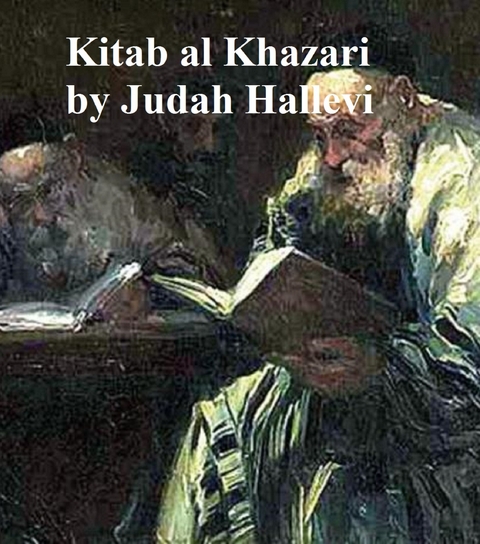
Kitab al Khazari, in English translation (eBook)
489 Seiten
Seltzer Books (Verlag)
978-1-4553-0061-7 (ISBN)
'Framed as a dialog between the king of the Khazars, a Central Asian kingdom, and a Rabbi, the Khazari is an exposition of late medieval Jewish philosophy. Legend has it that the king of the Khazars held a symposium to decide whether his people should convert to Judaism, Christianity or Islam. This book is a fictional account of the Jewish side of this debate. Judah Ha-Levi, the author, was born about 1080 C.E. in Muslim-controlled area of southern Spain.'
"e;Framed as a dialog between the king of the Khazars, a Central Asian kingdom, and a Rabbi, the Khazari is an exposition of late medieval Jewish philosophy. Legend has it that the king of the Khazars held a symposium to decide whether his people should convert to Judaism, Christianity or Islam. This book is a fictional account of the Jewish side of this debate. Judah Ha-Levi, the author, was born about 1080 C.E. in Muslim-controlled area of southern Spain."e;
PART TWO
1. AFTER this the Khazari, as is related in the history of the Khazars, was anxious to reveal to his Vezier in the mountains of Warsan the secret of his dream and its repetition, in which he was urged to seek the God-pleasing deed. The king and his Vezier travelled to the deserted mountains on the sea shore, and arrived one night at the cave in which some Jews used to celebrate the Sabbath. They disclosed their identity to them, embraced their religion, were circumcised in the cave, and then returned to their country, eager to learn the Jewish law. They kept their conversion secret, however, until they found an opportunity of disclosing the fact gradually to a few of their special friends. When the number had increased, they made the affair public, and induced the rest of the Khazars to embrace the Jewish faith. They sent to various countries for scholars and books, and studied the Torah. Their chronicles also tell of their prosperity, how they beat their foes, conquered their lands, secured great treasures; how their army swelled to hundreds of thousands, how they loved their faith, and fostered such love for the Holy House that they erected a Tabernacle in the shape of that built by Moses. They also honoured and cherished those born Israelites who lived among them. While the king studied the Torah and the books of the prophets, he employed the Rabbi as his teacher, and put many questions to him on Hebrew matters. The first of these questions referred to the names and attributes ascribed to God and their anthropomorphistic forms, which are unmistakeably objectionable alike both to reason and to law.
2. Said the Rabbi: All names of God, save the Tetragrammaton, are predicates and attributive descriptions, derived from the way His creatures are affected by His decrees and measures. He is called merciful, if he improves the condition of any man whom people pity for his sorry plight. They attribute to Him mercy and compassion, although this is, in our conception, surely nothing but a weakness of the soul and a quick movement of nature. This cannot be applied to God, who is a just Judge, ordaining the poverty of one individual and the wealth of another. His nature remains quite unaffected by it. He has no sympathy with one, nor anger against another. We see the same in human judges to whom questions are put. They decide according to law, making some people happy, and others miserable. He appears to us, as we observe His doings, sometimes a 'merciful and compassionate God,' (Exod. xxxiv. 6), sometimes 'a jealous and revengeful God' (Nahum i. 2), whilst He never changes from one attribute to the other. All attributes (excepting the Tetragrammaton) are divided into three classes, viz. creative, relative and negative. As regards the creative attributes, they are derived from acts emanating from Him by ways of natural medium, e.g. making poor and rich, exalting or casting down, 'merciful and compassionate,' 'jealous and revengeful,' 'strong and almighty,' and the like. As regards the relative attributes, viz. 'Blessed, praised, glorified, holy, exalted, and extolled,' they are borrowed from the reverence given to Him by mankind. However numerous these may be, they produce no plurality, as far as He is concerned, nor do they affect his Unity. As regards the negative attributes, such as 'Living, Only, First and Last,' they are given to Him in order to negative their contrasts, but not to establish them in the sense we understand them. For we cannot understand life except accompanied by sensibility and movement. God, however, is above them. We describe Him as living in order to negative the idea of the rigid and dead, since it would be an a priori conclusion that that which does not live is dead. This cannot, however, be applied to the intellect. One cannot, e.g. speak of time as being endowed with life, yet it does not follow that it is dead, since its nature has nothing to do with either life or death. In the same way one cannot call a stone ignorant, although we may say that it is not learned. Just as a stone is too low to be brought into connexion with learning or ignorance, thus the essence of God is too exalted to have anything to do with life or death, nor can the terms light or darkness be applied to it. If we were asked whether this essence is light or darkness, we should say light by way of metaphor, for fear one might conclude that that which is not light must be darkness. As a matter of fact we must say that only material bodies are subject to light and darkness, but the divine essence is no body, and can consequently only receive the attributes of light or darkness by way of simile, or in order to negative an attribute hinting at a deficiency. Life and death are, therefore, only applicable to material bodies, whilst the divine essence is as much exempt from both as it is highly extolled above them. The 'life' of which we speak in this connexion is not like ours, and this is what I wish to state, since 'we cannot think of any other kind of life but ours. It is as if one would say: We know not what it is. If we say 'living God' and 'God of life' (Ps. cvi. 28), it is but a relative expression placed in opposition to the gods of the Gentiles, which are 'dead gods' from which no action emanates. In the same way we take the term One, viz. to negative plurality, but not to establish unity as we understand it. For we call a thing one, when the component parts are coherent and of the same materials, e.g. one bone, one sinew, one water, one air. In a similar way time is compared to a compact body, and we speak of one day, and one year. The divine essence is exempt from complexity and divisibility, and 'one' only stands to exclude plurality. In the same way [we style Him] 'First' in order to exclude the notion of any later origin, but not to assert that He has a beginning; thus also 'Last' stands to repudiate the idea that His existence has no end, but not to fix a term for Him. All these attributes neither touch on the divine essence, nor do they lead us to assume a multiplicity. The attributes which are connected with the Tetragrammaton are those which describe His power of creating without any natural intermediaries, viz. Creator, Producer, Maker, 'To Him who alone doeth great wonders (Ps. cxxxvi. 4),' which means that [He creates] by His bare intention and will, to the exclusion of any assisting cause. This is perhaps meant in the word of the Bible: 'And I appeared unto Abraham . . . as El Shaddai' (Exod. vi. 3), viz. in the way of power and dominion, as is said: 'He suffered no man to do them wrong; yea, He reproved kings for their sake' (Ps. cv. 14). He did not, however, perform any miracle for the patriarchs as He did for Moses, saying: 'but my name J H W H was I not known to them' (Exod. 1. c). This means by My name J H W H, since the beth in beel shaddai refers to the former. The wonders done for Moses and the Israelites left no manner of doubt in their souls that the Creator of the world also created these things which He brought into existence immediately by His will, as the plagues of Egypt, the dividing of the Red Sea, the manna, the pillar of a cloud, and the like. The reason of this was not because they were higher than the Patriarchs, but because they were a multitude, and had nourished doubt in their souls, whilst the patriarchs had fostered the utmost faith and purity of mind. If they had all their lives been pursued by misfortune, their faith in God would not have suffered. Therefore they required no signs. We also style Him wise of heart, because He is the essence of intelligence, and intelligence itself; but this is no attribute. As to 'Almighty,' this belongs to the creative attributes.
3. Al Khazari: 'How dost thou explain those attributes which are even of a more corporeal nature than those, viz. seeing, hearing, speaking, writing the tablets, descending on mount Sinai, rejoicing in His works, grieved in His heart.'
4. The Rabbi: Did I not compare him with a just judge in whose qualities no change exists, and from whose decrees result the prosperity and good fortune of people, so that they say that he loves them and takes pleasure in them? Others, whose fate it is to have their houses destroyed and themselves be annihilated, would describe Him as filled with hate and wrath. Nothing, however, that is done or spoken escapes Him, 'He sees and hears'; the air and all bodies came into existence by His will, and assumed shape by His command, as did heaven and earth. He is also described as 'speaking and writing.' Similarly from the aethereal and spiritual substance, which is called 'holy spirit,' arose the spiritual forms called 'glory of God' (Exod. xix. 20). Metaphorically He is called J H W H (ibid.) who descended on the mount Sinai. We shall discuss this more minutely when treating on metaphysics.
5. Al Khazari: Granting that thou hast justified the use of these attributes, so that no idea of plurality need of necessity follow, yet a difficulty remains as regards the attribute of Will with which thou dost invest Him, but which the philosopher denies.
6. The Rabbi: If no other objection is raised, except the Will, we will soon vindicate ourselves. We say: O philosophers, what is it which in thy opinion made the heavens revolve continually, the uppermost sphere carrying the whole, without place or inclination in its movement, the earth firmly fixed in the centre without support or prop; which fashioned the order of the universe in quantity, quality, and the forms we perceive? Thou canst not help admitting this, for things did neither create themselves nor each other. Now the same adapted the air to giving the sound of the Ten Commandments, and formed the writing engraved in the tables, call it will, or thing, or what thou...
| Erscheint lt. Verlag | 1.3.2018 |
|---|---|
| Übersetzer | Judah Hallevi |
| Sprache | englisch |
| Themenwelt | Geisteswissenschaften ► Religion / Theologie ► Judentum |
| ISBN-10 | 1-4553-0061-6 / 1455300616 |
| ISBN-13 | 978-1-4553-0061-7 / 9781455300617 |
| Informationen gemäß Produktsicherheitsverordnung (GPSR) | |
| Haben Sie eine Frage zum Produkt? |
 EPUB (Adobe DRM)
Größe: 488 KB
Kopierschutz: Adobe-DRM
Adobe-DRM ist ein Kopierschutz, der das eBook vor Mißbrauch schützen soll. Dabei wird das eBook bereits beim Download auf Ihre persönliche Adobe-ID autorisiert. Lesen können Sie das eBook dann nur auf den Geräten, welche ebenfalls auf Ihre Adobe-ID registriert sind.
Details zum Adobe-DRM
Dateiformat: EPUB (Electronic Publication)
EPUB ist ein offener Standard für eBooks und eignet sich besonders zur Darstellung von Belletristik und Sachbüchern. Der Fließtext wird dynamisch an die Display- und Schriftgröße angepasst. Auch für mobile Lesegeräte ist EPUB daher gut geeignet.
Systemvoraussetzungen:
PC/Mac: Mit einem PC oder Mac können Sie dieses eBook lesen. Sie benötigen eine
eReader: Dieses eBook kann mit (fast) allen eBook-Readern gelesen werden. Mit dem amazon-Kindle ist es aber nicht kompatibel.
Smartphone/Tablet: Egal ob Apple oder Android, dieses eBook können Sie lesen. Sie benötigen eine
Geräteliste und zusätzliche Hinweise
Buying eBooks from abroad
For tax law reasons we can sell eBooks just within Germany and Switzerland. Regrettably we cannot fulfill eBook-orders from other countries.
EPUB (Ohne DRM)Digital Rights Management: ohne DRM
Dieses eBook enthält kein DRM oder Kopierschutz. Eine Weitergabe an Dritte ist jedoch rechtlich nicht zulässig, weil Sie beim Kauf nur die Rechte an der persönlichen Nutzung erwerben.
Dateiformat: EPUB (Electronic Publication)
EPUB ist ein offener Standard für eBooks und eignet sich besonders zur Darstellung von Belletristik und Sachbüchern. Der Fließtext wird dynamisch an die Display- und Schriftgröße angepasst. Auch für mobile Lesegeräte ist EPUB daher gut geeignet.
Systemvoraussetzungen:
PC/Mac: Mit einem PC oder Mac können Sie dieses eBook lesen. Sie benötigen dafür die kostenlose Software Adobe Digital Editions.
eReader: Dieses eBook kann mit (fast) allen eBook-Readern gelesen werden. Mit dem amazon-Kindle ist es aber nicht kompatibel.
Smartphone/Tablet: Egal ob Apple oder Android, dieses eBook können Sie lesen. Sie benötigen dafür eine kostenlose App.
Geräteliste und zusätzliche Hinweise
Buying eBooks from abroad
For tax law reasons we can sell eBooks just within Germany and Switzerland. Regrettably we cannot fulfill eBook-orders from other countries.
aus dem Bereich