


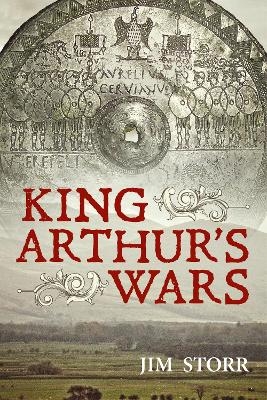
King Arthur's Wars
Seiten
2019
Helion & Company (Verlag)
978-1-912390-52-6 (ISBN)
Helion & Company (Verlag)
978-1-912390-52-6 (ISBN)
'King Arthur's Wars' describes one of the biggest archaeological finds of our times; yet there is nothing new to see. There are secrets hidden in plain sight.
King Arthur's Wars describes one of the biggest archaeological finds of our times; yet there is nothing new to see. There are secrets hidden in plain sight. We speak English today, because the Anglo-Saxons took over most of post-Roman Britain. How did that happen? There is little evidence: not much little archaeology, and even less written history. There is, however, a huge amount of speculation. King Arthur's Wars brings an entirely new approach to the subject. The answers are out there, in the countryside, waiting to be found.
Months of field work and map study allow us to understand, for the first time, how the Anglo-Saxons conquered England; county by county and decade by decade.
King Arthur's Wars exposes what the landscape and the place names tell us. As a result, we can now know far more about this 'Dark Age'. What is so special about Essex? Why is Buckinghamshire an odd shape? Why is the legend of King Arthur so special to us? Why don't Cumbrian farmers use English numbers, when they count sheep? Why don't we know where Camelot was? Why did the Romano-British stop eating oysters?
King Arthur's Wars tells that story.
King Arthur's Wars describes one of the biggest archaeological finds of our times; yet there is nothing new to see. There are secrets hidden in plain sight. We speak English today, because the Anglo-Saxons took over most of post-Roman Britain. How did that happen? There is little evidence: not much little archaeology, and even less written history. There is, however, a huge amount of speculation. King Arthur's Wars brings an entirely new approach to the subject. The answers are out there, in the countryside, waiting to be found.
Months of field work and map study allow us to understand, for the first time, how the Anglo-Saxons conquered England; county by county and decade by decade.
King Arthur's Wars exposes what the landscape and the place names tell us. As a result, we can now know far more about this 'Dark Age'. What is so special about Essex? Why is Buckinghamshire an odd shape? Why is the legend of King Arthur so special to us? Why don't Cumbrian farmers use English numbers, when they count sheep? Why don't we know where Camelot was? Why did the Romano-British stop eating oysters?
King Arthur's Wars tells that story.
Professor Jim Storr is a former soldier turned analyst and academic. He was the British Army's most prolific thinker and writer. On leaving the Army, he started a second career in consultancy, teaching, writing and research. Jim has lectured or taught in staff colleges and military academies around the world, as well as at several universities. He has published scores of articles, papers, book chapters and publications. His first book, 'The Human Face of War', was published by Continuum (now Bloomsbury) in 2009.
| Erscheinungsdatum | 20.11.2018 |
|---|---|
| Zusatzinfo | 94 b/w figures/maps, 16 color photos |
| Verlagsort | Solihull |
| Sprache | englisch |
| Maße | 152 x 229 mm |
| Themenwelt | Geisteswissenschaften ► Archäologie |
| Geschichte ► Allgemeine Geschichte ► Vor- und Frühgeschichte | |
| ISBN-10 | 1-912390-52-3 / 1912390523 |
| ISBN-13 | 978-1-912390-52-6 / 9781912390526 |
| Zustand | Neuware |
| Informationen gemäß Produktsicherheitsverordnung (GPSR) | |
| Haben Sie eine Frage zum Produkt? |
Mehr entdecken
aus dem Bereich



aus dem Bereich
Konzepte – Methoden – Theorien
Buch | Softcover (2024)
UTB (Verlag)
CHF 55,85
auf den Spuren der frühen Zivilisationen
Buch | Hardcover (2023)
C.H.Beck (Verlag)
CHF 27,95


