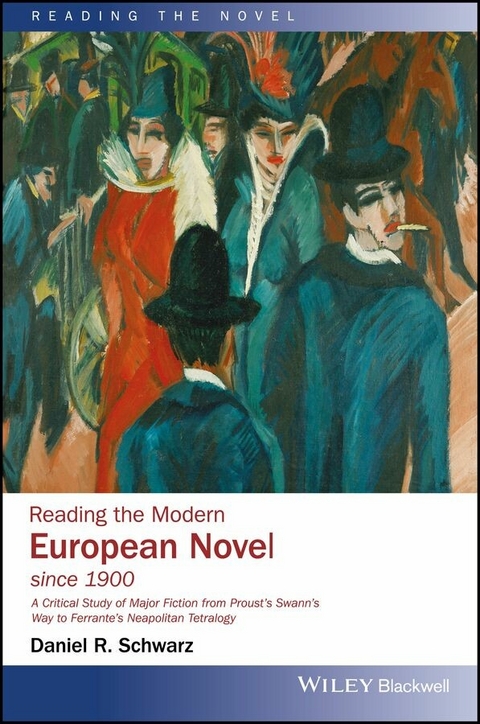
Reading the Modern European Novel since 1900 (eBook)
John Wiley & Sons (Verlag)
978-1-118-69341-4 (ISBN)
An exploration of the modern European novel from a renowned English literature scholar
Reading the Modern European Novel since 1900 is an engaging, in-depth examination of the evolution of the modern European novel. Written in Daniel R. Schwarz's precise and highly readable style, this critical study offers compelling discussions on a wide range of major works since 1900 and examines recurring themes within the context of significant historical events, including both World Wars and the Holocaust. The author cites important developments in the evolution of the modern novel and explores how these paradigmatic works of fiction reflect intellectual and cultural history, including developments in painting and cinema. Schwarz focuses on narrative complexity, thematic subtlety, and formal originality as well as how novels render historical events and cultural developments Discussing major works by Proust, Camus, Mann, Kafka, Grass, di Lampedusa, Bassani, Kertesz, Pamuk, Kundera, Saramago, Muller and Ferrante, Schwarz explores how these often experimental masterworks pay homage to the their major predecessors--discussed in Schwarz's ground-breaking Reading the European Novel to 1900--even while proposing radical departures from realism in their approach to time and space, their testing the limits of language, and their innovative ways of rendering the human psyche.
Written for teachers and students by a highly-acclaimed scholar and including valuable study questions, Reading the Modern European Novel since 1900 offers a guide for a deeper understanding of how these original modern masters respond to both the past and present.
Daniel R. Schwarz is Frederic J. Whiton Professor of English Literature and Stephen H. Weiss Presidential Fellow at Cornell University. In 1998 he received Cornell's College of Arts and Sciences Russell Award for Distinguished Teaching. Considered one of the world's leading authorities on James Joyce, Joseph Conrad, and Twentieth and Twenty-first Century Modernism, his most recent books are How to Succeed in College and Beyond: The Art of Learning and Reading the European Novel to 1900.
An exploration of the modern European novel from a renowned English literature scholar Reading the Modern European Novel since 1900 is an engaging, in-depth examination of the evolution of the modern European novel. Written in Daniel R. Schwarz's precise and highly readable style, this critical study offers compelling discussions on a wide range of major works since 1900 and examines recurring themes within the context of significant historical events, including both World Wars and the Holocaust. The author cites important developments in the evolution of the modern novel and explores how these paradigmatic works of fiction reflect intellectual and cultural history, including developments in painting and cinema. Schwarz focuses on narrative complexity, thematic subtlety, and formal originality as well as how novels render historical events and cultural developments Discussing major works by Proust, Camus, Mann, Kafka, Grass, di Lampedusa, Bassani, Kertesz, Pamuk, Kundera, Saramago, Muller and Ferrante, Schwarz explores how these often experimental masterworks pay homage to the their major predecessors discussed in Schwarz's ground-breaking Reading the European Novel to 1900 even while proposing radical departures from realism in their approach to time and space, their testing the limits of language, and their innovative ways of rendering the human psyche. Written for teachers and students by a highly-acclaimed scholar and including valuable study questions, Reading the Modern European Novel since 1900 offers a guide for a deeper understanding of how these original modern masters respond to both the past and present.
Daniel R. Schwarz is Frederic J. Whiton Professor of English Literature and Stephen H. Weiss Presidential Fellow at Cornell University. In 1998 he received Cornell's College of Arts and Sciences Russell Award for Distinguished Teaching. Considered one of the world's leading authorities on James Joyce, Joseph Conrad, and Twentieth and Twenty-first Century Modernism, his most recent books are How to Succeed in College and Beyond: The Art of Learning and Reading the European Novel to 1900.
Acknowledgments ix
Also by Daniel R. Schwarz xi
1 Introduction: The Novel After 1900 1
2 Cultural Crisis: Decadence and Desire in Mann's Death in Venice (1912) 13
3 Proust's Swann's Way (1913) and the Novel of Sensibility: Memory, Obsession, and Consciousness 34
4 The Metamorphosis (1915): Kaf ka's Noir Challenge to Realism 59
5 Camus's Indifferent, Amoral, and Godless Cosmos: The Stranger (1942) and The Plague (1947) as Existential Novels 77
6 Why Giorgio Bassani Matters: The Elegiac Imagined World of Bassani and the Jews of Ferrara 109
7 The Novel as Elegy: Giuseppe Tomasi di Lampedusa's The Leopard (1958) 126
8 Günter Grass's The Tin Drum (1959): Reconfiguring European History as Fable 144
9 Imre Kertész's Fatelessness (1975): Rendering the Holocaust as a Present Tense Event 176
10 Milan Kundera's The Unbearable Lightness of Being (1984): History as Fate 197
11 Saramago's The History of the Siege of Lisbon (1989): Rewriting History, Reconfiguring Lives 223
12 Orhan Pamuk's My Name is Red (1998): Cultural Conflict in Sixteenth?]Century Istanbul and its Modern Implications 242
13 Herta Müller's The Hunger Angel (2009): A Hunger for Life, A Hunger for Words 265
14 Elena Ferrante's Neapolitan Quartet: Women Discovering Their Voices in a Violent and Sexist Male Society 286
Selected Bibliography (Including Works Cited) 327
Index 334
"For over four decades, Daniel R. Schwarz has taught
generations of students in the Cornell classroom and countless
teachers through his thorough and yet accessible scholarship how to
approach British Modernism from historical, psychological, and
aesthetic perspectives. In recent years, Schwarz has turned
his attention to a variety of other 20th Century topics
including painting, the poetry of Wallace Stevens, the Holocaust,
urban culture, and The New York Times. Now, in the
first of a two volume study on Reading the European Novel to
1900, Schwarz extends his scope once more, this time moving
back in time and across a continent to offer sensitive,
well-informed close readings of classic novels from Cervantes in
17th Century Spain, Stendhal, Balzac, Flaubert, and Zola
in 19th Century France, and Tolstoi and Dostoyevsky in
19th Century Russia. His focus is on the genre's greatest
examples from a time when the realist novel reached its apex even
as it included folklore, fantasy, and magical realist elements on
the cusp of the form's transition into modernist
experimentalism and psychological exploration. Schwarz's
study is chock full of judicious evaluation of characters,
narratives devices, ethical commentary, and helpful information
about historical and political contexts including the role of
Napoleon, the rise of capitalism, trains, class divisions,
transformation of rural life, and the struggle to define human
values in a period characterized by debates between and among
rationalism, spiritualism, and determinism. One experiences the
pleasure of watching a master critic as he re-reads, savors, and
passes on his hard-won wisdom about how we as humans read and
why."
--David Morris, Purdue University
Chapter 1
Introduction: The Novel After 1900
“What we write about fiction is never an objective response to a text; it is always part of a bigger mythmaking – the story we are telling ourselves about ourselves.”
Jeanette Winterson1
Basic Premises
As with my past books about literature, I am writing this book to share the joy of reading the texts I have chosen. I have chosen works that demand my attention and create a desire – indeed, a need – for me to understand them, sometimes because of their thematic focus, sometimes for their experimental techniques, and usually for a combination of both. All of the works I discuss demonstrate how a particular historical moment shaped the behavior and direction of a nation or significant community, although some of the works are more historically inflected than others. Among my criteria for inclusion in this volume: (1) I revel in rereading and rereading the text; (2) when I am not reading that text, I am thinking about my reading experience; when I awake, the issues generated by the text sometimes displace the more urgent issues of life; (3) I sometimes dream about the text’s characters and events; (4) on each rereading and rethinking, I discover new aspects of the text’s complexity, subtlety, and originality.
While any inclusive generalizations risk the danger of being reductive, we can say that the novel after 1900 is often experimental in form and challenges our expectations of continuity and consistency. These novels ask the reader to play a significant role in perceiving formal unity and in interpreting idiosyncratic, irrational, and seemingly inexplicable behavior. David Lodge has argued that “The modernist novel is generally characterized by a radical rearrangement of the spatial‐temporal unity of the narrative line” (Lodge, “Milan Kundera, and the Idea of the Author in Modern Criticism,” 141).2 What he means is that the narrative of what happened next has given way to radical rearrangements of time and space, unexpected fissures, surprising returns to events in the past, inexplicable accidents, deviations from realism, and radical metaphors. More often than in the past the telling (discourse) of the story is as much or more the author’s focal point as the events of the story; hence, in many cases, the telling becomes the center of the reader’s experience. What I will be stressing is that readers must respond to the uncanny and unimaginable in both form and content.
What is Modernism?
I am using the term Modernism to refer to the period beginning in the late nineteenth century. Modernism is a response to cultural crisis. By the 1880s we have Nietzsche’s Gay Science (1882–1887) with his contention that God is Dead as well as Krafft‐Ebing’s revolutionary texts on sexuality; we also have the beginnings of modern physics in the work of J. J. Thomson. All challenged absolutist theories of truth.
Let us recall that Darwin’s Origin of Species appeared in 1859 and Essays and Reviews (edited by John William Parker) which in 1860 questioned the Bible as revealed history; in the period from 1865 to 1870, Karl Marx began to publish Das Kapital, Alfred Nobel invented dynamite, and Freud opened the doors of psychopathology in the 1880s. Otto von Bismarck and Benjamin Disraeli dominated Europe, and colonialism expanded its reach.
In its response to difficult circumstances Modernism is an ideology of possibility and hope. But paradoxically Modernism is also an ideology of despair in its response to excessive faith in industrialism, urbanization, so‐called technological progress, and to the Great War of 1914 to 1918 which was believed to be the War to End All Wars.
As we shall see, Modernism goes beyond previous cultures in engaging otherness and questioning Western values. As James Clifford notes, in 1900 “‘Culture’ referred to a single evolutionary process.” He articulates an important aspect of Modernism:
The European bourgeois ideal of autonomous individuality was widely believed to be the natural outcome of a long development, a process that, although threatened by various disruptions, was assumed to be the basic, progressive movement of humanity. By the turn of the century, however, evolutionist confidence began to falter, and a new ethnographic conception of culture became possible. The word began to be used in the plural, suggesting a world of separate, distinctive, and equally meaningful ways of life. The ideal of an autonomous, cultivated subject could appear as a local project, not a telos for all humankind. (Clifford, The Predicament of Culture, 92–93)3
Modernism contains the aspirations and idealism of nineteenth‐century high culture and the prosaic world of nineteenth‐century city life; both are colored by an ironic and self‐conscious awareness of limitation. Often convictions are framed by an ironic stand indicating an awareness of the difficulty of fulfilling possibility. Prior to modernist questioning, the possibility of a homogeneous European culture existed. As John Elderfield puts it, “history was not always thought to be quite possibly a species of fiction but once comprised a form of order” (Elderfield, Henri Matisse, 203).4
We must not look for reductive consistency in our narrative of Modernism but for pluralistic and even contradictory explanations. Modernism depends on the interpretive intelligence of a reader’s perspective. We need to not only look at assumptions from a modern point of view that is open to destabilizing shibboleths, but we also need to try to understand the world of modern authors and painters from a perspective that takes account of how they intervene, intersect, transform, and qualify the culture of which they are a part.
Modernism emphasizes that we lack a coherent identity and seeks techniques to express this idea. Stressing how each of us is changing every moment, Henri Bergson wrote in Creative Evolution:
Duration is the continuous progress of the past which gnaws into the future and which swells as it advances. … The piling up of the past upon the past goes on without relaxation. In reality, the past is preserved by itself, automatically. In its entirety, probably, it follows us at every instant; all that we have felt, thought, and willed from our earliest infancy is there, leaning over the present which is about to join it, pressing against the portals of consciousness that would fain leave it outside. (Ellmann and Feidelson, Jr., The Modern Tradition, 725)5
Bergson continues: “What are we in fact, what is our character, if not the condensation of the history we have lived from our birth?” (ibid., 725). Note the parallel to Mikhail Bakhtin’s concept that when each of us speaks or writes, our prior systems of language voluntarily and involuntarily manifest themselves in a heteroglossic voice.
We now accept that, given the ever‐changing nature of self, each of us has multiple selves and points of view. That shared understanding that we lack one coherent self is a cause of the complex dramatized consciousness of the narrators in Proust’s Swann’s Way, Grass’s The Tin Drum, Ferrante’s Neapolitan tetralogy as well as the multiple narrative perspectives of Pamuk in My Name is Red and Kundera in The Unbearable Lightness of Being. Is there not a continuity between Oscar Wilde’s concept of transcending the self by lying and Henri Bergson’s of duration? Both seek to transform the tick‐tock of daily life’s passing time – what the Greeks called chronos – into significant time or kairos.
In “Tradition and the Individual Talent,” T. S. Eliot affirmed that literary tradition meant writing with an historical sense which
compels a man to write not merely with his own generation in his bones, but with a feeling that the whole of the literature of Europe from Homer and within it the literature of his own country has a simultaneous existence and composes a simultaneous order. … No poet, no artist of any art, has his complete meaning alone. His significance, his appreciation is the appreciation of his relation to the dead poets and artists. You cannot value him alone; you must set him, for contrast and comparison, among the dead. I mean this as a principle of aesthetic, not merely historical, criticism. (Eliot, Selected Essays, 4)6
Modernism is inclusive, containing both the aestheticism and complexity of high culture, the straightforwardness and earthiness of working‐class culture, and, like its successor Post‐Modernism, an ironic awareness of its own self‐consciousness. Just as writers like Zola and Grass not only include the urban working class, agrarian workers, and miners but also focus on the lives and aspirations of these people, modernist painters focus on the vernacular in painting – Cézanne’s card players, Degas’s laundresses, and Picasso’s prostitutes, café life, and circus performers. Yet writers such as Pamuk and Kundera also believed in the power of art and in the artist as visionary prophet.
The Role of History in Shaping Fiction
Although I was trained as a formalist focusing on the fictional ontology of literary works, I have become more and more interested in how art, and...
| Erscheint lt. Verlag | 14.3.2018 |
|---|---|
| Reihe/Serie | Reading the Novel |
| Reading the Novel | Reading the Novel |
| Sprache | englisch |
| Themenwelt | Geisteswissenschaften ► Sprach- / Literaturwissenschaft ► Anglistik / Amerikanistik |
| Geisteswissenschaften ► Sprach- / Literaturwissenschaft ► Literaturwissenschaft | |
| Schlagworte | Bassani and the novel • Camus and the novel • Cultural and intellectual history • defining Modernism • di Lampedusa and the novel • europäische Literatur • European Literature • Ferrante's Neapolitan tetralogy • fiction after 1900 • guide to the novel since 1900 • Gunther Grass The Tin Drum • historicaland cultural contexts of the novel • how does history and culture both shape and reflect the novel • Kertesz and the novel • Literature • literature and the novel • Literaturwissenschaft • Muller and the novel • Narrative theory • Pamuk and the novel • powerful readings of paradigmatic modern novels • Proust's Swann's Way • realism and surrealism • resistant readings of the novel • resource for understanding the novel since 1900 • Saramago and the novel • study guide and suggested syllabi for fiction after 1900 • The European novel since 1900 • the experimental novel and other art forms • the Holocaust and the Novel: the experimental novel • the novel after 1900 • Translation theory • WWII and the Novel |
| ISBN-10 | 1-118-69341-8 / 1118693418 |
| ISBN-13 | 978-1-118-69341-4 / 9781118693414 |
| Informationen gemäß Produktsicherheitsverordnung (GPSR) | |
| Haben Sie eine Frage zum Produkt? |
 EPUB (Adobe DRM)
Kopierschutz: Adobe-DRM
Adobe-DRM ist ein Kopierschutz, der das eBook vor Mißbrauch schützen soll. Dabei wird das eBook bereits beim Download auf Ihre persönliche Adobe-ID autorisiert. Lesen können Sie das eBook dann nur auf den Geräten, welche ebenfalls auf Ihre Adobe-ID registriert sind.
Details zum Adobe-DRM
Dateiformat: EPUB (Electronic Publication)
EPUB ist ein offener Standard für eBooks und eignet sich besonders zur Darstellung von Belletristik und Sachbüchern. Der Fließtext wird dynamisch an die Display- und Schriftgröße angepasst. Auch für mobile Lesegeräte ist EPUB daher gut geeignet.
Systemvoraussetzungen:
PC/Mac: Mit einem PC oder Mac können Sie dieses eBook lesen. Sie benötigen eine
eReader: Dieses eBook kann mit (fast) allen eBook-Readern gelesen werden. Mit dem amazon-Kindle ist es aber nicht kompatibel.
Smartphone/Tablet: Egal ob Apple oder Android, dieses eBook können Sie lesen. Sie benötigen eine
Geräteliste und zusätzliche Hinweise
Buying eBooks from abroad
For tax law reasons we can sell eBooks just within Germany and Switzerland. Regrettably we cannot fulfill eBook-orders from other countries.
aus dem Bereich