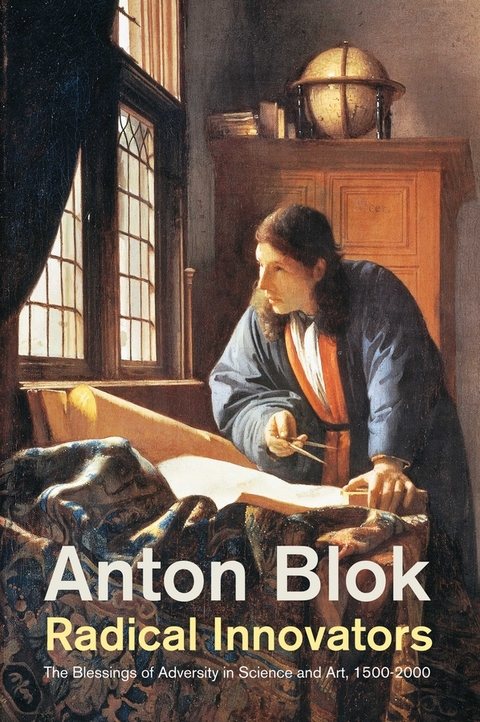
Radical Innovators (eBook)
John Wiley & Sons (Verlag)
978-1-5095-0553-1 (ISBN)
Through a collective biography of some ninety radical innovators, including Erasmus, Spinoza, Newton, Bach, Sade, Darwin, Melville, Mendel, Cézanne, Curie, Brâncusi, Einstein, Wittgenstein, Keynes, and Goodall, Blok shows how a significant proportion in fact benefited from social exclusion. Beethoven's increasing deafness isolated him from his friends, creating more time for composing and experimenting, while Darwin's chronic illness gave him an excuse to avoid social gatherings and get on with his work.
Adversity took various forms, including illegitimate birth, early parental loss, conflict with parents, bankruptcy, chronic illness, physical deficiencies, neurological and genetic disorders, minority status, peripheral origins, poverty, exile, and detention. Blok argues, however, that all these misfortunes had the same effect: alienation from mainstream society. As outsiders, innovators could question conventional beliefs and practices. With little to lose, they could take chances and exploit opportunities.
With governments, universities and industry all emphasizing the importance of investing in innovation, typically understood to mean planned and focussed research teams, this book runs counter to conventional wisdom. For far more often, radical innovation in science and art is entirely unscripted, resulting from trial and error by individuals ready to take risks, fail, and start again.
Anton Blok is Emeritus Professor of Cultural Anthropology at the University of Amsterdam.
Contents
Foreword
Chapter 1 The margins as a place of innovation
Chapter 2 Sibling rivalry
Chapter 3 Heuristic exceptions
Chapter 4 Adversity
Chapter 5 Chance and necessity
Chapter 6 The periphery as a locus of innovation.
Appendices
Notes
Bibliography
Index of names
Index of subjects
?Theories of innovation may seem to be a monopoly of economists, but Anton Blok, an anthropologist who has studied history and is interested in psychology, has produced a new and powerful answer to the questions, Who becomes an innovator? And what drives them??
Peter Burke, University of Cambridge
?Anton Blok has solved the riddle of genius. What does it take to become a ?radical innovator? in art or science? Childhood adversity and the attendant social exclusion, early and complete concentration in a chosen field, and a lifelong, total devotion to the self-imposed task. One can only wonder what youthful fate and adult commitment enabled Blok to achieve his radically innovative account of artistic and scientific creativity in this highly readable book.?
Abram de Swaan, University of Amsterdam
| Erscheint lt. Verlag | 23.5.2017 |
|---|---|
| Sprache | englisch |
| Themenwelt | Geisteswissenschaften ► Archäologie |
| Geisteswissenschaften ► Geschichte ► Allgemeine Geschichte | |
| Sozialwissenschaften ► Ethnologie | |
| Sozialwissenschaften ► Soziologie | |
| Schlagworte | Anthropologie • Anthropology • Anthropology Special Topics • Geschichte • Historical & Regional Anthropology • Historische u. regionale Anthropologie • History • History Special Topics • Innovation, genius, pioneers • Spezialthemen Anthropologie • Spezialthemen Geschichte |
| ISBN-10 | 1-5095-0553-9 / 1509505539 |
| ISBN-13 | 978-1-5095-0553-1 / 9781509505531 |
| Informationen gemäß Produktsicherheitsverordnung (GPSR) | |
| Haben Sie eine Frage zum Produkt? |
 PDF (Adobe DRM)
Kopierschutz: Adobe-DRM
Adobe-DRM ist ein Kopierschutz, der das eBook vor Mißbrauch schützen soll. Dabei wird das eBook bereits beim Download auf Ihre persönliche Adobe-ID autorisiert. Lesen können Sie das eBook dann nur auf den Geräten, welche ebenfalls auf Ihre Adobe-ID registriert sind.
Details zum Adobe-DRM
Dateiformat: PDF (Portable Document Format)
Mit einem festen Seitenlayout eignet sich die PDF besonders für Fachbücher mit Spalten, Tabellen und Abbildungen. Eine PDF kann auf fast allen Geräten angezeigt werden, ist aber für kleine Displays (Smartphone, eReader) nur eingeschränkt geeignet.
Systemvoraussetzungen:
PC/Mac: Mit einem PC oder Mac können Sie dieses eBook lesen. Sie benötigen eine
eReader: Dieses eBook kann mit (fast) allen eBook-Readern gelesen werden. Mit dem amazon-Kindle ist es aber nicht kompatibel.
Smartphone/Tablet: Egal ob Apple oder Android, dieses eBook können Sie lesen. Sie benötigen eine
Geräteliste und zusätzliche Hinweise
Buying eBooks from abroad
For tax law reasons we can sell eBooks just within Germany and Switzerland. Regrettably we cannot fulfill eBook-orders from other countries.
aus dem Bereich