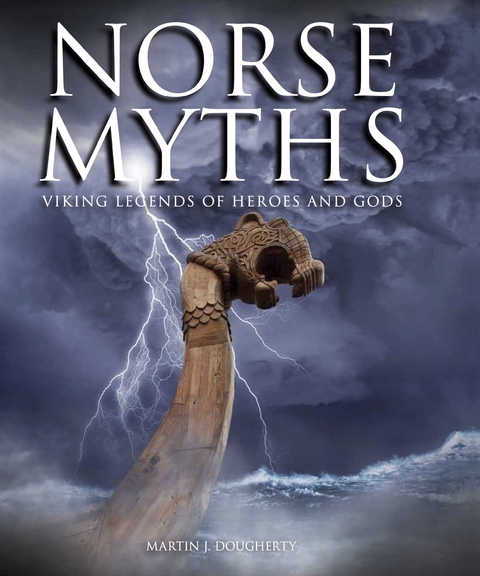
Norse Myths (eBook)
224 Seiten
Amber Books Ltd (Verlag)
978-1-78274-343-9 (ISBN)
* Provides a detailed exploration of the gods, monsters, characters and symbols of Norse mythology * Examines the written sources of Norse mythology, the Eddas and Norse sagas * Illustrated with 180 photographs, artworks and illustrations
Dating from the twelfth century, long after the ‘Viking Age’, this tapestry depicts Odin, Freya and Thor. Much of our knowledge of the Norse mythos comes from such later sources; little was recorded at the time.
THE NORSEMEN
The stories of Thor, Odin and Loki are at least vaguely familiar to most of us. Many people can recall – often without being able to say exactly where they heard the story – that the Norse gods fought against giants and were ultimately betrayed by Loki the trickster. The end of the world and the death of the gods in a grim battle called Ragnarok has also found its way into popular culture.
People who would never consider studying mythology may know a surprising amount about the religion of the Norse people, often without realizing they do. One reason for this is the profound influence that Norse mythology has had upon other cultures, causing the legends to filter through to today, not only in the histories of the Norse people themselves, but from other sources, too. Ideas ‘borrowed’ from Norse mythology are frequently found in modern fantasy and science fiction – such as elves, dwarfs and undead warriors rising from an unquiet grave, for example.
In some cases, the use of Norse characters in modern stories is deliberate. In Marvel’s graphic novels and movies, Thor and his fellow gods are an advanced race whose science gives them god-like powers, but they are essentially the same people as in the original myths. In David Drake’s Northworld series of novels, the lead characters are parallels of the Norse gods – Commander North himself lost an eye in return for knowledge of the future, as did Odin the Allfather. This use of mythical characters is quite deliberate on the part of the author.
Other influences may be less obvious, and, indeed, the creator might not be aware of the process by which he or she ended up adding Norse concepts to a novel of modern fantasy or science fiction. Magical weaponry made by dwarfs is a common fantasy trope; few realize that it comes from Norse legend. Similarly, there are numerous ‘Ragnarok Devices’ and ‘Ragnarok Operations’ in science fiction; the meaning is obvious even to those who do not know anything about the original mythology.
The modern fascination with the Norsemen has resulted in detailed reconstruction of their homes and way of life, such as here at L’Anse aux Meadows, Newfoundland.
THE NEWFOUNDLAND AND GREENLAND NORSE COLONIES ARE LONG GONE, BUT ICELAND PROSPERED AND BECAME A MODERN NATION.
There are many reasons why Norse characters and stories exert such a powerful influence whereas other mythologies do not. For one thing, these are interesting characters whose adventures make a great story. Other mythologies have equally fascinating concepts, but are less well known. They require more explanation and will not necessarily grab the audience’s attention in the same way. A familiar story rings true: a familiar character is easy to identify with. So the mythology of the Norsemen continues to inspire and entertain us today, and one reason for that is the Norsemen themselves.
The Norsemen
Often (rather inaccurately) referred to as ‘Vikings’, the Norse people inhabited Scandinavia – modern Denmark, Norway and Sweden as well as parts of Finland – and spread out into other regions. In what is now Russia they became known as ‘the Rus’, who heavily influenced the development of that country. Their settlements in Normandy, France, were recognized by the King of the Franks and became a European duchy from which the present monarchy of the United Kingdom is derived. William the Conqueror was Duke of Normandy, something different from a Norse war-leader, but his lineage and traditions originated in the Norse world.
The Norsemen also settled in Iceland, Greenland and even a very small part of North America (Newfoundland) – although the latter was extremely short-lived. These Newfoundland and Greenland colonies are long gone, but Iceland prospered and became a modern nation. It was there that many of the heroic sagas of the Norse people were finally written down, and it is from Icelandic tradition that we derive much of what we know about the Norsemen and their gods.
Early raids were conducted with at most a handful of ships, but later in the ‘Viking Age’ the Norsemen sent forth fleets of hundreds of ships containing thousands of men. They besieged Paris in 845 and again in 885–6.
The term ‘Viking’, often applied to Norsemen in general, in fact referred to someone who was involved in an expedition, or ‘Vik’. An expedition was defined as a journey where it was necessary to take turns at the oars of a ship; short trips where the vessel was rowed directly to the destination in one shift at the oars did not qualify for the term. More generally, an expedition was considered to mean any long journey on land or sea, and anyone undertaking one was a Viking – but only until he returned home.
The most famous Norse ‘expeditions’ were, of course, their increasingly destructive raids along the coasts of Europe, but they were equally willing to trade. Some expeditions were a bit of both, depending on the wealth of the places visited and how well guarded they appeared to be. These raiding and trade expeditions took Norsemen around the coasts of Europe and into the Mediterranean, and, of course, some settled in lands they found pleasing. The British Isles and the coasts of northern Europe and Iceland were extensively settled, as well as areas inland of the Baltic Sea.
Trade expeditions (and raids) got as far as the Arab world, and pushed some way up the Silk Road. There have been somewhat fanciful attempts to connect what appears to be runic graffiti in Southeast Asia with a ‘Viking’ expedition along the trade routes of the Silk Road to China, then down the Yangtze River and along the Pacific Coast. There are even claims that Norsemen reached Australia, but these do not come from credible sources. Likewise, the settlement of North America has been greatly exaggerated by some, with numerous fake artefacts ‘proving’ that there were Norse settlements in the American interior when it is almost certain that there were not.
Using the great rivers of Europe and Russia as highways, the Norsemen reached the Middle East where they interacted with Arab traders. This created a link to the Silk Road reaching all the way to China.
Leaving aside the wilder claims about where the Norsemen went and what they did, it is certainly true that they visited many places and left an impression – both good and bad. The Byzantine emperors maintained an elite unit called the Varangian Guard that was initially recruited from the warriors of the Rus, who were themselves relocated Norsemen. The Varangian Guard later took recruits from much of northern Europe, although these often came from Norse-influenced regions.
Wherever the Norsemen raided, legends sprang up about them. Where they settled, they brought their own myths and stories, and these endured long after the adoption of Christianity. Indeed, for a time many Norsemen were happy to accept both Christianity and their older gods side-by-side. Over time, however, the Norse gods faded into myth, although their cultural influence was still felt.
THE MERGING OF MYTH AND REALITY
The legendary ‘dragon ships’ of the Norsemen are an example of how fact and fiction have become distorted. The term ‘dragon ship’ has been used for many years to describe the longships used for raids and trading expeditions. These ships did indeed have a carved prow in the shape of a fearsome creature, but no clear evidence of a dragon has ever been found. Serpents, horses and all manner of other designs have been identified by archaeologists, and of course it is possible that dragon designs were popular, but none have survived.
The carved prows of Norse ships were undoubtedly a source of great pride and gave the vessel its own identity – something that might be important to men who had to cross many miles of open sea in it.
The term ‘dragon ship’ is of obscure origins. Some historical sources seem to imply a connection between the Norse ships and dragons, possibly of a more fanciful nature than a description of the carved prow. It could be that the chroniclers recorded a garbled version of eyewitness accounts – after all, as a vessel full of bloodthirsty Norsemen approaches, the average villager could be forgiven for failing to note that the prow is carved as a serpent rather than a dragon! Or it might be the result of hyperbole or bardic speech. The Skalds, who were part historian, part bard and part data-retrieval system, used phrases known as ‘Kennings’ in their poetry. Kennings could be quite simple, such as ‘sea-steed’ for ship, or subtle and complex. A term like ‘wave-dragon’ could be taken to mean a ship with a dragon-carved prow or a boatload of rapacious Vikings descending to bring chaos upon their victims.
The Norsemen were a hardy folk from a land that could often be challenging. They were willing to undertake long voyages in open vessels, and even invented ways of navigating on the ocean. They were certainly a brave people, but although they were entirely willing to use violence when needed, there were actually very few professional warriors in Norse culture. Most ‘Vikings’...
| Erscheint lt. Verlag | 8.3.2016 |
|---|---|
| Reihe/Serie | Histories | Histories |
| Sprache | englisch |
| Themenwelt | Literatur ► Biografien / Erfahrungsberichte |
| Literatur ► Historische Romane | |
| Literatur ► Märchen / Sagen | |
| Literatur ► Romane / Erzählungen | |
| Geisteswissenschaften ► Geschichte ► Regional- / Ländergeschichte | |
| Geschichte ► Teilgebiete der Geschichte ► Militärgeschichte | |
| Schlagworte | Denmark • Loki • Norse • Norway • Odin • Ragnarok • Scandinavia • Thor • Valhalla • viking |
| ISBN-10 | 1-78274-343-X / 178274343X |
| ISBN-13 | 978-1-78274-343-9 / 9781782743439 |
| Informationen gemäß Produktsicherheitsverordnung (GPSR) | |
| Haben Sie eine Frage zum Produkt? |
 EPUB (Adobe DRM)
Größe: 19,9 MB
Kopierschutz: Adobe-DRM
Adobe-DRM ist ein Kopierschutz, der das eBook vor Mißbrauch schützen soll. Dabei wird das eBook bereits beim Download auf Ihre persönliche Adobe-ID autorisiert. Lesen können Sie das eBook dann nur auf den Geräten, welche ebenfalls auf Ihre Adobe-ID registriert sind.
Details zum Adobe-DRM
Dateiformat: EPUB (Electronic Publication)
EPUB ist ein offener Standard für eBooks und eignet sich besonders zur Darstellung von Belletristik und Sachbüchern. Der Fließtext wird dynamisch an die Display- und Schriftgröße angepasst. Auch für mobile Lesegeräte ist EPUB daher gut geeignet.
Systemvoraussetzungen:
PC/Mac: Mit einem PC oder Mac können Sie dieses eBook lesen. Sie benötigen eine
eReader: Dieses eBook kann mit (fast) allen eBook-Readern gelesen werden. Mit dem amazon-Kindle ist es aber nicht kompatibel.
Smartphone/Tablet: Egal ob Apple oder Android, dieses eBook können Sie lesen. Sie benötigen eine
Geräteliste und zusätzliche Hinweise
Buying eBooks from abroad
For tax law reasons we can sell eBooks just within Germany and Switzerland. Regrettably we cannot fulfill eBook-orders from other countries.
EPUB (Ohne DRM)Digital Rights Management: ohne DRM
Dieses eBook enthält kein DRM oder Kopierschutz. Eine Weitergabe an Dritte ist jedoch rechtlich nicht zulässig, weil Sie beim Kauf nur die Rechte an der persönlichen Nutzung erwerben.
Dateiformat: EPUB (Electronic Publication)
EPUB ist ein offener Standard für eBooks und eignet sich besonders zur Darstellung von Belletristik und Sachbüchern. Der Fließtext wird dynamisch an die Display- und Schriftgröße angepasst. Auch für mobile Lesegeräte ist EPUB daher gut geeignet.
Systemvoraussetzungen:
PC/Mac: Mit einem PC oder Mac können Sie dieses eBook lesen. Sie benötigen dafür die kostenlose Software Adobe Digital Editions.
eReader: Dieses eBook kann mit (fast) allen eBook-Readern gelesen werden. Mit dem amazon-Kindle ist es aber nicht kompatibel.
Smartphone/Tablet: Egal ob Apple oder Android, dieses eBook können Sie lesen. Sie benötigen dafür eine kostenlose App.
Geräteliste und zusätzliche Hinweise
Buying eBooks from abroad
For tax law reasons we can sell eBooks just within Germany and Switzerland. Regrettably we cannot fulfill eBook-orders from other countries.
aus dem Bereich