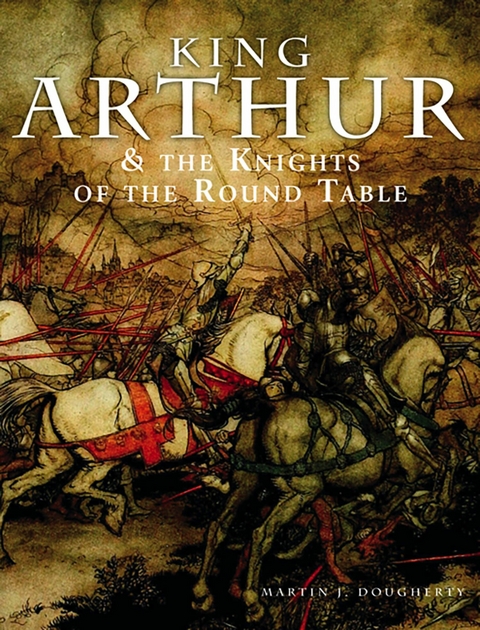
King Arthur and the Knights of the Round Table (eBook)
224 Seiten
Amber Books Ltd (Verlag)
978-1-78274-405-4 (ISBN)
Here lies entombed the renowned King Arthur in the island of Avalon.
- Inscription found at Glastonbury in the late 12th century
King Arthur most probably never existed and if he did we know precious little about him, and yet he is one of the most famous Britons, while Excalibur and Camelot are perhaps the world's best known sword and castle, and Hollywood doesn't tire of returning to the world of Arthurian romance - another major movie is to be released in 2016. So, what's the truth behind King Arthur? How did the legends take hold? And why have they endured for so long?
Long before the Marvel Universe there was the universe of Arthurian romance and King Arthur and the Knights of the Round Table examines the fact and the fiction behind Arthur, Lancelot, Merlin, Guinevere, Galahad, among others, as well as the quest for the Holy Grail. Beginning in the 12th century, the book explores what factual basis there is for the tales and how the characters, stories and motifs developed through histories, epic poems and prose tellings. The book also charts the revived interest in Arthurian romance in the 19th century and considers how the tales still hold the popular imagination today.
Illustrated with more than 180 colour and black-and-white artworks and photographs and maps, King Arthur and the Knights of the Round Table is an expertly written account of where literature, mythology and history meet.
Here lies entombed the renowned King Arthur in the island of Avalon. - Inscription found at Glastonbury in the late 12th century King Arthur most probably never existed and - even if he did - we know precious little about him, and yet he is one of the most famous Britons, while Excalibur and Camelot are perhaps the world's best known sword and castle. So, what's the truth behind King Arthur? How did the legends take hold? And why have they endured for so long? Long before the Marvel Universe there was the universe of Arthurian romance, and King Arthur and the Knights of the Round Table examines the fact and the fiction behind Arthur, Lancelot, Merlin, Guinevere, Galahad, among others, as well as the quest for the Holy Grail. Beginning in the 12th century, the book explores what factual basis there is for the tales and how the characters, stories and motifs developed through histories, epic poems and prose tellings. The book also charts the revived interest in Arthurian romance in the 19th century and considers how the tales still hold the popular imagination today. Illustrated with more than 180 colour and black-and-white artworks and photographs and maps, King Arthur and the Knights of the Round Table is an expertly written account of where literature, mythology and history meet.
The multiple crowns in this Medieval depiction of King Arthur indicate that he was High King over other kings in Britain rather than the ruler of a unified nation in the modern sense.
1
THE REAL KING ARTHUR
Historians have identified a number of figures who might have been a ‘historical Arthur’ – someone who defended at least a part of Britain in troubled times and built a realm that was renowned far and wide.
These figures include early British war-leaders, possibly of Celtic origin, a Romano-British cavalry commander doing his best to protect his people after the soldiers of Rome evacuated the islands, and later kings who might more resemble the classic version of Arthur.
There are also traditional Celtic tales that revolve around a figure who looks suspiciously like a proto-Arthur. The mystical elements of these stories are probably the origin of the supernatural parts of some Arthurian legends. Since this traditional Celtic folklore has been a part of Western culture for many centuries, it feels familiar and tends to ring true when incorporated into the tale of King Arthur.
Thus the Arthurian legend seems to be a combination of real events and mystical folktales, with a fair amount of Christian influence as well. This did not happen overnight; today’s many versions of the Arthurian legends developed through numerous retellings and the occasional gritty reboot. Much of the general storyline is derived from a collection of Medieval literature dealing with legendary and semi-historical events in Europe, collectively known as the ‘matters’ of Britain, France and Rome.
There are similarities between these three literary cycles. Much of the ‘Matter of France’ deals largely with the exploits of the paladins – a term now generally taken to mean heroic knights – serving Charlemagne in his battles against the Moorish invaders. Most famous of these tales is the Song of Roland, a tragedy based on historical events occurring around 778 AD. Roland and the paladins were killed defending Roncevaux Pass to allow the rest of their army to escape.
Like the tales of Arthur, the Song of Roland is a mix of fact and fiction. The battle did likely take place, and heroic deeds were done. Later versions of events introduced the heroic paladins – in some variants of the tale one of them is a sorcerer – until the story entered the realms of myth rather than history. Indeed, the word ‘paladin’ has come to mean a warrior who is a paragon of virtue, usually a gentle Christian knight or possibly a holy opponent of evil. Yet the original reference was nothing to do with virtue.
The tale of Roland (illustrated) and the paladins has much in common with that of King Arthur. It forms a major part of the body of Medieval literature known as the ‘Matter of France’.
The 12 paladins who served Charlemagne were high-ranking nobles whose title probably derived from the Latin ‘palatinus’, with connotations of rulership. In Britain, some regions were established as semi-autonomous areas whose lord ruled them as he saw fit so long as he met an obligation imposed by the crown. County Durham was a county palatine founded in the early days of the Norman Conquest to defend the rest of Britain from the Scots. Lancashire was set up as a county palatine in 1351.
Thus these paladins were most probably high-ranking nobles with responsibility for regional governorship – which says nothing at all about their piety or character. According to the Song of Roland they fought to the last to defend the retreating army, saving many lives by their sacrifice and earning eternal glory. It is perhaps through this combination of self-sacrifice and feats of arms that the term ‘paladin’ has gained its new meaning. The word, with connotations of heroism and virtue, has been applied to Arthur’s Knights of the Round Table, even though few if any of them would have been rulers of a palatinate.
Roland’s battle against the giant Moorish knight Farragut is memorialized on the Palace of the Kings of Navarre. Farragut had only one weak spot: his navel. After a lengthy fight, Roland impaled him there with a spear.
Although the Song of Roland and the associated tales are less well known today than the Arthurian legends, the Matter of France has at times been widely known and extremely popular – perhaps as much so as Arthur’s legend. There are some parallels between the deeds of the paladins and those of the Knights of the Round Table, and also between the stories themselves. The matters of France and of Britain are tales of national heroism (albeit from a time when there were no countries in the modern sense) and form part of the culture of those nations.
The ‘Matter of Rome’ is somewhat different. It is a rather anachronistic retelling of the myths of ancient Greece and Rome in which various Medieval concepts are substituted for historical accuracy. Warriors are recast as knights, with tournaments and other purely Medieval concepts added into the mix. The subject matter is largely drawn from the work of the ancient poet Homer, and it is not at all clear how closely his poems reflected historical reality. He was writing centuries after the events he described, and essentially creating a narrative from old tales he had collected. In modern parlance, the ‘Matter of Rome’ is a reboot of the classical myths set in a pseudo-Medieval era.
THE ‘MATTER OF ROME’ IS A REBOOT OF THE CLASSICAL MYTHS SET IN A PSEUDO-MEDIEVAL ERA.
Similarly, the ‘Matter of Britain’ draws on historical sources as well as traditional tales and a great deal of Celtic mythology. One underlying theme is the arrival in ancient times of heroes from the Trojan War, which features in some Celtic mythology as well as pseudo-historical material dealing with the descent of Welsh nobility from these heroes. In many cases these writings are an interesting mix of known fact and what is presumably invention, with the royal bloodlines running back from people who definitely lived to ancestors who are almost certainly mythical. The exact point at which history fades into myth is unclear.
The Roman invasion of Britain initially met with vigorous resistance from local tribes, but the Britons lacked the unity necessary to prevent a Roman takeover. Many tribes were won over by political or economic means rather than being subjugated by military force.
The ‘Matter of Britain’ is not exclusively the tale of King Arthur and his knights, although Arthur is of particular importance. In this body of Medieval literature, Arthur is a king of the Ancient Britons who defends his realm from Saxon invaders. The era is the fifth or sixth century AD, some time after the end of Roman rule in Britain, so within the period sometimes referred to as the ‘Dark Ages’ rather than the High Medieval era depicted in most movies about Arthur.
Roman Influences
It is not certain when Roman influence in Britain began. The expeditions of Julius Caesar in 55–54 BC were of no great consequence, but contact with the continent had been commonplace long before this. The people of Britain were closely related to their continental cousins, and had contact with Rome through them before the Roman conquest of Britain began.
Over the next decades, the Roman Empire planned invasions and made agreements with various tribes that brought them into client status with the empire, and finally invaded as a result of a chaotic political situation in Britain. Disputes between tribes created an opportunity to annex the British Isles, and in 43 AD a Roman force landed in Britain. Despite initial resistance, Rome conquered southern Britain and gradually pushed its frontiers north and west.
There was no concept of Britain as a nation at this time, or for several centuries afterwards. Britain was a place in which numerous tribes had their territory; it was tribal loyalties that predominated rather than any concept of realms or regions. This tribalism persisted under Roman rule, but was eroded to some extent as the Britons became Romanized.
THERE WAS NO CONCEPT OF A BRITISH NATION IN THIS ERA; TRIBAL LOYALTIES PREDOMINATED.
Roman-controlled Britain was a province of the empire until around 410 AD, when Roman troops were withdrawn to defend territories closer to home. Parts of the British Isles lay outside Roman control of course; the tribes of Caledonia (Scotland) successfully resisted Roman incursions for the most part, and Hibernia (Ireland) was completely beyond the control of Rome.
At the time of the Roman invasion, the role of cavalry was fulfilled among the Britons by chariots. This practice was outdated elsewhere, but had been retained in the British Isles and was used with some success. With Romanization came the use of cavalry; in 175 a force of Sarmatian horsemen was deployed in Britain. Sarmatia lay north of the Black Sea, roughly where the modern nation of Ukraine is found today.
Although the chariot was obsolete in Continental Europe, the Ancient Britons made effective use of its mobility. Chariot forces essentially combined the mobility of cavalry with the ability to jump down and fight on foot, then return to the chariot and escape from a bad situation.
Sarmatians at War
This force of cavalry was sent to Britain as a result of a peace treaty after a war between the Roman Empire and the Sarmatians. Part of the...
| Erscheint lt. Verlag | 8.5.2017 |
|---|---|
| Reihe/Serie | Histories | Histories |
| Sprache | englisch |
| Themenwelt | Literatur ► Historische Romane |
| Literatur ► Märchen / Sagen | |
| Literatur ► Romane / Erzählungen | |
| Geschichte ► Teilgebiete der Geschichte ► Kulturgeschichte | |
| Geisteswissenschaften ► Sprach- / Literaturwissenschaft ► Anglistik / Amerikanistik | |
| Geisteswissenschaften ► Sprach- / Literaturwissenschaft ► Literaturwissenschaft | |
| Sozialwissenschaften ► Soziologie | |
| Schlagworte | Arthur • Camelot • chivalry • Gawain • grail • Guinevere • Holy • King • Knight • Lancelot • Merlin • Quest • Romance • Round • Table |
| ISBN-10 | 1-78274-405-3 / 1782744053 |
| ISBN-13 | 978-1-78274-405-4 / 9781782744054 |
| Informationen gemäß Produktsicherheitsverordnung (GPSR) | |
| Haben Sie eine Frage zum Produkt? |
 EPUB (Ohne DRM)
Digital Rights Management: ohne DRM
Dieses eBook enthält kein DRM oder Kopierschutz. Eine Weitergabe an Dritte ist jedoch rechtlich nicht zulässig, weil Sie beim Kauf nur die Rechte an der persönlichen Nutzung erwerben.
Dateiformat: EPUB (Electronic Publication)
EPUB ist ein offener Standard für eBooks und eignet sich besonders zur Darstellung von Belletristik und Sachbüchern. Der Fließtext wird dynamisch an die Display- und Schriftgröße angepasst. Auch für mobile Lesegeräte ist EPUB daher gut geeignet.
Systemvoraussetzungen:
PC/Mac: Mit einem PC oder Mac können Sie dieses eBook lesen. Sie benötigen dafür die kostenlose Software Adobe Digital Editions.
eReader: Dieses eBook kann mit (fast) allen eBook-Readern gelesen werden. Mit dem amazon-Kindle ist es aber nicht kompatibel.
Smartphone/Tablet: Egal ob Apple oder Android, dieses eBook können Sie lesen. Sie benötigen dafür eine kostenlose App.
Geräteliste und zusätzliche Hinweise
Buying eBooks from abroad
For tax law reasons we can sell eBooks just within Germany and Switzerland. Regrettably we cannot fulfill eBook-orders from other countries.
aus dem Bereich