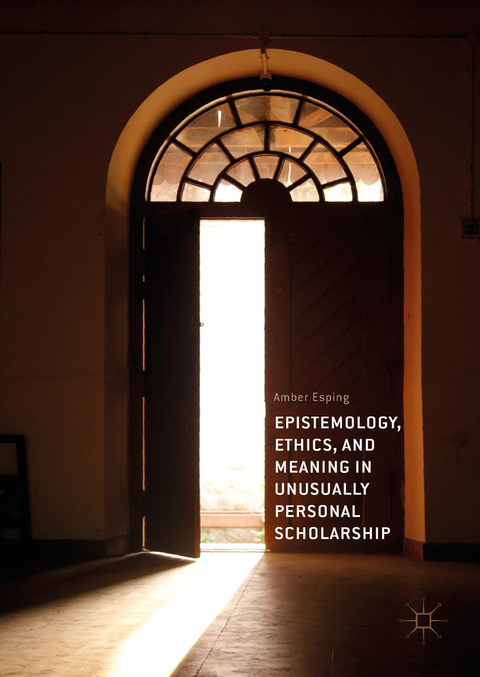
Epistemology, Ethics, and Meaning in Unusually Personal Scholarship (eBook)
XIX, 187 Seiten
Springer International Publishing (Verlag)
978-3-319-73718-8 (ISBN)
This book uses Viktor Frankl's Existential Psychology (logotherapy) to explore the ways some professors use unusually personal scholarship to discover meaning in personal adversity. A psychiatrist imprisoned for three years in Nazi concentration camps, Frankl believed the search for meaning is a powerful motivator, and that its discovery can be profoundly therapeutic. Part I begins with four stories of professors finding meaning. Using the case studies as a foundation, Part II investigates issues of epistemology and ethics in unusually personal research from an existential perspective. The book offers advice for graduate students and faculty who want to live and work more meaningfully in the academy.
Amber Esping is Associate Professor of Educational Psychology at Texas Christian University in Fort Worth, USA. She is the author of Sympathetic Vibrations: A Guide for Private Music Teachers (2000), and co-author (with Jonathan Plucker) of Intelligence 101 (2014). Her research focuses on the history of human intelligence theory and testing, and the application of existential psychology to academic contexts and qualitative inquiry.
Amber Esping is Associate Professor of Educational Psychology at Texas Christian University in Fort Worth, USA. She is the author of Sympathetic Vibrations: A Guide for Private Music Teachers (2000), and co-author (with Jonathan Plucker) of Intelligence 101 (2014). Her research focuses on the history of human intelligence theory and testing, and the application of existential psychology to academic contexts and qualitative inquiry.
1. Introduction to Mesearch2. Mesearch in the Social and Behavioral Sciences3. Mesearch in the Hard Sciences4. Mesearch in the Arts and Humanities5. Autoethnography6. Mesearch in Graduate School7. Mesearch and Motivation8. To Disclose or Not?9. Getting a Job and Getting Tenure10. Mesearch as Therapeutic Practice11. Mesearch and Activism12. The Case for a New Epistemology13. The Future of Mesearch
| Erscheint lt. Verlag | 23.2.2018 |
|---|---|
| Zusatzinfo | XIX, 187 p. 3 illus. |
| Verlagsort | Cham |
| Sprache | englisch |
| Themenwelt | Geisteswissenschaften ► Philosophie |
| Geisteswissenschaften ► Psychologie | |
| Schlagworte | Authoethnography • Educational Psychology • Existentialism • existential psychology • humanistic psychology • Indigenous Inquiry • Mesearch • Phenomenology • Research Methodology |
| ISBN-10 | 3-319-73718-X / 331973718X |
| ISBN-13 | 978-3-319-73718-8 / 9783319737188 |
| Informationen gemäß Produktsicherheitsverordnung (GPSR) | |
| Haben Sie eine Frage zum Produkt? |
 PDF (Wasserzeichen)
DRM: Digitales Wasserzeichen
Dieses eBook enthält ein digitales Wasserzeichen und ist damit für Sie personalisiert. Bei einer missbräuchlichen Weitergabe des eBooks an Dritte ist eine Rückverfolgung an die Quelle möglich.
Dateiformat: PDF (Portable Document Format)
Mit einem festen Seitenlayout eignet sich die PDF besonders für Fachbücher mit Spalten, Tabellen und Abbildungen. Eine PDF kann auf fast allen Geräten angezeigt werden, ist aber für kleine Displays (Smartphone, eReader) nur eingeschränkt geeignet.
Systemvoraussetzungen:
PC/Mac: Mit einem PC oder Mac können Sie dieses eBook lesen. Sie benötigen dafür einen PDF-Viewer - z.B. den Adobe Reader oder Adobe Digital Editions.
eReader: Dieses eBook kann mit (fast) allen eBook-Readern gelesen werden. Mit dem amazon-Kindle ist es aber nicht kompatibel.
Smartphone/Tablet: Egal ob Apple oder Android, dieses eBook können Sie lesen. Sie benötigen dafür einen PDF-Viewer - z.B. die kostenlose Adobe Digital Editions-App.
Buying eBooks from abroad
For tax law reasons we can sell eBooks just within Germany and Switzerland. Regrettably we cannot fulfill eBook-orders from other countries.
aus dem Bereich