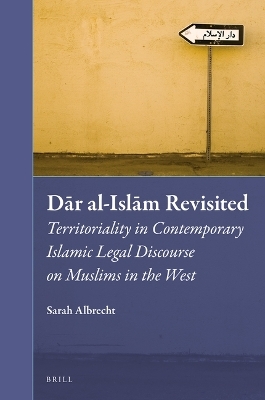
Dār al-Islām Revisited
Brill (Verlag)
9789004364547 (ISBN)
Where is dār al-islām, and who defines its boundaries in the 21st century? In Dār al-Islām Revisited. Territoriality in Contemporary Islamic Legal Discourse on Muslims in the West, Sarah Albrecht explores the variety of ways in which contemporary Sunni Muslim scholars, intellectuals, and activists reinterpret the Islamic legal tradition of dividing the world into dār al-islām, the “territory of Islam,” dār al-ḥarb, the “territory of war,” and other geo-religious categories. Starting with an overview of the rich history of debate about this tradition, this book traces how and why territorial boundaries have remained a matter of controversy until today. It shows that they play a crucial role in current discussions of religious authority, identity, and the interpretation of the shariʿa in the West.
Sarah Albrecht, Ph.D., is a lecturer and research associate at Freie Universität Berlin. She is the author of Islamisches Minderheitenrecht: Yūsuf al-Qaraḍāwīs Konzept des fiqh al-aqallīyāt (2010) and co-editor of Conceptualising Muslim Diaspora (Special Issue of the Journal of Muslims in Europe, 2016).
Acknowledgements
List of Abbreviations
Notes on Transliteration, Translation, and Dates
1 Introduction
1.1 Contested Territory: Dār al-Islām and Dār al-Ḥarb in Western Academia and Beyond
1.2 Research Questions and Scope of This Study
1.3 Sources and Methodology
1.4 Conceptual Framework: A Spatial Perspective on Islamic Legal Discourse
1.5 Typology of Territorial Concepts and Chapter Outline
Part 1: Territoriality in Islamic Legal Discourse: A Historical Outline
2 Formation and Development of Territorial Concepts in the Pre-Modern Period
2.1 The Emergence of the Concepts of Dār al-Islām and Dār al-Ḥarb
2.2 The Development of Territorial Concepts in the Pre-modern Period
2.3 Residence in Non-Muslim Territory and the Obligation of Hijra
2.4 Ibn Taymiyya’s Attempt to Abandon Dualist Conceptions of Territories
2.5 On the Applicability of the Shariʿa and the Validity of Non-Muslim Laws
2.6 Chapter Summary and Concluding Remarks
3 Debates on Territoriality in the Modern Period
3.1 Dār al-Islām under Occupation: Discussions about Territoriality in the Colonial Period
3.2 Rethinking Territoriality in a World of Nation States
3.3 Is Europe Dār al-Islām? The Beginnings of the Contemporary Discourse on Territoriality
3.4 Chapter Summary and Concluding Remarks
Part 2: Contemporary Discourse on Territoriality
4 Dār al-Islām versus Dār al-Kufr: Reinventing Traditional Binaries
4.1 Prominent Proponents
4.2 Contextualizing Their Approaches
4.3 Dār al-Islām versus Dār al-Kufr: A Perennial Dichotomy
4.4 The West as a “Territory of Unbelief”
4.5 Territoriality from the Perspective of Hizb ut-Tahrir
4.6 Jihadists’ Views on Territoriality
4.7 Chapter Summary and Concluding Remarks
5 Dār al-Islām and the West: A Contractual Relationship
5.1 Prominent Proponents
5.2 Contextualizing Their Approaches
5.3 Normative but Adaptable? Tracing the Origins of Territorial Concepts
5.4 Defining the Boundaries of Dār al-Islām
5.5 Locating the West
5.6 Chapter Summary and Concluding Remarks
6 Dār al-Islām Relocated: How “Islamic” is the West?
6.1 Prominent Proponents
6.2 Contextualizing Their Approaches
6.3 “Islam Does Not Know Geographic Boundaries” – Reconsidering the Origins of Dār al-Islām
6.4 Deconstructing Traditional Boundaries
6.5 The Institutionalization of the Idea: The International Institute of Islamic Thought
6.6 Measuring the “Islamicity” of Modern States: The Shariah Index Project
6.7 Chapter Summary and Concluding Remarks
7 Rethinking Territoriality beyond Dār al-Islām: Alternative Calls for Overcoming Geo-Religious Boundaries
7.1 Prominent Proponents
7.2 Contextualizing their Approaches
7.3 Dār al-Shahāda: Ramadan’s Notion of the World as a Unified “Territory of Testimony”
7.4 Oubrou’s Call for a New “Geotheology”
7.5 Nayed’s Concept of the “Interior Abode of Peace”
7.6 Chapter Summary and Concluding Remarks
Part 3: Why Territoriality Matters
8 Territoriality, Residence, and Legal Interpretation in the West
8.1 Legitimacy of Residence in non-Muslim Countries
8.2 On the Validity of non-Muslim Laws
8.3 Territoriality and the Legitimization of Minority Fiqh
8.4 Chapter Summary and Concluding Remarks
9 Territoriality, Authority, and Identity
9.1 Territoriality and the Question of Religious Authority in a Globalized World
9.2 Territoriality and the Construction of Muslim Identity
9.3 Chapter Summary and Concluding Remarks
10 Conclusion
Bibliography
Interviews and Personal Communication
| Erscheinungsdatum | 30.07.2018 |
|---|---|
| Reihe/Serie | Muslim Minorities ; 29 |
| Verlagsort | Leiden |
| Sprache | englisch |
| Maße | 155 x 235 mm |
| Gewicht | 900 g |
| Themenwelt | Geisteswissenschaften |
| Naturwissenschaften ► Geowissenschaften ► Geografie / Kartografie | |
| Recht / Steuern ► Allgemeines / Lexika | |
| Recht / Steuern ► EU / Internationales Recht | |
| Sozialwissenschaften ► Soziologie ► Spezielle Soziologien | |
| ISBN-13 | 9789004364547 / 9789004364547 |
| Zustand | Neuware |
| Informationen gemäß Produktsicherheitsverordnung (GPSR) | |
| Haben Sie eine Frage zum Produkt? |
aus dem Bereich