


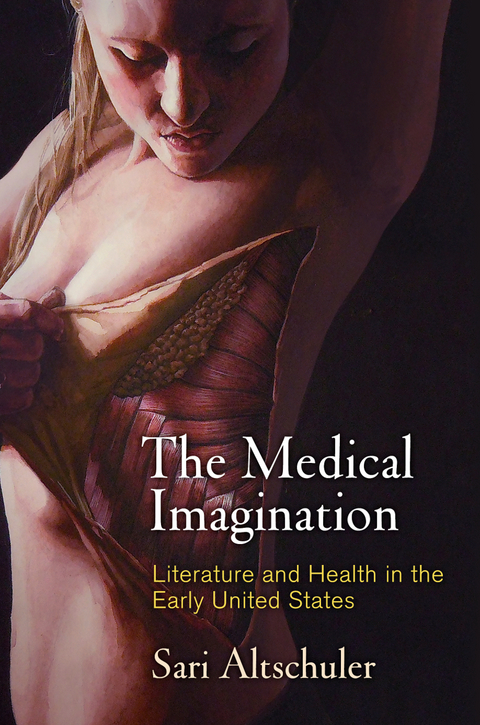
The Medical Imagination (eBook)
312 Seiten
University of Pennsylvania Press (Verlag)
978-0-8122-9474-3 (ISBN)
In 1872, Ralph Waldo Emerson wrote, "Science does not know its debt to imagination," words that still ring true in the worlds of health and health care today. The checklists and clinical algorithms of modern medicine leave little space for imagination, and yet we depend on creativity and ingenuity for the advancement of medicine—to diagnose unusual conditions, to innovate treatment, and to make groundbreaking discoveries. We know a great deal about the empirical aspects of medicine, but we know far less about what the medical imagination is, what it does, how it works, or how we might train it.
In The Medical Imagination, Sari Altschuler argues that this was not always so. During the eighteenth and nineteenth centuries, doctors understood the imagination to be directly connected to health, intimately involved in healing, and central to medical discovery. In fact, for physicians and other health writers in the early United States, literature provided important forms for crafting, testing, and implementing theories of health. Reading and writing poetry trained judgment, cultivated inventiveness, sharpened observation, and supplied evidence for medical research, while novels and short stories offered new perspectives and sites for experimenting with original medical theories.
Such imaginative experimentation became most visible at moments of crisis or novelty in American medicine, such as the 1790s yellow fever epidemics, the global cholera pandemics, and the discovery of anesthesia, when conventional wisdom and standard practice failed to produce satisfying answers to pressing questions. Throughout the eighteenth and nineteenth centuries, health research and practice relied on a broader complex of knowing, in which imagination often worked with and alongside observation, experience, and empirical research. In reframing the historical relationship between literature and health, The Medical Imagination provides a usable past for contemporary conversations about the role of the imagination—and the humanities more broadly—in health research and practice today.
Sari Altschuler is Associate Professor of English and Associate Director of the Northeastern Humanities Center at Northeastern University.
Introduction
Chapter 1. Revolution
Chapter 2. Yellow Fever
Chapter 3. Cholera
Chapter 4. Difference
Chapter 5. Anesthesia
Conclusion. Humanistic Inquiry in Medicine, Then and Now
Notes
Bibliography
Index
Acknowledgments
| Reihe/Serie | Early American Studies | Early American Studies |
|---|---|
| Zusatzinfo | 12 illus. |
| Verlagsort | Philadelphia |
| Sprache | englisch |
| Themenwelt | Geisteswissenschaften ► Sprach- / Literaturwissenschaft ► Anglistik / Amerikanistik |
| Geisteswissenschaften ► Sprach- / Literaturwissenschaft ► Literaturwissenschaft | |
| Schlagworte | American History • American Studies • Cultural Studies • Literature • Medicine |
| ISBN-10 | 0-8122-9474-2 / 0812294742 |
| ISBN-13 | 978-0-8122-9474-3 / 9780812294743 |
| Informationen gemäß Produktsicherheitsverordnung (GPSR) | |
| Haben Sie eine Frage zum Produkt? |
 EPUB (Adobe DRM)
Kopierschutz: Adobe-DRM
Adobe-DRM ist ein Kopierschutz, der das eBook vor Mißbrauch schützen soll. Dabei wird das eBook bereits beim Download auf Ihre persönliche Adobe-ID autorisiert. Lesen können Sie das eBook dann nur auf den Geräten, welche ebenfalls auf Ihre Adobe-ID registriert sind.
Details zum Adobe-DRM
Dateiformat: EPUB (Electronic Publication)
EPUB ist ein offener Standard für eBooks und eignet sich besonders zur Darstellung von Belletristik und Sachbüchern. Der Fließtext wird dynamisch an die Display- und Schriftgröße angepasst. Auch für mobile Lesegeräte ist EPUB daher gut geeignet.
Systemvoraussetzungen:
PC/Mac: Mit einem PC oder Mac können Sie dieses eBook lesen. Sie benötigen eine
eReader: Dieses eBook kann mit (fast) allen eBook-Readern gelesen werden. Mit dem amazon-Kindle ist es aber nicht kompatibel.
Smartphone/Tablet: Egal ob Apple oder Android, dieses eBook können Sie lesen. Sie benötigen eine
Geräteliste und zusätzliche Hinweise
Buying eBooks from abroad
For tax law reasons we can sell eBooks just within Germany and Switzerland. Regrettably we cannot fulfill eBook-orders from other countries.
aus dem Bereich


