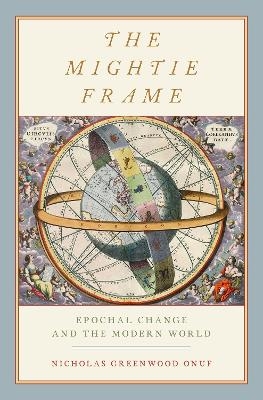
The Mightie Frame
Oxford University Press Inc (Verlag)
978-0-19-087980-8 (ISBN)
Inspired by Michel Foucault's The Order of Things, this book tells a story about epochal change in the modern world. Like Foucault, Nicholas Onuf is concerned with how we moderns think about ourselves and our world, but in this book he emphasizes the conceptual links in the ways we think, talk, get things done, conduct ourselves, and run societies, from age to age. As with his previous work, Onuf emphasizes the "rules for rule" that have solidified over time through repeated behaviors that work themselves out into a system of social uniformity and hierarchy. Rules set out who is a member of society, establish goals, provide opportunities to act, and dictate who sits on top -- in other words, what any political society looks like in a particular time and place. This book looks at the political society that has evolved since the Renaissance, or what might be called "the modern world," in order to consider what is yet to come. Onuf argues that modernity, although consisting of a succession of epochs or ages separated by great ruptures, has continued to change within the confines of a "mightie frame" (a turn of phrase he borrows from John Milton). Epoch by epoch, this frame has linked the limits of our knowledge, à la Michel Foucault, to conditions of rule, and it points to a plausible ethics for what comes next. But unlike Foucault, Onuf argues that modernism marked an end to societal and political transitions, and that we have entered a period during which established conditions of rule are likely to be reinforced -- and the mighty frame will grow ever mightier.
Nicholas Greenwood Onuf is Professor Emeritus of Politics and International Relations at Florida International University. He is author of seven books, two with his brother, and several articles in journals and edited volumes. His book, Making Sense, Making Worlds: Constructivism in Social Theory and International Relations, was published in conjunction with the republication of World of Our Making: Rules and Rule in Social Theory and International Relations.
Prologue: Refreshing Metaphors
Chapter 1: What Can We Know?
Chapter 2: Modernity's Mighty Frame
Chapter 3: Traditional Societies
Chapter 4: Transitional Figures: Hugo Grotius, Thomas Hobbes, Samuel Pufendorf
Interlude: "Working models"
Chapter 5: "This quarter of the globe"
Chapter 6: Transitional Figures: Immanuel Kant, Adam Smith, James Madison
Chapter 7: State-Nations
Chapter 8: Transitional Figures: Edmund Husserl, Emile Durkheim, the Fabian Society
Interlude: Growth Rates
Chapter 9: Epochal Destruction
Chapter 10: Transitional Figures: J. L. Austin, Jay Forrester, Donna Haraway
Chapter 11: Paradise Lost?
Chapter 12: Relative Virtue
Epilogue: "Saving constructivism"
References
Acknowledgments
Index
| Erscheinungsdatum | 20.09.2018 |
|---|---|
| Verlagsort | New York |
| Sprache | englisch |
| Maße | 236 x 157 mm |
| Gewicht | 517 g |
| Themenwelt | Geisteswissenschaften ► Philosophie |
| Sozialwissenschaften ► Politik / Verwaltung ► Europäische / Internationale Politik | |
| Sozialwissenschaften ► Politik / Verwaltung ► Politische Theorie | |
| ISBN-10 | 0-19-087980-7 / 0190879807 |
| ISBN-13 | 978-0-19-087980-8 / 9780190879808 |
| Zustand | Neuware |
| Informationen gemäß Produktsicherheitsverordnung (GPSR) | |
| Haben Sie eine Frage zum Produkt? |
aus dem Bereich