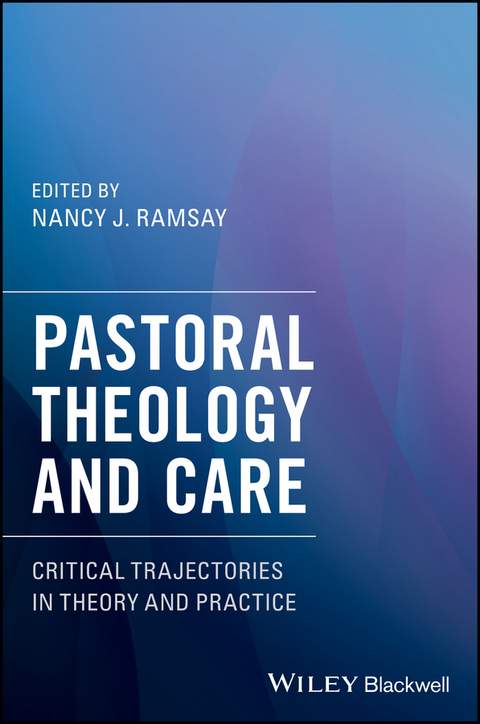
Pastoral Theology and Care (eBook)
John Wiley & Sons (Verlag)
978-1-119-29259-3 (ISBN)
Leading pastoral theologians explore a wide variety of themes related to pastoral practice.
Pastoral Theology and Care: Critical Trajectories in Theory and Practice offers a collection of essays by leading pastoral theologians that represent emerging trajectories in the fields of pastoral theology and care. The topics explored include: qualitative research and ethnography, advances in neuroscience, care across pluralities and intersections in religion and spiritualties, the influence of neoliberal economics in socio-economic vulnerabilities, postcolonial theory and its implications, the intersections of race and religion in caring for black women, and the usefulness of intersectionality for pastoral practice. Each of the essays offers a richly illustrated review of a practice of pastoral care relationally and in the public domain.
The contributions to this volume engage seven critical directions emerging in the literature of pastoral theology in the United States and internationally among pastoral and practical theologians. While coverage of these topics does not exhaust important points of activity in the field, it does represent especially promising resources for theory and practice. This important work:
- Offers unique coverage of new directions in the field
- Includes contributions from an exceptional group of experts who are noted leaders in their areas of study
- Introduces the newest perspectives on pastoral care and offers constructive proposals
Filled with case illustrations that make chapters pedagogically useful, Pastoral Theology and Care is essential reading for faculty, seminarians and students in advanced degree programs, and pastors.
Nancy J. Ramsay is Professor of Pastoral Theology and Pastoral Care, Brite Divinity School, Fort Worth Texas. Previously, she served on the faculty of Louisville Presbyterian Theological Seminary as the Harrison Ray Anderson Professor of Pastoral Theology.
Leading pastoral theologians explore a wide variety of themes related to pastoral practice. Pastoral Theology and Care: Critical Trajectories in Theory and Practice offers a collection of essays by leading pastoral theologians that represent emerging trajectories in the fields of pastoral theology and care. The topics explored include: qualitative research and ethnography, advances in neuroscience, care across pluralities and intersections in religion and spiritualties, the influence of neoliberal economics in socio-economic vulnerabilities, postcolonial theory and its implications, the intersections of race and religion in caring for black women, and the usefulness of intersectionality for pastoral practice. Each of the essays offers a richly illustrated review of a practice of pastoral care relationally and in the public domain. The contributions to this volume engage seven critical directions emerging in the literature of pastoral theology in the United States and internationally among pastoral and practical theologians. While coverage of these topics does not exhaust important points of activity in the field, it does represent especially promising resources for theory and practice. This important work: Offers unique coverage of new directions in the field Includes contributions from an exceptional group of experts who are noted leaders in their areas of study Introduces the newest perspectives on pastoral care and offers constructive proposals Filled with case illustrations that make chapters pedagogically useful, Pastoral Theology and Care is essential reading for faculty, seminarians and students in advanced degree programs, and pastors.
Nancy J. Ramsay is Professor of Pastoral Theology and Pastoral Care, Brite Divinity School, Fort Worth Texas. Previously, she served on the faculty of Louisville Presbyterian Theological Seminary as the Harrison Ray Anderson Professor of Pastoral Theology.
List of Contributors ix
Introduction 1
Nancy J. Ramsay ix
1 Practice Matters: New Directions in Ethnography and Qualitative Research 5
Mary Clark Moschella
2 How the Brain Matters 31
David A. Hogue
3 Class Power and Human Suffering: Resisting the Idolatry of the Market in Pastoral Theology and Care 55
Bruce Rogers-Vaughn
4 Postcolonializing Pastoral Theology: Enhancing the Intercultural Paradigm 79
Emmanuel Y. Amugi Lartey
5 Caring from a Distance: Intersectional Pastoral Theology amid Plurality Regarding Spirituality and Religion 99
Kathleen J. Greider
6 Womanist Pastoral Theology and Black Women's Experience of Gender, Religion, and Sexuality 125
Phillis Isabella Sheppard
7 Analyzing and Engaging Asymmetries of Power: Intersectionality as a Resource for Practices of Care 149
Nancy J. Ramsay
Index 175
1
Practice Matters: New Directions in Ethnography and Qualitative Research
Mary Clark Moschella
I trace my own nascent interest in ethnography and pastoral care back to 1993, when I attended the famous Re‐imagining conference sponsored by the Ecumenical Decade Committee for Churches in Solidarity with Women, held in Minneapolis, Minnesota. There I participated in my first anti‐racism workshop, where personal experiences of racism were poignantly described and blatant instances of racism in the media were dissected. I remember feeling overwhelmed by emotion and asking the leaders of the workshop what I could do, as a white woman, to make a difference. The leaders gave me a surprising answer: learn more about your own ethnicity. Ever the literalist, I took this on in graduate school, where I conducted an ethnographic study of Italian Catholic devotional practices in Mary, Star of the Sea parish in San Pedro, California (Moschella, 2008a). Through immersion in one Italian American community, a picture of the people’s lives, faith, and practices began to appear. Through studying the history of immigration, I saw how the process of Italian immigrants becoming American in the early to mid‐20th century was clearly linked to a process of “becoming white.” My research helped me understand how discrimination and racism have persisted in the US and how these forces can be challenged or supported by religious practices. This research experience also convinced me that pastoral care itself must be reimagined if it is to be a truly liberating endeavor.
For me, engaging in an ethnographic study was a transformative experience, and one that set the stage for my work in developing a methodology for pastoral ethnography (Moschella, 2008b). I soon discovered that I was not alone in reaching toward this new approach and that I was participating in a growing trajectory of scholarship employing qualitative research as a means toward pastoral (or practical) theological ends. In this chapter, I will offer a brief history of this trajectory in the field of pastoral theology, with some attention to the wider discipline of practical theology as well. I will then describe a number of recent, exemplary studies within this trajectory, grouping them into three streams of work, and noting how the issues animating the broader field of qualitative research have echoes and analogues in pastoral research. The three streams include: ethnographic and qualitative research that illuminates and invigorates pastoral practices; the work of the Ecclesiology and Ethnography Network of scholars that focuses on the intersection between theology and ecclesial practices; and narrative qualitative studies. These three streams are not exhaustive; neither are they entirely discrete, as will become evident. Many of the exemplary studies I reference demonstrate the overlapping concerns, methods, and goals in each category. Nevertheless, this broad classification helps illumine the contours of pastoral scholars’ current questions, goals, and contributions. Following this exploration of the literature, I will make a case for the importance of qualitative research in pastoral theology and care, arguing that practice matters, and that exploring actual practice is in fact central to the field’s stated identity of “constructive theology growing out of the exercise of caring relationships” (Mission Statement, Journal of Pastoral Theology). In the last section, I will address future directions in this research trajectory, articulating my particular interest in the development of the third research stream, narrative qualitative research, and its burgeoning creative, therapeutic, and prophetic capacities.
Development of the Research Trajectory
The qualitative research trajectory in pastoral theology and care participates in a broader “turn to culture” in theological and religious studies that can be seen in the work of historians, ethicists, systematic theologians, and biblical scholars.1 Timothy Snyder offers an apt description of this pronounced shift:
The turn to culture in academic theology has recovered its incarnational, or embodied, nature, which has at times been obscured by the abstract and universalizing tendencies of theological reflection in the post‐Enlightenment era. Most of all, it reintroduced a creative tension between the particular and the universal in theological reflection.
(Snyder, 2014)
Don Browning helped set the stage for pastoral and practical theologians to participate in this turn to culture with his emphasis on social and cultural description (Browning, 1991). Robert Schreiter’s work (1985) on local theologies embraces an inter‐connected view of theology and culture. Elaine Graham (1996) illuminates the transformational and revelatory dimensions of practice, highlighting the “creative tension” of which Snyder speaks, and arguing for an interpretive rather than prescriptive role for pastoral and practical theologians.
John Patton’s description of the communal contextual paradigm of care, along with his image of the pastoral caregiver as a “mini‐ethnographer” (Patton, 2005, p. 43) encourages pastors and scholars alike to pay careful attention to the lives of persons and communities in order to be able to practice genuinely helpful pastoral care. At the same time, multiple contributions of scholars of color, feminists, womanists, and others from under‐represented or marginalized social groups have challenged the pastoral field to recognize the dominant cultural paradigms embedded in the literature that do not adequately represent their lived religious experiences. Their focus on the cultural contexts of care, now routine in introductory pastoral theology and care courses, spurred the need for new methodologies in pastoral research.
The field of congregational studies provided impetus and resources for the pastoral trajectory in qualitative research by emphasizing the study of congregations in their complex social and geographic ecologies (Ammerman et al., 1998; Eiesland, 2000). Participatory action research, with its emphasis on community‐based research for the purpose of social change, is a related approach that practical theologians have taken up with vigor (Cameron et al., 2010; Conde‐Frazier, 2012). My work on ethnography as a pastoral practice brings ethnographic principles and methods to the practice of pastoral care (Moschella, 2008b). To date, numerous scholars from pastoral and practical theology as well as other theological fields have been engaging in qualitative research studies linked to theological reflection (Scharen and Vigen, 2011).
Similarly, the teaching of ethnography and qualitative research in theological schools has been expanding dramatically. Once the sole purview of sociology of religion, such courses are now taught by pastoral, practical, and systematic theologians, ethicists, field education supervisors, clinical pastoral educators, and others. Susan Willhauck (2016), in research funded by Wabash, found that qualitative research methods are being taught in more than 50 theological schools in the US and Canada alone.
I argue that the disciplined study of religious practices is one way of keeping pastoral scholars and practitioners accountable to the people in the ecclesial, social, and political worlds we address. In pastoral theology, in particular, we need to be informed about the particular practices and experiences of a wide array of culturally and religiously diverse persons, congregations, and communities. Rather than prescribing overly general theories of care, we need the wisdom that can only come from close exploration of lived theology and practice. The qualitative research trajectory helps us reclaim the central importance of listening, of attending to people in their socio‐cultural particularity, and allowing ourselves to learn from the people who share their stories with us.
The Field of Qualitative Research
This trajectory in pastoral theological research has required us to adapt the methodological resources of the broader field of qualitative research. In their Introduction to The Discipline and Practice of Qualitative Research, Norman Denzin and Yvonna Lincoln (2011) review the various research paradigms animating that field. Rehearsing the history of debates among proponents of quantitative, positivist, constructivist, and critical theory paradigms, the authors show how forms of resistance to qualitative research still loom over the field. While many quantitative researchers regard qualitative studies as “unreliable, impressionistic, and not objective” (Denzin and Lincoln, 2011, p. 9), qualitative researchers assert the value of studying “the world of lived experience, for this is where individual belief and action intersect with culture” (Denzin and Lincoln, 2011, p. 2). These tensions linger, contributing to a range of interpretive paradigms within qualitative research, ranging from positivist/postpositivist, constructivist, feminist, ethnic, Marxist, cultural studies, to queer theory (Denzin and Lincoln, 2011, p. 13). Each of these approaches has distinct criteria for evaluation, theories of analysis, and types of narration. Denzin and Lincoln stress that the politics of interpretation must always be kept in view. They write:
The interpretive practice of making sense of one’s findings is both artistic and political. Multiple criteria for evaluating qualitative research now...
| Erscheint lt. Verlag | 24.1.2018 |
|---|---|
| Sprache | englisch |
| Themenwelt | Religion / Theologie ► Christentum ► Kirchengeschichte |
| Religion / Theologie ► Christentum ► Pastoraltheologie | |
| Schlagworte | Analyzing and Engaging Asymmetries of Power: Intersectionality as a Resource for Practices of Care • Black Women's Experience of Religion and Sexuality in Womanist Pastoral Theology • Caring from a Distance: Intersectional Pastoral Theology amid Plurality Regarding Spirituality and Religion • Class Power and Human Suffering: Resisting the Idolatry of the Market in Religious Practice and Pastoral Theology • contemporary theology • Critical Trajectories in Theory and Practice • Enhancing the Intercultural Paradigm • How the Brain Matters in pastoral theology • Moderne Theologie • Moraltheologie, christliche Ethik • Moral Theology / Christian Ethics • New Directions in Ethnography and Qualitative Research in pastoral theology • Pastoral Theology and Care • Postcolonializing Pastoral Theology • Religion & Theology • Religion u. Theologie • Resource to pastoral theology and care • Theologie • Theology |
| ISBN-10 | 1-119-29259-X / 111929259X |
| ISBN-13 | 978-1-119-29259-3 / 9781119292593 |
| Informationen gemäß Produktsicherheitsverordnung (GPSR) | |
| Haben Sie eine Frage zum Produkt? |
 EPUB (Adobe DRM)
Kopierschutz: Adobe-DRM
Adobe-DRM ist ein Kopierschutz, der das eBook vor Mißbrauch schützen soll. Dabei wird das eBook bereits beim Download auf Ihre persönliche Adobe-ID autorisiert. Lesen können Sie das eBook dann nur auf den Geräten, welche ebenfalls auf Ihre Adobe-ID registriert sind.
Details zum Adobe-DRM
Dateiformat: EPUB (Electronic Publication)
EPUB ist ein offener Standard für eBooks und eignet sich besonders zur Darstellung von Belletristik und Sachbüchern. Der Fließtext wird dynamisch an die Display- und Schriftgröße angepasst. Auch für mobile Lesegeräte ist EPUB daher gut geeignet.
Systemvoraussetzungen:
PC/Mac: Mit einem PC oder Mac können Sie dieses eBook lesen. Sie benötigen eine
eReader: Dieses eBook kann mit (fast) allen eBook-Readern gelesen werden. Mit dem amazon-Kindle ist es aber nicht kompatibel.
Smartphone/Tablet: Egal ob Apple oder Android, dieses eBook können Sie lesen. Sie benötigen eine
Geräteliste und zusätzliche Hinweise
Buying eBooks from abroad
For tax law reasons we can sell eBooks just within Germany and Switzerland. Regrettably we cannot fulfill eBook-orders from other countries.
aus dem Bereich