Engaging Archaeology (eBook)
John Wiley & Sons (Verlag)
978-1-119-24053-2 (ISBN)
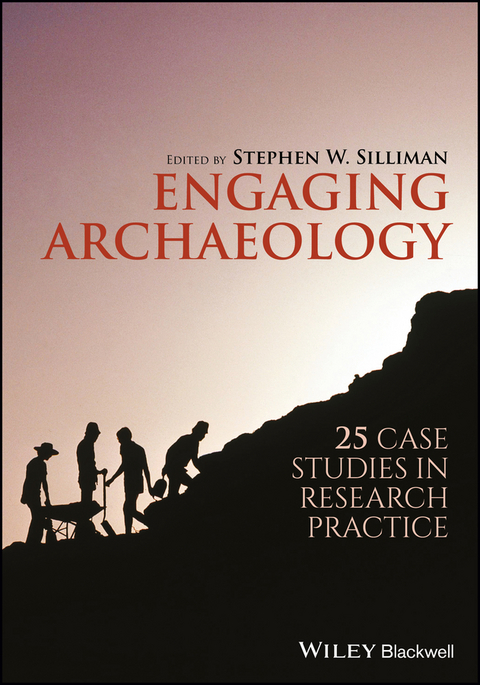
Bringing together 25 case studies from archaeological projects worldwide, Engaging Archaeology candidly explores personal experiences, successes, challenges, and even frustrations from established and senior archaeologists who share invaluable practical advice for students and early-career professionals engaged in planning and carrying out their own archaeological research.
With engaging chapters, such as 'How Not to Write a PhD Thesis on Neolithic Italy' and 'Accidentally Digging Central America's Earliest Village', readers are transported to the desks, digs, and data-labs of the authors, learning the skills, tricks of the trade, and potential pit-falls of archaeological fieldwork and collections research. Case studies collectively span many regions, time periods, issues, methods, and materials. From the pre-Columbian Andes to Viking Age Iceland, North America to the Middle East, Medieval Ireland to remote north Australia, and Europe to Africa and India, Engaging Archaeology is packed with rich, first-hand source material.
Unique and thoughtful, Stephen W. Silliman's guide is an essential course book for early-stage researchers, advanced undergraduates, and new graduate students, as well as those teaching and mentoring. It will also be insightful and enjoyable reading for veteran archaeologists.
Stephen W. Silliman is Professor - and current Department Chair - in the Department of Anthropology at the University of Massachusetts Boston. He has conducted fieldwork in the Northeastern USA, the American West Coast, Bermuda, and Japan. His research interests focus on Native American history, colonialism and post-colonialism, identity, social and practice theories, collaborative research, and the politics of heritage.
Stephen W. Silliman is Professor - and current Department Chair - in the Department of Anthropology at the University of Massachusetts Boston. He has conducted fieldwork in the Northeastern USA, the American West Coast, Bermuda, and Japan. His research interests focus on Native American history, colonialism and post-colonialism, identity, social and practice theories, collaborative research, and the politics of heritage.
List of Figures ix
List of Tables xi
Notes on Contributors xiii
Acknowledgments xix
1 Engaging Archaeology: An Introduction and a Guide 1
Stephen W. Silliman
Part I Landscapes, Settlements, and Regions 13
2 Climbing Hillforts and Thinking about Warfare in the Pre?]Columbian Andes 15
Elizabeth Arkush
3 Losing Control in the American Southwest: Collaborative Archaeology in the Service of Descendant Communities 23
Matthew Liebmann
4 Getting It Wrong for All the Right Reasons: Developing an Approach to Systematic Settlement Survey for Viking Age Iceland 31
John M. Steinberg, Douglas J. Bolender, and Brian N. Damiata
5 Archaeological Projects in India: Decolonizing Archaeological Research, Assessing Success, and Valuing Failure 41
Uzma Z. Rizvi
6 Lifeways of the First Australians: Regional Archaeology in the Remote North of Australia 51
Jane Balme
7 The Kuril Biocomplexity Project: Anatomy of an Interdisciplinary Research Program in the North Pacific 61
Ben Fitzhugh
8 Listen for the Echo of Drums Across the Water: Rock Art Sites as Engaged Community Research in Ontario, Canada 71
John William Norder
9 The Heart of Lightness: Doing Archaeology in the Brazilian Central Amazon 79
Eduardo G. Neves
Part II Sites, Households, and Communities 87
10 Household Archaeology at the Community Scale? Refining Research Design in a Complex Polynesian Chiefdom 89
Jennifer G. Kahn
11 Research Spaces from Borderland Places - Late Woodland Archaeology in Southern Ontario 99
Neal Ferris
12 Ethnoarchaeology of Pottery in Tigray, Ethiopia: Engaging with Marginalized People 109
Diane Lyons
13 Integrating Paleoethnobotany in Investigations of Spanish Colonialism in the American Southwest 119
Heather B. Trigg
14 Framing Local History with Global Archaeological Lenses in Osun Grove, Nigeria 127
Akinwumi Ogundiran
15 Rooting in New England: Archaeologies of Colonialism, Community, and Collaboration 135
Stephen W. Silliman
16 Accidentally Digging Central America's Earliest Village 143
Rosemary A. Joyce
17 Slouching Towards Theory: Implementing Bioarchaeological Research at Petra, Jordan 151
Megan A. Perry
18 In Archaeology, "You Get What You Get," and Most of the Time What You Get Is Unexpected: Investigating Paleoindians in Western North America 159
Ted Goebel
19 Archaeologies of a Medieval Irish Castle: Thinking about Trim 169
Tadhg O'Keeffe
Part III Materials, Collections, and Analyses 179
20 Dr. Stage?]Love, or: How I Learned to Stop Worrying and Love My Dissertation on Race, Pipes, and Classification in the Chesapeake 181
Anna S. Agbe?]Davies
21 Lessons Learned in Seriating Maya Pottery 189
Lisa J. LeCount
22 The Bones from the Other Tell: Zooarchaeology at Catalhoyuk West 199
David Orton
23 Disrupting Fixed Narratives: Researching Colonial Dress and Identity in Museum Collections 209
Diana DiPaolo Loren
24 Reverse Engineering in Prehistory: The Neolithic Bow of La Draga, Spain 219
Juan A. Barceló, Vera Moitinho de Almeida, Oriol López-Bultó, Antoni Palomo, and Xavier Terradas
25 Learning about Learning in Ice Age France through Stone Tools: An Intersectional Feminist Approach without Gender 227
Kathleen Sterling
26 How Not to Write a PhD Thesis: Some Real?]Life Lessons from 1990s Michigan and Prehistoric Italy 235
John Robb
Index 245
"Central to the vibrancy of this collection is voice. The chapters are clearly narratives, not academic tomes." - Canadian Journal of Archaeology/Journal canadien d'archéologie 45:98-100 (2021)
Notes on Contributors
Anna S. Agbe‐Davies is an Associate Professor in the Department of Anthropology at the University of North Carolina, Chapel Hill. She holds a PhD from the University of Pennsylvania (2004). Prior positions at DePaul University and the Colonial Williamsburg Foundation led to research on sites of colonialism and plantation slavery in the US Southeast and Caribbean and post‐Emancipation lives in the rural and urban Midwest. The results appear in a range of articles, technical reports, books, and online resources.
Elizabeth Arkush is an Associate Professor at the University of Pittsburgh, where she has taught since 2010; prior to that time she taught at the University of Virginia. She obtained her PhD in Anthropology from the University of California, Los Angeles in 2005. Her field research in the south‐central Andes has been published in her book Hillforts of the Ancient Andes (2011) and several articles and book chapters. She also co‐edited The Archaeology of Warfare (2006).
Jane Balme obtained her PhD from the Australian National University in 1991. She has taught at the University of Western Australia since 1996. She has published over 70 articles on subjects such as the human colonization of Australia, the archaeology of gender, and archaeology education. She has worked with Indigenous groups on Australian archaeological projects in northern and western New South Wales, southern Arnhem Land, the Kimberley, and southwest Australia.
Juan A. Barceló is Professor of Quantitative Archaeology and Head of the Quantitative Archaeology Laboratory at the Universitat Autònoma de Barcelona (Spain). His teaching and research activities deal with theoretical and methodological developments in archaeology and in digital humanities, notably in the domain of artificial intelligence, advanced statistics, and virtual reality and computer visualization. He has published extensively about those subjects, and is also the author of Computational Intelligence in Archaeology.
Douglas J. Bolender received his PhD in Anthropology from Northwestern University in 2006. He has held postdoctoral positions at SUNY Buffalo and the Field Museum for Natural History and is currently a Research Assistant Professor in the Department of Anthropology at the University of Massachusetts Boston. His research focuses on the Viking Age North Atlantic, where he has conducted fieldwork since 1998. He has published an edited book and several articles and book chapters.
Brian N. Damiata received his PhD in Geological Sciences‐Geophysics from the University of California, Riverside in 2001. He is a Research Assistant Professor with the Andrew Fiske Memorial Center for Archaeological Research at the University of Massachusetts Boston and also an Assistant Researcher with the Cotsen Institute of Archaeology at UCLA. He has conducted fieldwork in Barbados, China, Dominica, Egypt, Guatemala, Greece, Greenland, Iceland, Turkey, and the United States. He has authored more than 35 articles and book chapters and more than 100 technical reports.
Neal Ferris (PhD, McMaster University, 2006) is Lawson Research Chair of Canadian Archaeology at the University of Western Ontario, cross‐appointed between the Department of Anthropology and the Museum of Ontario Archaeology. He is also Director for Sustainable Archaeology: Western. Prior to his faculty career, Ferris served as a provincial archaeologist for the Ontario Ministry of Culture for 20 years. His research primarily focuses on archaeology of the last 1000 years in Eastern North America, British global colonialism, and the contemporary practice of archaeology.
Ben Fitzhugh received his PhD in Anthropology from the University of Michigan in 1996. He has taught in the Department of Anthropology at the University of Washington since 1997, where he is Associate Professor. He studies the North Pacific Rim from Kodiak Alaska to northern Japan and the Kuril Islands in Russia, with other fieldwork in north Alaska, northeast Canada, eastern United States, Peru, and Ukraine. Publications include one book, four edited books/special issues, and 40 articles, chapters, and essays.
Ted Goebel received his PhD in Anthropology from the University of Alaska Fairbanks in 1993. He has held faculty posts at Southern Oregon University, University of Nevada Las Vegas, University of Nevada Reno, and Texas A&M University, where he is currently the Endowed Professor of First Americans Studies and Associate Director of the Center for the Study of the First Americans. His field‐based research in the western United States, Alaska, and Siberia investigates the dispersal of modern humans.
Rosemary A. Joyce received the PhD in Anthropology from the University of Illinois‐Urbana in 1985. A curator and faculty member at Harvard University from 1985 to 1994, she moved to the University of California, Berkeley in 1994, where she served as Director of the Hearst Museum of Anthropology until 1999 and is currently Professor of Anthropology. She conducted fieldwork in Honduras from 1977 to 2009. She is the author of nine books and editor of nine others.
Jennifer G. Kahn received her PhD in Anthropology from the University of California, Berkeley in 2005. She has taught in the Department of Anthropology at the College of William and Mary since 2012, where she now holds the rank of Associate Professor. She has conducted fieldwork in the Pacific Island region (East Polynesia, Melanesia) and the Southwestern United States. She has published one co‐authored book, three edited books and journals, and more than 45 articles and book chapters.
Lisa J. LeCount received her PhD in Anthropology from the University of California, Los Angeles in 1996. She has taught in the Department of Anthropology at the University of Alabama since 1999, where she now holds the rank of Associate Professor. She has conducted fieldwork in the American West, Peru, and currently, Belize. She has published two edited books and more than 32 articles, book chapters, and other essays on political dynamics, identity, and pottery.
Matthew Liebmann is the John and Ruth Hazel Associate Professor of the Social Sciences in the Department of Anthropology, Harvard University. He served as Tribal Archaeologist and NAGPRA Program Coordinator for Jemez Pueblo from 2003–2005, and received his PhD from the University of Pennsylvania in 2006. He has conducted fieldwork in New Mexico, Arizona, Israel, and Guatemala, and his research interests include historical archaeology, the American Southwest, collaborative archaeology, and the archaeology of colonialism.
Oriol López‐Bultó obtained his PhD in Prehistoric Archaeology in 2015 from the Universitat Autònoma de Barcelona (Spain). He specializes in the study of wood technology (timber objects, structural elements, and unworked wood) and functionality using different methodological approaches including dendrology, 3D scanning, tool marks and use‐wear analyses, and experimental archaeology.
Diana DiPaolo Loren received her PhD in 1999 from SUNY Binghamton, arrived at Harvard University in 1999, and is currently Museum Curator of North American Archaeology at the Peabody Museum of Archaeology and Ethnology. She specializes in the colonial period American Southeast and Northeast, with a focus on the body, health, dress, and adornment. She is the author of In Contact: Bodies and Spaces in the Sixteenth‐ and Seventeenth‐Century Eastern Woodlands (2007) and The Archaeology of Clothing and Bodily Adornment in Colonial America (2010).
Diane Lyons has a PhD in Archaeology from Simon Fraser University (1992) and is currently an Associate Professor in the Department of Anthropology and Archaeology at the University of Calgary. She has participated in archaeological research in Canada, Australia, Hawaii, and South America. Her ethnoarchaeological research focuses on how social identities are constituted in vernacular architecture, spatial order, culinary practice, and craft production in rural communities in Cameroon, Sudan, and Ethiopia.
Vera Moitinho de Almeida is a postdoctoral researcher, and honorary collaborator at the Quantitative Archaeology Lab, at the Universitat Autònoma de Barcelona (Spain). She obtained the PhD from the Universitat Autònoma de Barcelona, focusing on technological and functional analysis of archaeological objects, using 3D digital models and reverse engineering processes. She has authored more than 40 publications in the field of 3D applications to research on cultural heritage.
Eduardo G. Neves received his PhD in Archaeology from Indiana University in 2000. He is Professor of Brazilian Archaeology at the Museum of Archaeology and Ethnology, University of São Paulo, Brazil. He has been working since the 1980s in the Brazilian Amazon and has supervised more than 30 master’s theses and PhD dissertations on Amazonian archaeology. He has published one authored book, two co‐authored books, one co‐edited volume, and more than 100 articles, book chapters, and other essays.
John William Norder is an enrolled member of the Spirit Lake Tribe and received his PhD in Anthropology from the University of Michigan in 2003. He is an Associate Professor in the Department of...
| Erscheint lt. Verlag | 26.1.2018 |
|---|---|
| Sprache | englisch |
| Themenwelt | Geisteswissenschaften ► Archäologie |
| Geschichte ► Allgemeine Geschichte ► Vor- und Frühgeschichte | |
| Schlagworte | Altertum • archaeological accounts • archaeological analysis • archaeological careers • archaeological concepts • Archaeological Method • Archaeological Method and Theory • Archaeological Methods & Theory • archaeological research design • archaeological research strategies • archaeological research techniques • Archaeological Theory • archaeologist experience • archaeology • archaeology field methods • Archaeology Special Topics • Archäologie • life of an archaeologist • Methoden u. Theorie der Archäologie • principles of archaeology archaeologist professional advice • real archaeology • Spezialthemen Archäologie • true archaeology |
| ISBN-10 | 1-119-24053-0 / 1119240530 |
| ISBN-13 | 978-1-119-24053-2 / 9781119240532 |
| Informationen gemäß Produktsicherheitsverordnung (GPSR) | |
| Haben Sie eine Frage zum Produkt? |
 EPUB (Adobe DRM)
Kopierschutz: Adobe-DRM
Adobe-DRM ist ein Kopierschutz, der das eBook vor Mißbrauch schützen soll. Dabei wird das eBook bereits beim Download auf Ihre persönliche Adobe-ID autorisiert. Lesen können Sie das eBook dann nur auf den Geräten, welche ebenfalls auf Ihre Adobe-ID registriert sind.
Details zum Adobe-DRM
Dateiformat: EPUB (Electronic Publication)
EPUB ist ein offener Standard für eBooks und eignet sich besonders zur Darstellung von Belletristik und Sachbüchern. Der Fließtext wird dynamisch an die Display- und Schriftgröße angepasst. Auch für mobile Lesegeräte ist EPUB daher gut geeignet.
Systemvoraussetzungen:
PC/Mac: Mit einem PC oder Mac können Sie dieses eBook lesen. Sie benötigen eine
eReader: Dieses eBook kann mit (fast) allen eBook-Readern gelesen werden. Mit dem amazon-Kindle ist es aber nicht kompatibel.
Smartphone/Tablet: Egal ob Apple oder Android, dieses eBook können Sie lesen. Sie benötigen eine
Geräteliste und zusätzliche Hinweise
Buying eBooks from abroad
For tax law reasons we can sell eBooks just within Germany and Switzerland. Regrettably we cannot fulfill eBook-orders from other countries.
aus dem Bereich