


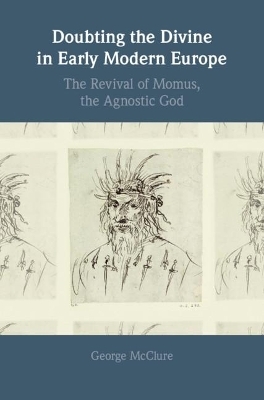
Doubting the Divine in Early Modern Europe
The Revival of Momus, the Agnostic God
Seiten
2018
Cambridge University Press (Verlag)
978-1-108-47027-8 (ISBN)
Cambridge University Press (Verlag)
978-1-108-47027-8 (ISBN)
This book explores the hidden history of unbelief in the early modern era through the lens of Momus, the Greek god of criticism and mockery. Examining his revival in Italy, France, Spain, Germany, the Netherlands, and England, it shows how Momus became a code for religious doubt in an age in which such writings remained dangerous for authors.
In this book, George McClure examines the intellectual tradition of challenges to religious and literary authority in the early modern era. He explores the hidden history of unbelief through the lens of Momus, the Greek god of criticism and mockery. Surveying his revival in Italy, France, Spain, Germany, the Netherlands, and England, McClure shows how Momus became a code for religious doubt in an age when such writings remained dangerous for authors. Momus ('Blame') emerged as a persistent and subversive critic of divine governance and, at times, divinity itself. As an emblem or as an epithet for agnosticism or atheism, he was invoked by writers such as Leon Battista Alberti, Anton Francesco Doni, Giordano Bruno, Luther, and possibly, in veiled form, by Milton in his depiction of Lucifer. The critic of gods also acted, in sometimes related fashion, as a critic of texts, leading the army of Moderns in Swift's Battle of the Books, and offering a heretical archetype for the literary critic.
In this book, George McClure examines the intellectual tradition of challenges to religious and literary authority in the early modern era. He explores the hidden history of unbelief through the lens of Momus, the Greek god of criticism and mockery. Surveying his revival in Italy, France, Spain, Germany, the Netherlands, and England, McClure shows how Momus became a code for religious doubt in an age when such writings remained dangerous for authors. Momus ('Blame') emerged as a persistent and subversive critic of divine governance and, at times, divinity itself. As an emblem or as an epithet for agnosticism or atheism, he was invoked by writers such as Leon Battista Alberti, Anton Francesco Doni, Giordano Bruno, Luther, and possibly, in veiled form, by Milton in his depiction of Lucifer. The critic of gods also acted, in sometimes related fashion, as a critic of texts, leading the army of Moderns in Swift's Battle of the Books, and offering a heretical archetype for the literary critic.
George McClure is Professor of History at the University of Alabama, where he has taught since 1986. He is the author of Sorrow and Consolation in Italian Humanism (2016), which won the Marraro Prize of the Society for Italian Historical Studies and The Culture of Profession in Late Renaissance Italy (2004).
1. The classical tradition ; 2. Renaissance Antihero: Leon Battista Alberti's Momus, the novel; 3. Momus and the reformation; 4. The execution of Giordano Bruno; 5. Milton's Lucifer; 6. God of Modern critics; 7. Conclusion: Momus and modernism.
| Erscheinungsdatum | 02.08.2018 |
|---|---|
| Zusatzinfo | Worked examples or Exercises |
| Verlagsort | Cambridge |
| Sprache | englisch |
| Maße | 160 x 235 mm |
| Gewicht | 550 g |
| Themenwelt | Geschichte ► Allgemeine Geschichte ► Neuzeit (bis 1918) |
| Geschichte ► Teilgebiete der Geschichte ► Kulturgeschichte | |
| Geisteswissenschaften ► Religion / Theologie | |
| Geisteswissenschaften ► Sprach- / Literaturwissenschaft ► Anglistik / Amerikanistik | |
| Geisteswissenschaften ► Sprach- / Literaturwissenschaft ► Literaturwissenschaft | |
| ISBN-10 | 1-108-47027-0 / 1108470270 |
| ISBN-13 | 978-1-108-47027-8 / 9781108470278 |
| Zustand | Neuware |
| Informationen gemäß Produktsicherheitsverordnung (GPSR) | |
| Haben Sie eine Frage zum Produkt? |
Mehr entdecken
aus dem Bereich


aus dem Bereich
Geschichte einer wilden Handlung
Buch | Hardcover (2024)
C.H.Beck (Verlag)
CHF 47,60


