


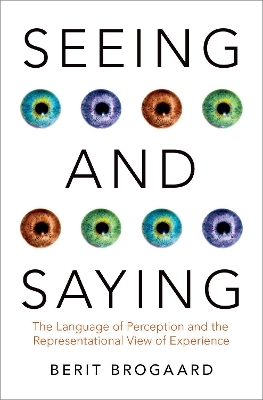
Seeing and Saying
The Language of Perception and the Representational View of Experience
Seiten
2018
Oxford University Press Inc (Verlag)
978-0-19-049525-1 (ISBN)
Oxford University Press Inc (Verlag)
978-0-19-049525-1 (ISBN)
Imagine you are sitting at Starbuck glancing at the blue coffee mug in front of you. The mug is blue on the outside, white on the inside. It's large for a mug. And it's nearly full of freshly made coffee. In the envisaged case, you see all those aspects of the scene in front of you, but it remains a question of ferocious debate whether the visual experience that makes up your seeing is a direct "perceptual" relation between you and your environment or a psychology state that has a content that represents the mug. If your experience involves an external "perceptual" relation to an external, mind-independent object, it is unlike familiar mental states such as belief and desire states, which are widely considered psychological states with a representational content that stands between you and the external world. Your belief that the coffee mug in front of you is blue has a content that represents the coffee mug as being blue. Your desire that the coffee in the mug is still hot has a content that represents a state of affairs that may or may not in fact obtain, namely the state of affairs that the coffee in the mug is still hot.
In this book, Brit Brogaard defends the view that visual experience is like belief in having a representational content. Her defense differs from most previous defenses of this view in that it begins by looking at the language of ordinary speech. She provides a linguistic analysis of what we say when we say that things look a certain way or that the world appears to us to be a certain way. She then argues that this analysis can be used to argue for the view that visual experience has a representation content that mediates between you and the world when you visually perceive.
In this book, Brit Brogaard defends the view that visual experience is like belief in having a representational content. Her defense differs from most previous defenses of this view in that it begins by looking at the language of ordinary speech. She provides a linguistic analysis of what we say when we say that things look a certain way or that the world appears to us to be a certain way. She then argues that this analysis can be used to argue for the view that visual experience has a representation content that mediates between you and the world when you visually perceive.
Berit Brogaard is Professor of Philosophy at University of Miami. Her published works include Transient Truths (2012), Does Perception Have Content? (2014), and On Romantic Love (2015).In her academic research she specializes in philosophy of language, philosophy of mind, and the cognitive sciences.
Acknowledgements
Introduction
Chapter 1. The Semantics of 'Appear' Words
Chapter 2. Looks and Seemings
Chapter 3. The Representational View of Experience
Chapter 4. Arguments against the Representational View
Chapter 5. Other Arguments from 'Look'
Chapter 6. Seeing Things
Chapter 7. Beyond Seeing
Conclusion
| Erscheinungsdatum | 11.09.2018 |
|---|---|
| Reihe/Serie | Philosophy of Mind Series |
| Verlagsort | New York |
| Sprache | englisch |
| Maße | 239 x 160 mm |
| Gewicht | 431 g |
| Themenwelt | Geisteswissenschaften ► Philosophie |
| ISBN-10 | 0-19-049525-1 / 0190495251 |
| ISBN-13 | 978-0-19-049525-1 / 9780190495251 |
| Zustand | Neuware |
| Informationen gemäß Produktsicherheitsverordnung (GPSR) | |
| Haben Sie eine Frage zum Produkt? |
Mehr entdecken
aus dem Bereich



aus dem Bereich
wie Tiere den Tod verstehen
Buch | Hardcover (2025)
Insel Verlag
CHF 42,90
eine Ethik des Verzichts
Buch | Softcover (2025)
Reclam (Verlag)
CHF 9,80
Buch | Softcover (2025)
Wiley-VCH (Verlag)
CHF 30,80


