


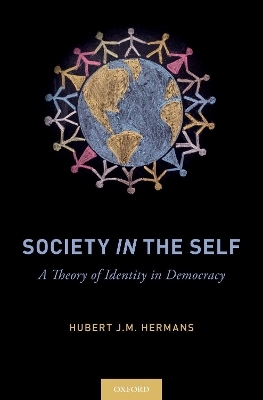
Society in the Self
Oxford University Press Inc (Verlag)
978-0-19-068779-3 (ISBN)
Instead of considering society as a social environment, Society in the Self begins from the assumption that society works in the deepest regions of self and identity, as expressed in phenomena like self-sabotage, self-radicalization, self-cure, self-government, self-nationalization, and self-internationalization. This leads to the central thesis that a democratic society can only function properly if it is populated by participants with a democratically organized self. In this book, an integrative model is presented that is inspired by three versions of democracy: cosmopolitan, deliberative, and agonistic democracy, with the latter focusing on the role of social power and emotions.
Drawing on these democratic views, three levels of inclusiveness are distinguished in the self: personal (I as an individual), social (I as a member of a group), and global (I as a human being). A democratic self requires the flexibility of moving up and down across these levels of inclusiveness and has to find its way in fields of tension between the self and the other, and between dialogue and social power. As author Hubert Hermans explains, this theory has far reaching consequences for such divergent topics as leadership in the self, cultural diversity in the self, the relationship between reason and emotion, self-empathy, cooperation and competition between self-parts, and the role of social power in prejudice, enemy image construction, and scapegoating.
The central message of this book is reflected in Mahatma Gandhi's dictum: "Be the change you want to see in the world."
Hubert Hermans is emeritus professor of psychology at the Radboud University of Nijmegen, Netherlands, and president of the International Society for Dialogical Science. He is the creator of Dialogical Self Theory. One of his books was used in the formation of the Dutch government in 2007 and he was decorated as Knight in the Order of the Netherlands Lion for his exceptional scientific contribution to society.
Acknowledgments
Introduction: The Democratic Organization of Self and Identity
Chapter 1. The Dynamics of Society-in-the-Self
Chapter 2. Positioning and Democracy in the Self
Chapter 3. Positioning and Democracy in Teams and Organizations
Chapter 4. The Positioning Brain
Chapter 5. Social and Societal Over-Positioning: The Emergence of I-Prisons
Chapter 6. Heterogenizing and Enriching the Self
Chapter 7. Dialogue as Generative Form of Positioning
Chapter 8: Dialogical democracy in a boundary-crossing world: Practical implications
Glossary
| Erscheinungsdatum | 15.05.2018 |
|---|---|
| Verlagsort | New York |
| Sprache | englisch |
| Maße | 163 x 236 mm |
| Gewicht | 726 g |
| Themenwelt | Geisteswissenschaften ► Psychologie |
| Sozialwissenschaften ► Ethnologie | |
| Sozialwissenschaften ► Politik / Verwaltung ► Politische Theorie | |
| Sozialwissenschaften ► Soziologie | |
| ISBN-10 | 0-19-068779-7 / 0190687797 |
| ISBN-13 | 978-0-19-068779-3 / 9780190687793 |
| Zustand | Neuware |
| Informationen gemäß Produktsicherheitsverordnung (GPSR) | |
| Haben Sie eine Frage zum Produkt? |
aus dem Bereich


